With a focus on actionable insights and strategic value, The Business Research Company’s 2026 market reports include market attractiveness scoring, total addressable market sizing, company benchmarking matrices, interactive Excel dashboards, deeper supply chain intelligence, emerging startup tracking, and granular product-level insights.
How Large Could The Automotive Cockpit Electronics Market Become By 2030 At A 8.4% CAGR?
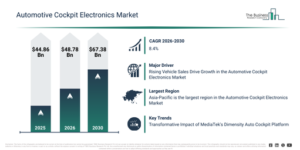
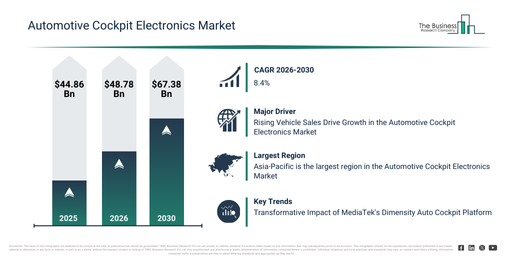
The automotive cockpit electronics market size has demonstrated robust growth in recent years. It is projected to expand from $44.86 billion in 2025 to $48.78 billion in 2026, reflecting a compound annual growth rate (CAGR) of 8.7%. The historical growth of this market can be attributed to factors like the increasing adoption of digital instrument clusters, heightened consumer demand for in-car infotainment, evolving vehicle safety regulations, the expansion of telematics systems, and the integration of touchscreen displays in vehicles.
The automotive cockpit electronics market is projected to experience substantial expansion over the coming years. Its size is anticipated to reach $67.38 billion by 2030, demonstrating a compound annual growth rate (CAGR) of 8.4%. This future growth is primarily driven by the increasing adoption of electric and hybrid vehicles, the rising integration of AI-enabled cockpit systems, the incorporation of AR-HUD technology in high-end vehicles, the expansion of connected car ecosystems, and the growing consumer desire for customized in-car experiences. Key developments expected during this period involve the integration of advanced driver assistance systems (ADAS), the prevalence of gesture and voice control interfaces, improvements in infotainment and connectivity solutions, the widespread use of augmented reality head-up displays (AR-HUD), and sophisticated smart HVAC and comfort management systems.
Get A Free Automotive Cockpit Electronics Market Sample With 2030 Forecast Insights:
Automotive Cockpit Electronics Market Outlook: Key Driver Supporting Long-Term Growth
The future expansion of the automotive cockpit electronics market is anticipated to be driven by a rising vehicle count. Several factors contribute to vehicle sales, including economic progress, consumers’ desire for vehicle ownership, the introduction of new models, technological innovations in vehicles, and appealing financial schemes. Automotive cockpit electronics elevate vehicle safety, comfort, and convenience through user-friendly controls, up-to-the-minute data, and sophisticated driver assistance capabilities, thereby refining the driving experience. As an illustration, data released in September 2022 by the Japan Automobile Dealers Association, a Japan-based organization for automobile dealers and Japan Light Motor Vehicle and Motorcycle Association, a Japan-based organization for protecting the ownership of light motor vehicles and motorcycles, revealed that in Japan, new car sales reached a total of 4,779,086 units in 2023, marking a 13.8% year-on-year increase. Consequently, the expanding vehicle population is a key catalyst for the growth experienced in the automotive cockpit electronics market.
Segmentation Of The Automotive Cockpit Electronics Market: Key Categories Explained
The automotive cockpit electronics market covered in this report is segmented –
1) By Product: Head-up Display (HUD), Information Display, Infotainment And Navigation, Instrument Cluster, Other Products
2) By Technology: Touchscreen Technology, Voice Recognition Systems, Connectivity Solutions
3) By Propulsion: Internal Combustion Engine (ICE) Vehicles, Electric and Hybrid Vehicles
4) By Vehicle Type: Passenger Cars, Commercial Vehicles
Subsegments:
1) By Head-up Display (HUD): Augmented Reality HUD (AR-HUD), Combiner HUD, Windshield HUD
2) By Information Display: Central Information Display, Touchscreen Display
3) By Infotainment and Navigation: Integrated Infotainment Systems, Standalone Infotainment Systems, Navigation Systems
4) By Instrument Cluster: Analog Instrument Cluster, Digital Instrument Cluster, Hybrid Instrument Cluster
5) By Other Products: HVAC Control Systems, Gesture Control Systems, Voice Recognition Systems
Automotive Cockpit Electronics Market Evolving Trends: What Businesses Should Know
Leading firms within the automotive cockpit electronics market are creating automotive platforms by incorporating artificial intelligence (AI) platforms to support advanced in-vehicle infotainment (IVI) systems. The incorporation of AI into automotive cockpit electronics elevates user experience by facilitating customized interactions, boosting safety via sophisticated driver assistance, and refining system efficiency through live data analysis and foresight features. As an example, in March 2024, MediaTek, a semiconductor enterprise based in Taiwan, unveiled the Dimensity auto cockpit platform, partnering with NVIDIA, a US-based software firm. This partnership seeks to embed sophisticated AI functionalities into vehicles, thereby improving the in-cabin experience for occupants. The Dimensity Auto Cockpit collection delivers robust AI-powered in-cabin experiences for future intelligent vehicles. This extensively integrated platform features four new automotive SoCs: dimensity auto cockpit C-X1, C-Y1, C-M1, and C-V1, covering the entire range from premium (C-X1) to entry-level (C-V1) market segments.
Who Competes In The Automotive Cockpit Electronics Market? Major Companies Listed
Major companies operating in the automotive cockpit electronics market are Robert Bosch GmbH, Denso Corporation, Continental AG, Aptiv plc, Valeo, HyundAI Mobis Co., Ltd., Mitsubishi Electric Corporation, Aisin Seiki Co., Ltd., Hella GmbH & Co. KGaA, Visteon Corporation, Harman International, Panasonic Corporation, LG Electronics, Texas Instruments, NXP Semiconductors, Infineon Technologies, Renesas Electronics Corporation, Marelli, Pioneer Corporation, Alpine Electronics, Inc., Fujitsu, ZF Friedrichshafen AG, IAV GmbH, Kostal Group, NVIDIA Corporation
Read The Complete Automotive Cockpit Electronics Market Forecast Report Through 2030:
Automotive Cockpit Electronics Market Regional Ranking: Which Geography Comes First?
Asia-Pacific was the largest region in the automotive cockpit electronics market in 2025. Asia-Pacific is expected to be the fastest-growing region in the forecast period. The regions covered in the automotive cockpit electronics market report are Asia-Pacific, South East Asia, Western Europe, Eastern Europe, North America, South America, Middle East, Africa.
Reach Out To Our Team:
The Business Research Company: https://www.thebusinessresearchcompany.com/
Americas: +1 310-496-7795
Asia: +44 7882 955267 & +91 8897263534
Europe: +44 7882 955267
Email us at: marketing@tbrc.info
Follow us on:
LinkedIn: https://in.linkedin.com/company/the-business-research-company
YouTube: https://www.youtube.com/channel/UC24_fI0rV8cR5DxlCpgmyFQ
Global Market Model: https://www.thebusinessresearchcompany.com/global-market-model

Wasay has over a decade of experience in market research, data modelling, and analytics, with prior experience at GlobalData and Decision Tree Consulting Services. At The Business Research Company , he leads research operations across syndicated studies, customized consulting engagements, and the Global Market Model platform. His professional experience includes supporting organizations such as Boston Consulting Group, KPMG, and Ernst & Young. Wasay holds a degree in Electronics and Communications Engineering, postgraduate management qualifications from International Management Institute Belgium and Indian School of Business and Entrepreneurship, and completed the Integrated Program in Business Analytics from Indian Institute of Management Indore.