Built to provide research that’s more actionable and strategically valuable, The Business Research Company’s 2026 market reports include market attractiveness analysis, total addressable market sizing, company benchmarking matrices, interactive Excel dashboards, broader supply chain intelligence, emerging startup tracking, and in-depth product insights.
Automotive Electronic Controller Market Size And Revenue Outlook Through 2030
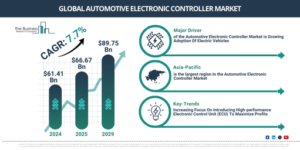
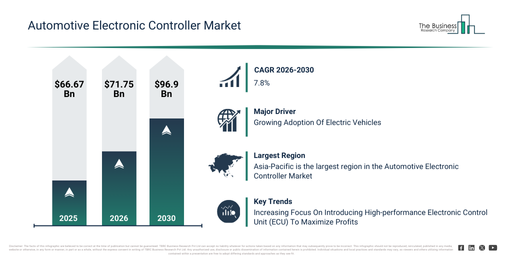
The automotive electronic controller market size has experienced robust expansion in recent years. Projections indicate an increase from $66.67 billion in 2025 to $71.75 billion in 2026, demonstrating a compound annual growth rate (CAGR) of 7.6%. Historically, this growth has been fueled by factors such as the increasing embrace of electronic safety systems, the emergence of electronically controlled engine management, a surge in infotainment module installations, the early incorporation of body control electronics, and the broadening scope of automotive electronics manufacturing.
The automotive electronic controller market is projected to experience robust expansion over the coming years. This market is anticipated to reach $96.9 billion by 2030, exhibiting a compound annual growth rate (CAGR) of 7.8%. This anticipated growth during the forecast period can be primarily attributed to several factors, including the transition towards autonomous driving technologies, the escalating adoption of battery electric vehicles (BEVs) and hybrid vehicles, the increasing imperative for cybersecurity within vehicle electronics, the growing requirement for high-speed communication networks in vehicles, and the expansion of sophisticated powertrain control systems. Key trends foreseen over this period encompass the integration of AI-enabled automotive control systems, the burgeoning utilization of connected and networked ECU architectures, a surge in demand for advanced powertrain electronic modules, the expansion of safety-critical electronic control applications, and the incorporation of high-performance embedded processing capabilities into vehicles.
Get A Free Sample Report With In-Depth Market Insights:
Automotive Electronic Controller Market Opportunity Drivers: What’s Unlocking New Revenue Potential?
The increasing integration of electric vehicles is projected to boost the expansion of the automotive electronic controller market in the coming years. Electric vehicles (EVs) are systems powered by electricity stored in batteries or other energy reservoirs, thereby eliminating the requirement for internal combustion engines. Within Electric Vehicles (EVs), automotive electronic controllers manage power distribution and enhance battery performance, leading to improved overall efficiency and range, and enabling advanced capabilities like regenerative braking. For instance, the International Energy Agency, a France-based intergovernmental organization, stated in July 2023 that electric vehicle sales reached 10 million in 2022, with an expected rise to 14 million sales in 2023. Therefore, the expanding adoption of electric vehicles is fostering the growth of the automotive electronic controller market.
Automotive Electronic Controller Market Segment Breakdown: Which Categories Lead On Revenue?
The automotive electronic controller market covered in this report is segmented –
1) By Product Type: Engine Control Units (ECUs), Transmission Control Units (TCUs), Body Control Modules (BCMs), Electronic Stability Control (ESC) Systems, Electronic Brake Systems (EBS), Other Products
2) By Vehicle Type: Light-Duty Vehicles, Heavy Commercial Vehicles, Construction And Mining Equipment, Agricultural Tractors
3) By Propulsion Type: Battery Electric Vehicles (BEVs), Hybrid Vehicles, Internal Combustion Engines Vehicles
4) By Application: Advanced Driver Assistance Systems And Safety System, Body Control And Comfort System, Infotainment And Communication System, Powertrain System
Subsegments:
1) By Engine Control Units (ECUs): Powertrain ECUs, Fuel Management ECUs, Ignition ECUs
2) By Transmission Control Units (TCUs): Automatic Transmission TCUs, Manual Transmission TCUs
3) By Body Control Modules (BCMs): Lighting Control Modules, Window And Door Control Modules, Climate Control Modules
4) By Electronic Stability Control (ESC) Systems: Sensor-based ESC Systems, Brake-Based ESC Systems
5) By Electronic Brake Systems (EBS): Anti-lock Braking System (ABS), Electronic Brake-force Distribution (EBD), Brake Assist Systems
6) By Other Product: Advanced Driver Assistance Systems (ADAS) Controllers, Battery Management Systems (BMS), Charging Control Units
Automotive Electronic Controller Market Innovation Trends Shaping Future Development
Major companies operating in the automotive electronic controller market are intensifying their focus on creating high-performance electronic control units (ECUs) to maximize their profitability. A high-performance electronic control unit (ECU) functions as a specialized computer, adeptly managing and optimizing diverse functions within vehicles or industrial systems, delivering remarkable speed and precision during real-time operations. For instance, in April 2023, TTTech Auto AG, an Austria-based provider of car safety solutions, launched the N4 Network Controller, a high-performance electronic control unit (ECU) boasting advanced networking capabilities. This N4 electronic control unit is equipped with sophisticated networking features that allow it to support cutting-edge automotive communication protocols, including Ethernet, CAN FD (controller area network flexible data rate), and FlexRay. The design of this electronic control unit (ECU) addresses the escalating demand for high-bandwidth communication in contemporary vehicles, which necessitates more advanced driver assistance systems, infotainment, and other functionalities.
Automotive Electronic Controller Market Leading Players And Competitive Positioning
Major companies operating in the automotive electronic controller market are Robert Bosch GmbH, Hitachi Automotive Systems Ltd., Panasonic Corporation, DENSO Corporation, Continental AG, ZF Friedrichshafen AG, HyundAI Mobis Co. Ltd, Toshiba Electronic Devices & Storage Corporation, Lear Corporation, Texas Instruments Incorporated, Nidec Motors and Actuators Inc., TE Connectivity Ltd., STMicroelectronics N.V., BorgWarner Inc., Infineon Technologies AG, NXP Semiconductors N.V., Renesas Electronics Corporation, Amphenol Corporation, Analog Devices Inc., ON Semiconductor Corporation, Microchip Technology Inc., Omron Corporation, Vishay Intertechnology Inc., Sanken Electric Co. Ltd., Diodes Incorporated, Melexis N.V., Magneti Marelli S.p.A., Pektron Group Limited, HGM Automotive Electronics Inc.
View The Full Automotive Electronic Controller Market Report:
Automotive Electronic Controller Market Largest Region: Which Geography Holds The Biggest Share?
Asia-Pacific was the largest region in the automotive electronic controller market in 2025. The regions covered in the automotive electronic controller market report are Asia-Pacific, South East Asia, Western Europe, Eastern Europe, North America, South America, Middle East, Africa.
Reach Out To Our Team:
The Business Research Company: https://www.thebusinessresearchcompany.com/
Americas: +1 310-496-7795
Asia: +44 7882 955267 & +91 8897263534
Europe: +44 7882 955267
Email us at: marketing@tbrc.info
Follow us on:
LinkedIn: https://in.linkedin.com/company/the-business-research-company
YouTube: https://www.youtube.com/channel/UC24_fI0rV8cR5DxlCpgmyFQ
Global Market Model: https://www.thebusinessresearchcompany.com/global-market-model

Wasay has over a decade of experience in market research, data modelling, and analytics, with prior experience at GlobalData and Decision Tree Consulting Services. At The Business Research Company , he leads research operations across syndicated studies, customized consulting engagements, and the Global Market Model platform. His professional experience includes supporting organizations such as Boston Consulting Group, KPMG, and Ernst & Young. Wasay holds a degree in Electronics and Communications Engineering, postgraduate management qualifications from International Management Institute Belgium and Indian School of Business and Entrepreneurship, and completed the Integrated Program in Business Analytics from Indian Institute of Management Indore.