Through market attractiveness analysis, total addressable market evaluation, company benchmarking matrices, interactive Excel dashboards, expanded supply chain intelligence, emerging startup coverage, and detailed product insights, The Business Research Company’s 2026 market reports provide more actionable and strategically valuable research.
Automotive Lithium-ion Battery Cell Market Value Analysis: What Growth Is Expected Over The Forecast Period?
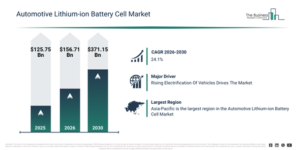
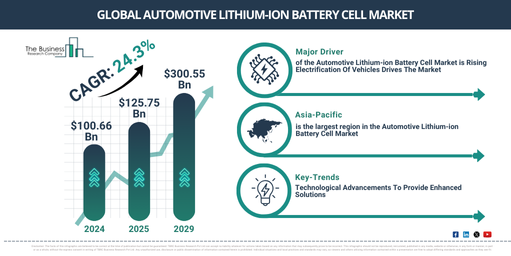
The automotive lithium-ion battery cell market size has seen exponential expansion in recent years. It is projected to increase from $125.75 billion in 2025 to $156.71 billion in 2026, demonstrating a compound annual growth rate (CAGR) of 24.6%. The growth observed in the historic period can be attributed to the early adoption in first-generation BEV models, a continued reliance on conventional lithium chemistries, the increased use of batteries in portable electronics, the expansion of early PHEV platforms, and the development of fundamental battery pack architectures.
The automotive lithium-ion battery cell market size is anticipated to undergo significant growth in the upcoming years, expanding to $371.15 billion by 2030, demonstrating a compound annual growth rate (CAGR) of 24.1%. This projected increase is fueled by factors such as the rising demand for high-capacity EV batteries, advancements in solid-state battery technologies, the broadening of fast-charging infrastructure, an increasing embrace of cobalt-reduced chemistries, and the establishment of large-scale battery manufacturing facilities. Noteworthy trends during this period encompass the expansion of high-energy EV battery cell platforms, the development of sustainable low-cobalt battery chemistries, the integration of intelligent battery management and monitoring systems, progress in AI-enabled cell optimization technologies, and the adoption of smart manufacturing practices for battery cells.
Download A Free Sample Report For Comprehensive Market Insights:
Automotive Lithium-ion Battery Cell Market Demand Drivers: What Is Fueling Industry Growth?
The global surge in vehicle electrification is projected to stimulate the growth of the automotive lithium-ion battery cell market. Vehicle electrification is defined as the process of powering a vehicle using electricity, where traditional energy components are replaced with electrical ones. Lithium-ion batteries are widely adopted for vehicle electrification because of their high energy density and capacity for powerful output, allowing them to store considerable energy in a relatively small and light package, and their lower rate of self-discharge compared to other battery types, which makes them ideal for this application. For example, in 2023, according to the Organisation Internationale des Constructeurs d’Automobiles (OICA), the worldwide automotive sector witnessed substantial expansion, with overall vehicle production reaching 93.55 million units, marking a considerable rise from the 85.07 units manufactured in 2022. As a result, the increasing electrification of vehicles worldwide will propel the automotive lithium-ion battery cell market.
Automotive Lithium-ion Battery Cell Market Segment Outlook: Which Categories Are Expanding The Fastest?
The automotive lithium-ion battery cell market covered in this report is segmented –
1) By Type: Lithium Iron Phosphate (LFP), Lithium Cobalt Oxide (LCO), Lithium Manganese Oxide (LMO), Lithium Nickel Manganese Cobalt Oxide (NMC)
2) By Cell Type: Cylindrical, Prismatic, Pouch Cells
3) By Application: Battery Electric Vehicle (BEV), Plug-In Hybrid Electric Vehicle (PHEV), Fuel-Cell Electric Vehicle
Subsegments:
1) By Lithium Iron Phosphate (LFP): Standard LFP Cells, High-Energy LFP Cells
2) By Lithium Cobalt Oxide (LCO): Standard LCO Cells, High-performance LCO Cells
3) By Lithium Manganese Oxide (LMO): Standard LMO Cells, High-capacity LMO Cells
4) By Lithium Nickel Manganese Cobalt Oxide (NMC): NMC 111 (1:1:1 Ratio), NMC 532 (5:3:2 Ratio), NMC 622 (6:2:2 Ratio), NMC 811 (8:1:1 Ratio)
Automotive Lithium-ion Battery Cell Market Key Companies And Competitive Benchmarking
Major companies operating in the automotive lithium-ion battery cell market are Samsung SDI Co. Ltd., Toshiba Corporation, Contemporary Ampere Technology Co. Ltd., LG Chem Ltd., GS Yuasa International Ltd., Johnson Controls International Plc, Panasonic Corporation, BYD Company Ltd., Automotive Energy Supply Corp., A123 Systems LLC, Exicom Power Solutions, Tesla Inc., Hitachi Ltd., NEC Corporation, Envision AESC Limited, Amperex Technology Limited, Blue Energy Limited, CBAK Energy Technology Inc., Tianjin Lishen Battery Joint-Stock CO. Ltd., Lithion Battery Inc., SK innovation Co. Ltd., OptimumNano Energy Co. Ltd., VARTA AG, Sony Corporation, Gotion High-Tech Co. Ltd.
Access The Complete Automotive Lithium-ion Battery Cell Market Report:
Automotive Lithium-ion Battery Cell Market Regional Analysis: Which Region Leads By Revenue?
Asia-Pacific was the largest region in the automotive lithium-ion battery cell market in 2025. The regions covered in the automotive lithium-ion battery cell market report are Asia-Pacific, South East Asia, Western Europe, Eastern Europe, North America, South America, Middle East, Africa.
Get in touch with us:
The Business Research Company: https://www.thebusinessresearchcompany.com/
Americas: +1 310-496-7795
Asia: +44 7882 955267 & +91 8897263534
Europe: +44 7882 955267
Email us at: marketing@tbrc.info
Follow us on:
LinkedIn: https://in.linkedin.com/company/the-business-research-company
YouTube: https://www.youtube.com/channel/UC24_fI0rV8cR5DxlCpgmyFQ
Global Market Model: https://www.thebusinessresearchcompany.com/global-market-model

Wasay has over a decade of experience in market research, data modelling, and analytics, with prior experience at GlobalData and Decision Tree Consulting Services. At The Business Research Company , he leads research operations across syndicated studies, customized consulting engagements, and the Global Market Model platform. His professional experience includes supporting organizations such as Boston Consulting Group, KPMG, and Ernst & Young. Wasay holds a degree in Electronics and Communications Engineering, postgraduate management qualifications from International Management Institute Belgium and Indian School of Business and Entrepreneurship, and completed the Integrated Program in Business Analytics from Indian Institute of Management Indore.