
Built to provide research that’s more actionable and strategically valuable, The Business Research Company’s 2026 market reports include market attractiveness analysis, total addressable market sizing, company benchmarking matrices, interactive Excel dashboards, broader supply chain intelligence, emerging startup tracking, and in-depth product insights.
Automotive Smart Camera Market Growth From $7.18 Billion In 2026 To $14.77 Billion By 2030 At A CAGR Of 19.78%
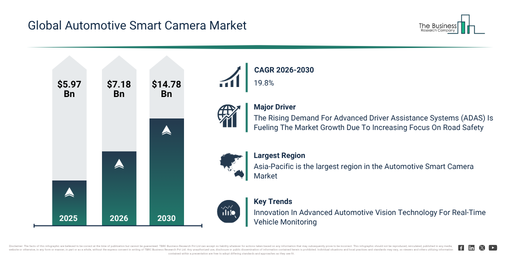
The automotive smart camera market has experienced rapid expansion over recent years. It is projected to expand from $5.97 billion in 2025 to $7.18 billion in 2026, demonstrating a compound annual growth rate (CAGR) of 20.2%. Historically, this growth can be attributed to a surge in demand for vehicle safety systems, stringent automotive safety regulations, the increasing integration of advanced driver assistance systems, higher passenger vehicle production, and a rising consumer desire for improved driving visibility.
The automotive smart camera market is poised for significant expansion in the coming years. This market is projected to reach $14.78 billion by 2030, demonstrating a compound annual growth rate (CAGR) of 19.8%. This anticipated growth is driven by several factors, including the expanding deployment of autonomous driving technologies, the increasing uptake of in-cabin monitoring systems, the surging demand for intelligent vision-based sensing solutions, the broader integration of high-performance automotive cameras, and heightened investment in advanced vehicle perception systems. Key trends expected during this period involve the rising adoption of high-resolution automotive vision systems, the escalating demand for multi-camera fusion technologies, the increasing integration of wide dynamic range imaging sensors, the enhancement of real-time image processing capabilities, and the accelerated development of compact automotive smart camera modules.
Get A Free Sample Report With In-Depth Market Insights:
Automotive Smart Camera Market Demand Drivers Opening New Revenue Streams
The escalating need for Advanced Driver Assistance Systems (ADAS) is anticipated to propel the expansion of the automotive smart camera market going forward. ADAS encompasses electronic technologies installed in vehicles designed to assist drivers with various driving and parking functions, thereby enhancing road safety and minimizing human error through features such as lane departure warning, adaptive cruise control, and automatic emergency braking. The increasing demand for advanced driver assistance systems (ADAS) stems from heightened concerns about road safety, as these systems effectively reduce human error, prevent accidents, and improve overall driving awareness via automatic braking, lane-keeping assistance, and collision warnings. Advanced driver assistance systems (ADAS) enhance the capabilities of automotive smart cameras by utilizing their real-time image capture and processing functions to detect lanes, identify pedestrians and vehicles, recognize traffic signs, and consistently monitor the driving environment, enabling safer, more accurate, and automated driving decisions. For instance, in October 2024, according to the MITRE Corporation, a US-based Not-for-profit organization, by the 2023 model year, 10 of the 14 Advanced Driver Assistance Systems (ADAS) features achieved over 50% market penetration, with five features surpassing 90%. Therefore, the increasing demand for advanced driver assistance systems (ADAS) is a key factor driving the growth of the automotive smart camera market.
Automotive Smart Camera Market Segment Performance And Emerging Opportunities
The automotive smart camera market covered in this report is segmented –
1) By Type: Front View Cameras, Driver Monitoring Cameras, Surround View Cameras, Rear Cameras
2) By Technology: Complementary Metal Oxide Semiconductor, Charge Coupled Device, Infrared Imaging, Thermal Imaging
3) By Sales Channel: Original Equipment Manufacturer, Aftermarket
4) By Application: Advanced Driver Assistance Systems, Autonomous Driving, Parking Assistance, In Cabin Monitoring
5) By End Use: Passenger Cars, Commercial Vehicles, Two Wheelers, Off Highway Vehicles
Subsegments:
1) By Front View Cameras: Advanced Driver Assistance System Front View Cameras, Lane Departure Warning Front View Cameras, Traffic Sign Recognition Front View Cameras, Collision Avoidance Front View Cameras
2) By Driver Monitoring Cameras: Infrared Driver Monitoring Cameras, Fatigue Detection Cameras, Eye Tracking Driver Monitoring Cameras, In Cabin Attention Monitoring Cameras
3) By Surround View Cameras: Three Hundred Sixty Degree Surround View Cameras, Parking Assistance Surround View Cameras, Multi Camera Fusion Systems, Birds Eye View Surround Cameras
4) By Rear Cameras: Backup Parking Cameras, High Definition Rear View Cameras, Night Vision Rear Cameras, Wide Angle Rear Cameras
Automotive Smart Camera Market Trends Powering Strategic Industry Growth
Leading companies in the automotive smart camera market are concentrating on developing advanced solutions, such as 360-degree surround view camera systems, to improve driver safety, reduce blind spots, and enhance vehicle maneuverability in complex traffic and parking situations. These 360-degree surround view camera systems are sophisticated automotive vision technologies that incorporate multiple wide-angle HD cameras placed around a vehicle to capture real-time video feeds. These feeds are then processed using image stitching and low-latency computing algorithms to generate a continuous bird’s-eye view of the surroundings, providing superior spatial awareness compared to traditional rear-view or single-camera systems. For instance, in July 2025, Pioneer Corporation, a Japan-based automotive electronics company, launched an Automotive 360° Surround View Camera System in India. This system is designed to deliver real-time stitched bird’s-eye imaging from four wide-angle HD/FHD cameras and features advanced image processing for low-latency output, fast auto-calibration, CAN-based vehicle integration, and ruggedized hardware for dependable performance under diverse driving conditions. It is engineered for seamless OEM integration and supports both new vehicle platforms and existing model upgrades, reflecting the increasing adoption of intelligent camera-based safety systems in modern automobiles.
Automotive Smart Camera Market Key Players: Which Companies Lead Industry Competition?
Major companies operating in the automotive smart camera market are Ambarella Inc., Aptiv PLC, Autoliv Inc., Continental AG, DENSO Corporation, FORVIA SE, Hitachi Astemo Ltd., Magna International Inc., Melexis NV, Mobileye Global Inc., NVIDIA Corporation, NXP Semiconductors N.V., onsemi, Panasonic Holdings Corporation, Qualcomm Technologies Inc., Renesas Electronics Corporation, Robert Bosch GmbH, Samsung Electronics Co. Ltd., Sony Group Corporation, STMicroelectronics N.V., Sunny Optical Technology (Group) Company Limited, Teledyne Technologies Incorporated, Valeo, Visteon Corporation, ZF Friedrichshafen AG
View The Full Automotive Smart Camera Market Report:
Automotive Smart Camera Market Top Region By Revenue And Market Share
Asia-Pacific was the largest region in the automotive smart camera market in 2025. Asia-Pacific is expected to be the fastest-growing region in the forecast period. The regions covered in the automotive smart camera market report are Asia-Pacific, South East Asia, Western Europe, Eastern Europe, North America, South America, Middle East, Africa.
Reach Out To Our Team:
The Business Research Company: https://www.thebusinessresearchcompany.com/
Americas: +1 310-496-7795
Asia: +44 7882 955267 & +91 8897263534
Europe: +44 7882 955267
Email us at: marketing@tbrc.info
Follow us on:
LinkedIn: https://in.linkedin.com/company/the-business-research-company
YouTube: https://www.youtube.com/channel/UC24_fI0rV8cR5DxlCpgmyFQ
Global Market Model: https://www.thebusinessresearchcompany.com/global-market-model

Wasay has over a decade of experience in market research, data modelling, and analytics, with prior experience at GlobalData and Decision Tree Consulting Services. At The Business Research Company , he leads research operations across syndicated studies, customized consulting engagements, and the Global Market Model platform. His professional experience includes supporting organizations such as Boston Consulting Group, KPMG, and Ernst & Young. Wasay holds a degree in Electronics and Communications Engineering, postgraduate management qualifications from International Management Institute Belgium and Indian School of Business and Entrepreneurship, and completed the Integrated Program in Business Analytics from Indian Institute of Management Indore.