Backed by market attractiveness analysis, total addressable market sizing, company benchmarking matrices, interactive Excel dashboards, wider supply chain intelligence, emerging startup coverage, and detailed product-level insights, The Business Research Company’s 2026 market reports are designed to offer research that is more actionable and strategically valuable than ever.
#Autonomous Charging Robots Market Revenue Outlook: What CAGR Lies Ahead Through 2030?#_x000D_
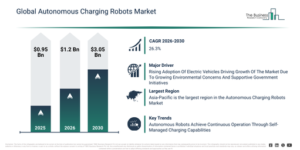
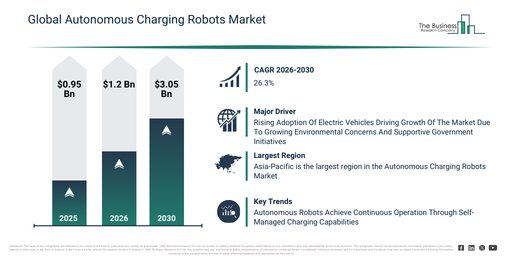
The autonomous charging robots market size has observed substantial growth in recent years. It is forecast to rise from $0.95 billion in 2025 to $1.2 billion in 2026, exhibiting a compound annual growth rate (CAGR) of 26.1%. The expansion seen historically can be ascribed to several factors, including the increasing uptake of electric vehicles, a rise in automated guided vehicle deployment, the growing need for continuous industrial operations, innovations in robotic navigation technologies, and the wider installation of smart charging infrastructure._x000D_
_x000D_
The autonomous charging robots market is projected for rapid expansion, reaching $3.05 billion by 2030, demonstrating a robust compound annual growth rate (CAGR) of 26.3%. This anticipated growth is driven by factors such as greater investments in autonomous mobility systems, a surge in the use of electric fleets, the proliferation of smart factories and warehouses, an increasing need for unmanned charging options, and a heightened emphasis on operational efficiency and uptime. Key developments during this period include a rise in the deployment of mobile autonomous charging robots, increased uptake of wireless charging alignment systems, enhanced integration of vision-guided docking technologies, wider application of robotic charging for EV fleets, and a greater emphasis on hands-free charging automation._x000D_
_x000D_
#Get A Free Sample Report With In-Depth Market Insights:#_x000D_
_x000D_
#Autonomous Charging Robots Market Growth Drivers: What’s Behind The Acceleration?#_x000D_
The increasing adoption of electric vehicles is expected to fuel the growth of the autonomous charging robots market moving forward. Electric vehicles (EVs) are propelled by one or more electric motors, utilizing energy stored in rechargeable battery packs, rather than an internal combustion engine (ICE) that runs on gasoline or diesel. The rise of electric vehicles is mainly attributed to swift improvements in battery technology, which are simultaneously lowering costs and enhancing driving range, charging speed, and overall vehicle performance. Autonomous charging robots support electric vehicles by facilitating automated, on-demand charging without human intervention, thereby reducing charging downtime and boosting the convenience and scalability of EV charging infrastructure. For example, in April 2025, as reported by the International Council on Clean Transportation (ICCT), a US-based non-profit organization, passenger electric vehicle (battery-electric + plug-in hybrid) sales hit around 1.56 million in 2024, with EVs making up 10% of all light-duty vehicle sales, an increase from a smaller percentage in 2023. Consequently, the rising adoption of electric vehicles is driving the expansion of the autonomous charging robots market._x000D_
_x000D_
#Autonomous Charging Robots Market Segment Breakdown: Which Categories Lead On Revenue?#_x000D_
The autonomous charging robots market covered in this report is segmented – _x000D_
_x000D_
1) By Type: Mobile Charging Robots; Stationary Charging Robots_x000D_
2) By Charging Technology: Wireless Charging; Wired Charging_x000D_
3) By Application: Electric Vehicles; Consumer Electronics; Industrial Equipment; Drones; Other Applications_x000D_
4) By End-User: Automotive; Industrial; Commercial; Residential; Other End-Users_x000D_
_x000D_
Subsegments:_x000D_
1) By Mobile Charging Robots: Wheeled Mobile Charging Robots; Track-Based Mobile Charging Robots; Automated Guided Charging Robots; Collaborative Mobile Charging Robots; Outdoor Mobile Charging Robots_x000D_
2) By Stationary Charging Robots: Fixed Robotic Charging Stations; Automated Docking Charging Systems; Smart Charging Kiosks; Multi Device Charging Stations; High Capacity Charging Units_x000D_
_x000D_
#Autonomous Charging Robots Market Trends: What’s Defining The Industry’s Next Phase?#_x000D_
Leading firms in the autonomous charging robot sector are prioritizing innovations in battery swapping and modular charging architectures, including autonomous hot-swappable battery systems. This is aimed at addressing the increasing need for uninterrupted operation in industrial and logistics settings, along with efficient unassisted charging for electric vehicles. Such a system describes a robotic platform’s ability to automatically identify depleted energy levels, proceed to a designated swap station, remove a used battery module, and integrate a new one without any human involvement. This drastically cuts down on inactive periods compared to conventional fixed battery charging, which typically necessitates manual external power connections and extended downtimes. As an illustration, in July 2025, UBTECH Robotics Corp. Ltd., a robotics producer originating from China, introduced the Walker S2. This humanoid robot possesses the capacity for entirely autonomous battery swapping. The Walker S2 facilitates complete autonomous battery replacement, enabling it to exchange exhausted batteries independently, thereby ensuring uninterrupted functioning in industrial and service settings. This platform incorporates advanced perception, motion control, and decision-making systems, which enable it to traverse intricate areas, precisely align itself with charging stations, and conduct battery changes securely and with high accuracy. Furthermore, the platform offers coordinated two-handed manipulation and stable two-legged movement capabilities, enhancing its adaptability for various tasks and overall dependability._x000D_
_x000D_
#Autonomous Charging Robots Market Leading Companies And Competitive Benchmarking#_x000D_
Major companies operating in the autonomous charging robots market are Tesla Inc., NaaS Technology Inc., Volkswagen AG, Siemens AG, Continental AG, ABB Ltd., Mob-Energy S.A.S, KUKA AG, Aiways Automobile Co. Ltd., Powermat Technologies Ltd., WiBotic Inc., WiTricity Corporation, EV Safe Charge Inc., Hevo Power, Rocsys B.V., Volterio GmbH, ChargeKart Private Limited, Stable Auto Inc., Alveri Ltd., Kolbev GmbH. _x000D_
_x000D_
#View The Full Autonomous Charging Robots Market Report:#_x000D_
_x000D_
#Autonomous Charging Robots Market Top Region By Revenue And Market Share#_x000D_
Asia-Pacific was the largest region in the autonomous charging robots market in 2025. Asia-Pacific is expected to be the fastest-growing region in the forecast period. The regions covered in the autonomous charging robots market report are Asia-Pacific, South East Asia, Western Europe, Eastern Europe, North America, South America, Middle East, Africa._x000D_
_x000D_
#Reach Out To Our Team:#_x000D_
_x000D_
The Business Research Company: https://www.thebusinessresearchcompany.com/_x000D_
Americas: +1 310-496-7795_x000D_
Asia: +44 7882 955267 & +91 8897263534_x000D_
Europe: +44 7882 955267_x000D_
Email us at: marketing@tbrc.info_x000D_
_x000D_
#Follow us on:#_x000D_
_x000D_
LinkedIn: https://in.linkedin.com/company/the-business-research-company_x000D_
YouTube: https://www.youtube.com/channel/UC24_fI0rV8cR5DxlCpgmyFQ_x000D_
Global Market Model: https://www.thebusinessresearchcompany.com/global-market-model

Wasay has over a decade of experience in market research, data modelling, and analytics, with prior experience at GlobalData and Decision Tree Consulting Services. At The Business Research Company , he leads research operations across syndicated studies, customized consulting engagements, and the Global Market Model platform. His professional experience includes supporting organizations such as Boston Consulting Group, KPMG, and Ernst & Young. Wasay holds a degree in Electronics and Communications Engineering, postgraduate management qualifications from International Management Institute Belgium and Indian School of Business and Entrepreneurship, and completed the Integrated Program in Business Analytics from Indian Institute of Management Indore.