Built to provide research that’s more actionable and strategically valuable, The Business Research Company’s 2026 market reports include market attractiveness analysis, total addressable market sizing, company benchmarking matrices, interactive Excel dashboards, broader supply chain intelligence, emerging startup tracking, and in-depth product insights.
Cooled Infrared Module Market Value Analysis: What Growth Lies Ahead Over The Forecast Period?
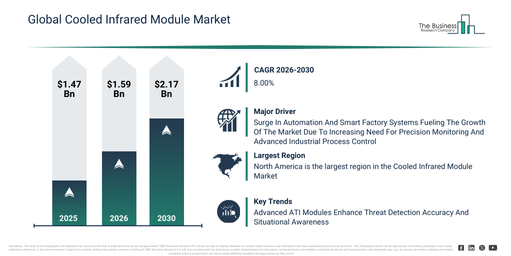
The cooled infrared module market has witnessed substantial growth in recent years. It is anticipated to expand from $1.47 billion in 2025 to $1.59 billion by 2026, achieving a compound annual growth rate (CAGR) of 8.3%. This historical development can be ascribed to an escalating need for ultra-high-sensitivity imaging, increasing deployment within defense and aerospace applications, wider utilization in long-range detection systems, the broadening scope of industrial inspection and monitoring applications, and the heightened demand for high-resolution thermal imaging.
The market for cooled infrared modules is projected to experience robust expansion over the coming years, with its size expected to grow to $2.17 billion in 2030 at a compound annual growth rate (CAGR) of 8.0%. This growth during the forecast period is fueled by several factors, such as the increased incorporation of these modules into autonomous systems, their expanding use in smart city surveillance, the rising need for multispectral and hyperspectral imaging, the development of service-centric solutions like calibration and maintenance, and their growing application in both healthcare and scientific research. Key trends anticipated for this period involve technological progress in low-SWaP cryocoolers, novel developments in detector materials like t2sl and qwiP, advancements in artificial intelligence (AI)-supported signal processing and automated target recognition, ongoing research and development into hybrid cooled-uncooled imaging systems, and the creation of more rugged and energy-efficient module designs.
Get A Free Sample Report With In-Depth Market Insights:
Cooled Infrared Module Market Growth Catalysts And Demand Drivers
The anticipated expansion of automation and smart factory systems is poised to drive the cooled infrared module market forward. These systems represent technologically sophisticated industrial settings, integrating linked machinery, sensors, robotics, and continuous monitoring to boost production efficiency, lessen human involvement, and improve workplace safety. The increasing adoption of automation and smart factory systems stems from the imperative for greater operational efficiency, as companies strive to cut expenses, reduce mistakes, and enhance output. Cooled infrared modules contribute to automation and smart factory systems by facilitating highly sensitive thermal imaging, precise temperature readings, and real-time anomaly detection, which in turn boosts system reliability and cuts down on downtime. For example, data from September 2025, provided by the International Federation of Robotics, a Germany-based robotics industry association, indicated that in 2024, China had 2,027,000 industrial robots operating in its factories, an increase from 1,890,000 units in 2023. Annual installations alone reached 295,000 units, marking a 7% rise over the prior year. Consequently, the expansion of automation and smart factory systems is a key driver for the cooled infrared module market.
Cooled Infrared Module Market Segment Breakdown: Which Categories Lead On Revenue?
The cooled infrared module market covered in this report is segmented –
1) By Types: Short-Wave Infrared, Medium-Wave Infrared, Long-Wave Infrared
2) By Detector Technology: Mid-Wave Infrared (MWIR) Modules, Long-Wave Infrared (LWIR) Modules, Short-Wave Infrared (SWIR) Modules, Multispectral And Hyperspectral Cooled IR Modules
3) By Module Configuration: Standalone Cooled Detector Modules, Integrated Cooled Infrared Camera Cores, Cooled Sensor-Engine Modules, Custom-Engineered Cooled IR Modules
4) By Sales Type: New Module Sales, Refurbished Or Overhauled Module Sales, Service-Based Lifecycle Support Packages
5) By End-Use Application: Military And Defense, Industrial And Commercial, Scientific Research, Homeland Security And Surveillance
Subsegments:
1) By Short-Wave Infrared: Indium Gallium Arsenide, Mercury Cadmium Telluride
2) By Medium-Wave Infrared: Mercury Cadmium Telluride, Indium Antimonide, Lead Salt
3) By Long-Wave Infrared: Vanadium Oxide, Amorphous Silicon, Mercury Cadmium Telluride
Cooled Infrared Module Market Trends Shaping Long-Term Demand
Leading companies in the cooled infrared module market are concentrating on developing sophisticated products, such as Automatic Threat Identification (ATI) systems. These advancements aim to improve detection accuracy, enhance situational awareness, and lessen the operational burden and mental fatigue on operators. Automatic Threat Identification (ATI) systems are defined as advanced processing capabilities embedded within infrared modules that automatically detect, classify, and notify operators of potential threats in real-time. For example, in March 2025, Lynred, a France-based company specializing in infrared detectors and imaging solutions, introduced two new ATI modules, TI EOLE and ATI GALATEA SL. These advanced threat identification modules are specifically engineered for airborne platforms, featuring high-resolution sensors and sophisticated algorithms that enable long-range detection and automatic classification of various aircraft, including low-flying and stealth targets. They are equipped with advanced image processing and real-time alert functionality, facilitating seamless threat assessment and engagement without extensive pilot intervention. Moreover, they incorporate low-power electronics and optimized cryogenic cooling, which extends the module’s lifespan and reduces lifecycle costs for defense and security operators.
Cooled Infrared Module Market Competitive Landscape: Which Companies Lead The Industry?
Major companies operating in the cooled infrared module market are Hamamatsu Photonics K.K., Raytheon Technologies Corporation, Teledyne FLIR LLC, Wuhan Guide Infrared Co. Ltd., Ophir Optronics Solutions Inc., Lynred, Exosens SAS, Sensors Unlimited Inc., Opgal Optronic Industries Ltd., VIGO Photonics S.A., Semi-Conductor Devices (SCD), Infrared Cameras Inc., Global Sensor Technology Co. Ltd., InfraTec GmbH Infrarotsensorik und Messtechnik, Sierra-Olympia Technologies Inc., Axiom Optics, Infiniti Electro-Optics, Noxant, RP Optical Lab Ltd., Vision Datum Technology Co. Ltd., IRCameras LLC, Nanjing CNGEIR Technology Co. Ltd.
View The Full Cooled Infrared Module Market Report:
Cooled Infrared Module Market Regional Breakdown: Where Is Demand Concentrated?
North America was the largest region in the cooled infrared module market in 2025. Asia-Pacific is expected to be the fastest-growing region in the forecast period. The regions covered in the cooled infrared module market report are Asia-Pacific, South East Asia, Western Europe, Eastern Europe, North America, South America, Middle East, Africa.
Reach Out To Our Team:
The Business Research Company: https://www.thebusinessresearchcompany.com/
Americas: +1 310-496-7795
Asia: +44 7882 955267 & +91 8897263534
Europe: +44 7882 955267
Email us at: marketing@tbrc.info
Follow us on:
LinkedIn: https://in.linkedin.com/company/the-business-research-company
YouTube: https://www.youtube.com/channel/UC24_fI0rV8cR5DxlCpgmyFQ
Global Market Model: https://www.thebusinessresearchcompany.com/global-market-model

Wasay has over a decade of experience in market research, data modelling, and analytics, with prior experience at GlobalData and Decision Tree Consulting Services. At The Business Research Company , he leads research operations across syndicated studies, customized consulting engagements, and the Global Market Model platform. His professional experience includes supporting organizations such as Boston Consulting Group, KPMG, and Ernst & Young. Wasay holds a degree in Electronics and Communications Engineering, postgraduate management qualifications from International Management Institute Belgium and Indian School of Business and Entrepreneurship, and completed the Integrated Program in Business Analytics from Indian Institute of Management Indore.