The Business Research Company’s 2026 market reports combine market attractiveness scoring, total addressable market sizing, company benchmarking matrices, interactive Excel dashboards, deeper supply chain intelligence, emerging startup tracking, and granular product-level insights to deliver research that is more actionable and strategically valuable.
Is The Data Center Chip Market Expanding? Latest Size Estimates And 2030 Projections
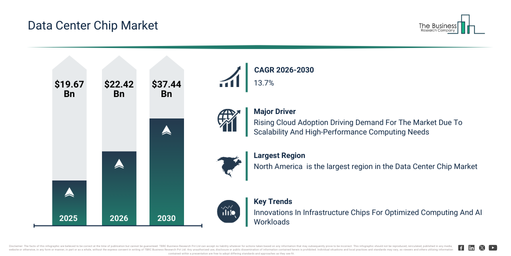
The data center chip market has experienced rapid expansion in recent years. Its value is set to increase from $19.67 billion in 2025 to $22.42 billion in 2026, demonstrating a compound annual growth rate (CAGR) of 14.0%. This past growth can be attributed to several factors, including the rising adoption of cloud computing, the expansion of hyperscale data centers, enhanced enterprise server virtualization, a growing demand for HPC workloads, and the decreasing cost per transistor achieved through scaling.
The data center chip market is poised for significant expansion in the upcoming years, with its valuation expected to reach $37.44 billion in 2030, exhibiting a compound annual growth rate (CAGR) of 13.7%. This anticipated increase throughout the forecast period stems from a rise in AI and ML workloads, a heightened demand for energy-efficient data center chips, the embrace of custom silicon by cloud providers, the proliferation of edge-to-cloud data processing, and continuous advancements in sub-5 NM manufacturing. Dominant trends during this period are projected to include chiplet-based processor architectures, the incorporation of heterogeneous computing, the widespread adoption of advanced semiconductor packaging, efforts towards supply chain localization and diversification, and optimized reliability and uptime for hyperscale data centers.
Free Data Center Chip Market Sample: Market Size, Growth Drivers And Competitive Landscape:
Data Center Chip Market Drivers Explained: What Is Supporting A 13.7% CAGR?
The data center chip market is anticipated to expand due to the rising uptake of cloud services in the future. Cloud services involve internet-based computing resources and applications that users can access as needed, eliminating the need for personal physical infrastructure. The rise in cloud services is fueled by their scalability, which enables businesses to readily scale resources up or down without substantial hardware investments. Data center chips support cloud services by offering high-performance computing and effective data processing, which allows servers to manage extensive workloads, store vast amounts of data, and provide swift, dependable cloud applications. For example, information from AAG IT Services, a UK-based non-government organization, indicated in June 2024 that in 2023, roughly 63% of small and medium-sized business workloads and 62% of small and medium-sized business data were projected to reside in public clouds, a rise from 57% and 56% respectively in 2022. Consequently, the growing integration of cloud services is a primary driver for the expansion of the data center chip market.
Data Center Chip Market Segment Guide: Main Divisions And Subsegments
The data center chip market covered in this report is segmented –
1) By Chip Type: Central Processing Units (Cpus), Graphics Processing Units (Gpus), Application-Specific Integrated Circuits (Asics), Field-Programmable Gate Arrays (Fpgas), Neural Processing Units (Npus)
2) By Technology: 25 Nanometer (NM) And Below, 26 Nanometer (NM) To 45 Nanometer (NM), 46 Nanometer (NM) To 65 Nanometer (NM), Above 65 Nanometer (NM)
3) By Data Center Size: Small And Medium Size, Large Size
4) By Application Area: Data Storage, Networking, High-Performance Computing (HPC), Artificial Intelligence (Ai) And Machine Learning (Ml), Cloud Computing
5) By End-Use: Information Technology, Telecom, Healthcare, Banking, Financial Services, And Insurance (BFSI), Retail And E-Commerce, Entertainment And Media, Energy, Other End-Users
Subsegments:
1) By Central Processing Units: Server Central Processing Units (CPUs), High-Performance Central Processing Units (CPUs), Low-Power Central Processing Units (CPUs)
2) By Graphics Processing Units: Discrete Graphics Processing Units (GPUs), Integrated Graphics Processing Units (GPUs), Artificial Intelligence Or Machine Learning Accelerators, High-Performance Computing Graphics Processing Units
3) By Application-Specific Integrated Circuits: Networking Application-Specific Integrated Circuits (ASICs), Storage Application-Specific Integrated Circuits (ASICs), Security Application-Specific Integrated Circuits (ASICs), Artificial Intelligence or Machine Learning Application-Specific Integrated Circuits (ASICs), Custom Application-Specific Integrated Circuits (ASICs)
4) By Field-Programmable Gate Arrays: High-End Field-Programmable Gate Arrays (Fpgas), Mid-Range Field-Programmable Gate Arrays (Fpgas), Low-End Field-Programmable Gate Arrays (Fpgas), Embedded Field-Programmable Gate Arrays (Fpgas)
5) By Neural Processing Units: Edge Neural Processing Units (NPUs), Cloud Neural Processing Units (NPUs), Artificial Intelligence Inference Neural Processing Units (NPUs), Artificial Intelligence Training Neural Processing Units (NPUs)
Data Center Chip Market Trends And Opportunities For 2026–2030
Leading companies within the data center chip market are focusing on implementing technological advancements, such as custom-designed data center infrastructure chips, to enhance server performance, boost energy efficiency, and support the growing demands of complex cloud and AI workloads. Custom-designed data center infrastructure chips are specialized semiconductor components precisely engineered for data center operations, optimized for tasks like high-performance computing, data storage, networking, and AI processing, rather than for general-purpose computing. For example, in November 2024, Microsoft Corporation, a US-based technology company, introduced Azure Integrated HSM (hardware security module) and Azure Boost DPU (data processing unit) to bolster cloud security and accelerate data-intensive workloads. The Azure Integrated HSM is designed to secure encryption keys within dedicated hardware, facilitating faster and safer cryptographic operations in the cloud, while the Azure Boost DPU offloads network and storage tasks from CPUs, thereby increasing data center speed and efficiency for demanding AI applications.
Which Major Players Are Active In The Data Center Chip Market?
Major companies operating in the data center chip market are Google LLC, Samsung Electronics Co. Ltd., Huawei Technologies Co. Ltd., Intel Corporation, IBM Corporation, Cisco Systems Inc., Oracle Corporation, Qualcomm Technologies Inc., Sk Hynix Inc., Broadcom Inc., Hewlett Packard Enterprise, Fujitsu Limited, NVIDIA Corporation, Advanced Micro Devices Inc., Texas Instruments Incorporated, STMicroelectronics N.V., Marvell Technology Group Ltd., Arm Holdings Plc, Monolithic Power Systems Inc., Ampere Computing LLC
Unlock The Complete Data Center Chip Market Report With Company Benchmarking:
Data Center Chip Market World Regions Compared: Which Leads In Revenue?
North America was the largest region in the data center chip market in 2025. Asia-Pacific is expected to be the fastest-growing region in the forecast period. The regions covered in the data center chip market report are Asia-Pacific, South East Asia, Western Europe, Eastern Europe, North America, South America, Middle East, Africa.
Reach Out To Our Team:
The Business Research Company: https://www.thebusinessresearchcompany.com/
Americas: +1 310-496-7795
Asia: +44 7882 955267 & +91 8897263534
Europe: +44 7882 955267
Email us at: marketing@tbrc.info
Follow us on:
LinkedIn: https://in.linkedin.com/company/the-business-research-company
YouTube: https://www.youtube.com/channel/UC24_fI0rV8cR5DxlCpgmyFQ
Global Market Model: https://www.thebusinessresearchcompany.com/global-market-model

Wasay has over a decade of experience in market research, data modelling, and analytics, with prior experience at GlobalData and Decision Tree Consulting Services. At The Business Research Company , he leads research operations across syndicated studies, customized consulting engagements, and the Global Market Model platform. His professional experience includes supporting organizations such as Boston Consulting Group, KPMG, and Ernst & Young. Wasay holds a degree in Electronics and Communications Engineering, postgraduate management qualifications from International Management Institute Belgium and Indian School of Business and Entrepreneurship, and completed the Integrated Program in Business Analytics from Indian Institute of Management Indore.