The Business Research Company’s 2026 market reports combine market attractiveness scoring, total addressable market sizing, company benchmarking matrices, interactive Excel dashboards, deeper supply chain intelligence, emerging startup tracking, and granular product-level insights to deliver research that is more actionable and strategically valuable.
Digital Camera Market Size Trajectory: Key Numbers Every Industry Stakeholder Should Know
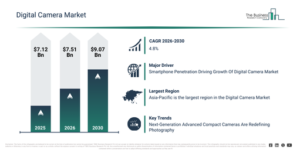
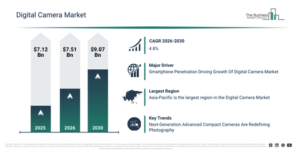
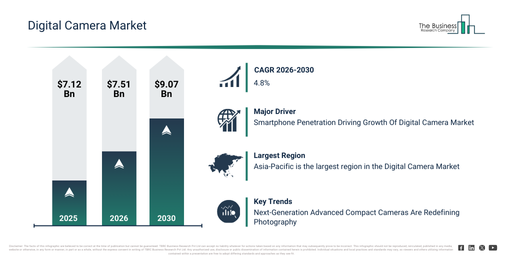
The digital camera market has experienced significant growth over recent years. Its valuation is expected to rise from $7.12 billion in 2025 to $7.51 billion in 2026, achieving a compound annual growth rate (CAGR) of 5.5%. The expansion witnessed in the past can be attributed to factors such as the shift from film to digital photography, the decreasing expenses associated with digital imaging technology, the proliferation of social media for photo sharing, a growing consumer interest in photography as a hobby, and the professional requirement for high-quality imaging.
The digital camera market size is expected to show steady expansion in the upcoming years. It is projected to reach $9.07 billion by 2030, with a compound annual growth rate (CAGR) of 4.8%. This growth during the forecast period can be attributed to the integration of AI-based photography features, increasing demand for professional content creation, the rise of travel and experiential photography, improvements in CMOS sensor technology, and the wider use of hybrid photo-video cameras. Significant trends anticipated for this period include the growing adoption of mirrorless cameras over DSLRs, a heightened demand for high-resolution image sensors, the increasing popularity of vlogging and content creation cameras, the expansion of advanced image processing and autofocus capabilities, and a growing preference for lightweight and compact camera designs.
Looking For Reliable Digital Camera Market Data? Request A Free Sample:
What Is Behind The Rising Demand In The Digital Camera Market?
The expanding presence of smartphones is anticipated to stimulate future expansion in the digital camera market. These are mobile gadgets that integrate the capabilities of a cellular phone with functionalities commonly associated with personal computers. The adoption rate of smartphones is increasing, driven by factors such as technological advancements, cost-effectiveness, improved network connections, a wide range of functions, seamless ecosystem integration, and evolving digital lifestyle patterns. Smartphones benefit digital cameras through integrated editing features, immediate sharing options, enhanced connectivity, and by acting as supplementary tools for data storage, remote operation, and content organization. For example, as reported by Demand Sage, a U.S.-based technology firm, in October 2025, smartphone adoption in the United States hit 82.2% in 2023, marking an increase from 76.5% in 2022. This growing prevalence of smartphones is thus a key factor fueling the expansion of the digital camera market.
Digital Camera Market Segment Coverage And Subsegment Analysis
The digital camera market covered in this report is segmented –
1) By Type: Compact Digital Cameras, Mirrorless Interchangeable Lens Cameras, Digital Single-Lens Reflex Cameras
2) By Lens Type: Built-In, Interchangeable
3) By Digital Sensor Type: Charge-Coupled Device (CCD) Sensor, Complementary Metal-Oxide-Semiconductor (CMOS) Sensor, Live Metal-Oxide-Semiconductor (MOS) Sensor
4) By Resolution: Low-Resolution Cameras, High-Resolution Cameras
5) By End User: Personal, Profession
Subsegments:
1) By Compact Digital Cameras: Point-And-shoot Cameras, Slim And Ultra-compact Cameras, Waterproof And Shockproof Compact Cameras, High Zoom Compact Cameras, Travel And Vlogging Compact Cameras, Advanced Compact Cameras With Manual Controls
2) By Mirrorless Interchangeable Lens Cameras: Entry-level Mirrorless Cameras, Mid-range Mirrorless Cameras, High-End Mirrorless Cameras, Full-Frame Mirrorless Cameras, Aps-c Sensor Mirrorless Cameras, Travel And Vlogging Mirrorless Cameras
3) By Digital Single-lens Reflex (Dslr) Cameras: Entry-level Dslr Cameras, Mid-Range Dslr Cameras, Professional Dslr Cameras, Full-frame Dslr Cameras, Aps-c Sensor Dslr Cameras, Sport And Action Dslr Cameras
Digital Camera Market Future Trends: Where Is The Industry Heading?
Major companies operating in the digital camera market are concentrating on developing innovative digital cameras, such as next-generation compact digital cameras, to meet the evolving requirements of photographers. These next-generation compact cameras, exemplified by the Fujifilm X100VI and the Sony α6700, provide advanced features customized for sophisticated photography and videography needs. For instance, in February 2024, Fujifilm Holdings Corp., a Japan-based camera manufacturing company, introduced the X100VI Digital Camera, an advanced next-generation compact camera. The X100VI Digital Camera incorporates a 5-axis, in-body image stabilization function with up to 6.0 stops, an X-TransTM CMOS 5 HR sensor with approximately 40.2 megapixels, and a fixed 23mm F2.0 lens. The X100VI features an Advanced Hybrid Viewfinder, 6.2K/30P movie recording, and Camera to Cloud integration for Adobe’s Frame.io, allowing for wireless photo and video uploads. Its design includes aluminum surfaces, an ultra-thin tilt LCD monitor, and an integrated body design for versatile shooting styles.
Digital Camera Market Top Players List For 2026
Major companies operating in the digital camera market are Samsung Electronics Co. Ltd., Sony Corporation, LG Electronics Inc., Hewlett-Packard Inc., Panasonic Corporation, Canon Inc., Fujifilm Holdings Corporation, Ricoh Company Ltd., Olympus Corporation, Nikon Corporation, Carl Zeiss AG, Casio Computer Co. Ltd., DJI Technology Co. Ltd., Eastman Kodak Company, GoPro Inc., Polaroid Corporation, Tamron Co. Ltd., Leica Camera AG, Blackmagic Design Pty. Ltd., Sigma Corporation, Phase One A/S, YI Technology Co. Ltd., Hasselblad Group, Vivo Technology Company Limited, Arashi Vision Inc (Insta360)
Order Your Copy Of The Digital Camera Market Report 2026:
How Does The Digital Camera Market Vary By Region?
Asia-Pacific was the largest region in the digital camera market in 2025. Asia-Pacific is expected to be the fastest-growing region in the forecast period. The regions covered in the digital camera market report are Asia-Pacific, South East Asia, Western Europe, Eastern Europe, North America, South America, Middle East, Africa.
Reach Out To Our Team:
The Business Research Company: https://www.thebusinessresearchcompany.com/
Americas: +1 310-496-7795
Asia: +44 7882 955267 & +91 8897263534
Europe: +44 7882 955267
Email us at: marketing@tbrc.info
Follow us on:
LinkedIn: https://in.linkedin.com/company/the-business-research-company
YouTube: https://www.youtube.com/channel/UC24_fI0rV8cR5DxlCpgmyFQ
Global Market Model: https://www.thebusinessresearchcompany.com/global-market-model

Wasay has over a decade of experience in market research, data modelling, and analytics, with prior experience at GlobalData and Decision Tree Consulting Services. At The Business Research Company , he leads research operations across syndicated studies, customized consulting engagements, and the Global Market Model platform. His professional experience includes supporting organizations such as Boston Consulting Group, KPMG, and Ernst & Young. Wasay holds a degree in Electronics and Communications Engineering, postgraduate management qualifications from International Management Institute Belgium and Indian School of Business and Entrepreneurship, and completed the Integrated Program in Business Analytics from Indian Institute of Management Indore.