Delivering more actionable and strategically valuable research, The Business Research Company’s 2026 market reports feature market attractiveness analysis, total addressable market evaluation, company benchmarking matrices, interactive Excel dashboards, expanded supply chain intelligence, emerging startup coverage, and detailed product insights.
Digital Engine-Control System Market Size, Value And Growth Trends Through 2030
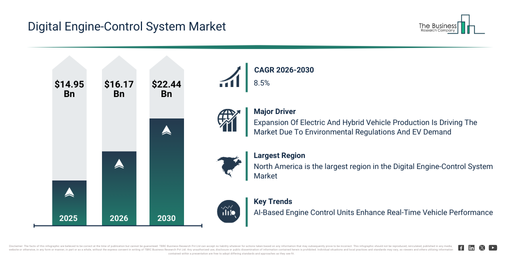
The market size for digital engine-control systems has observed robust growth in recent years. It is anticipated to increase from $14.95 billion in 2025 to $16.17 billion in 2026, achieving a compound annual growth rate (CAGR) of 8.2%. The expansion seen in the past can be attributed to factors such as rising demand for fuel-efficient engines, advancements in microcontrollers, regulatory pressure on emissions, growth in passenger vehicle production, and the adoption of electronic fuel injection systems.
The market for digital engine-control systems is projected to experience substantial expansion in the coming years. This market is anticipated to reach a valuation of $22.44 billion by 2030, exhibiting a compound annual growth rate (CAGR) of 8.5%. Factors contributing to this projected growth include the expanding incorporation of AI in engine management, the rise of hybrid and electric vehicles, increasing consumer desire for connected vehicles, improvements in predictive maintenance software, and the broadening of aftermarket engine control services. Key developments anticipated during this timeframe encompass predictive engine diagnostics, adaptive fuel management, real-time emission regulation, the integration of IoT into engine systems, and cloud-based monitoring of engine performance.
Download A Free Sample Report For Comprehensive Market Insights:
Digital Engine-Control System Market Growth Drivers: What Factors Are Accelerating Expansion?
The anticipated future expansion in the production of electric and hybrid vehicles is set to propel growth within the digital engine control system market. Electric and hybrid vehicle production encompasses the entire process of designing, manufacturing, assembling, and testing automobiles that are either fully electric or integrate an electric powertrain with a traditional internal combustion engine. This increasing production of electric and hybrid vehicles is propelled by stricter environmental regulations, which compel manufacturers to develop cleaner, low-emission vehicles to minimize carbon footprints and achieve sustainability objectives. Digital engine control systems support the growth of electric and hybrid vehicle production through optimizing powertrain efficiency, boosting energy conservation, and facilitating accurate control of both electric and combustion elements, leading to greater vehicle reliability and eco-friendliness. For instance, in January 2025, the U.S. Department of Transportation’s Federal Highway Administration, a US-based agency that supports state and local governments, indicated that the U.S. Federal Government intends to guarantee that 50% of all new vehicles sold by 2030 are zero-emission vehicles, a goal considerably above present adoption levels, alongside plans to develop an extensive and fair network of 500,000 chargers to improve EV access for both local and long-distance travel. Consequently, the increasing rollout of electric and hybrid vehicle manufacturing is boosting the digital engine control system market.
Digital Engine-Control System Market Segmentation And Category Breakdown
The digital engine-control system market covered in this report is segmented –
1) By Component: Hardware, Software, Services
2) By Engine Type: Gasoline, Diesel, Hybrid, Electric
3) By Vehicle Type: Passenger Cars, Commercial Vehicles, Off-Highway Vehicles, Other Types
4) By Application: Automotive, Aerospace, Marine, Industrial, Other Applications
5) By End User: Original Equipment Manufacturers, Aftermarket
Subsegments:
1) By Hardware: Electronic Control Units, Sensors, Actuators, Power Modules, Communication Interfaces
2) By Software: Control Algorithms, Diagnostic Software, Monitoring Software, Integration Software, Simulation And Modeling Tools
3) By Services: Installation And Integration, Maintenance And Repair, Training And Support, Upgrades And Modernization, Consulting Services
Digital Engine-Control System Market Trends Reshaping Industry Growth
Leading companies in the digital engine-control system market are concentrating on developing innovative solutions, such as artificial intelligence-based electronic control units (ECUs), to enhance engine performance, efficiency, and real-time vehicle control. An artificial intelligence-based electronic control unit (AI-ECU) functions as a vehicle control system that employs AI algorithms to optimize engine performance, fuel efficiency, and emissions in real time. For instance, in November 2024, Marelli Europe S.p.A., an Italy-based automotive technology company, introduced the VEC_480, an AI-based electronic control unit (ECU) specifically engineered for engine and vehicle control in motorsport applications. This ECU provides 2.5 times higher real-time computing performance, 10 times greater inter-processor bandwidth, and improved RAM throughput, allowing for the rapid execution of complex neural-network algorithms within milliseconds. The ECU utilizes AI algorithms to enable real-time predictive control of vehicle functions, thereby improving fuel efficiency and overall performance. It is designed to process data from vehicle sensors to make instantaneous decisions, supporting the transition towards software-defined vehicles.
Digital Engine-Control System Market Competitive Analysis Of Major Industry Participants
Major companies operating in the digital engine-control system market are Honeywell International Inc., GE Aerospace (GE Aviation), Safran S.A., Raytheon Technologies Corporation (RTX), BAE Systems plc, Moog Inc., Woodward Inc., Curtiss-Wright Corporation, Thales Group, Parker-Hannifin Corporation / Parker Aerospace, Triumph Group, Rolls-Royce Holdings plc, Cummins Inc., Mitsubishi Heavy Industries,Ltd. (MHI), Robert Bosch GmbH, DENSO Corporation, Continental AG, ZF Friedrichshafen AG, Aptiv PLC, Magneti Marelli S.p.A., FADEC Alliance, Silver Atena GmbH, Electronic Concepts & Engineering Inc. (ECE), MTU Aero Engines AG, HEICO Corporation, Kongsberg Gruppen ASA, Infineon Technologies AG, Siemens AG, Emerson Electric Co., Rockwell Automation Inc., ABB Ltd.
Access The Complete Digital Engine-Control System Market Report:
Digital Engine-Control System Market Geographic Distribution And Regional Opportunities
North America was the largest region in the digital engine-control system market in 2025. Asia-Pacific is expected to be the fastest-growing region in the forecast period. The regions covered in the digital engine-control system market report are Asia-Pacific, South East Asia, Western Europe, Eastern Europe, North America, South America, Middle East, Africa.
Get in touch with us:
The Business Research Company: https://www.thebusinessresearchcompany.com/
Americas: +1 310-496-7795
Asia: +44 7882 955267 & +91 8897263534
Europe: +44 7882 955267
Email us at: marketing@tbrc.info
Follow us on:
LinkedIn: https://in.linkedin.com/company/the-business-research-company
YouTube: https://www.youtube.com/channel/UC24_fI0rV8cR5DxlCpgmyFQ
Global Market Model: https://www.thebusinessresearchcompany.com/global-market-model

Wasay has over a decade of experience in market research, data modelling, and analytics, with prior experience at GlobalData and Decision Tree Consulting Services. At The Business Research Company , he leads research operations across syndicated studies, customized consulting engagements, and the Global Market Model platform. His professional experience includes supporting organizations such as Boston Consulting Group, KPMG, and Ernst & Young. Wasay holds a degree in Electronics and Communications Engineering, postgraduate management qualifications from International Management Institute Belgium and Indian School of Business and Entrepreneurship, and completed the Integrated Program in Business Analytics from Indian Institute of Management Indore.