Built to provide research that’s more actionable and strategically valuable, The Business Research Company’s 2026 market reports include market attractiveness analysis, total addressable market sizing, company benchmarking matrices, interactive Excel dashboards, broader supply chain intelligence, emerging startup tracking, and in-depth product insights.
Digital Fault Recorder Market Value Analysis: What Growth Lies Ahead Over The Forecast Period?
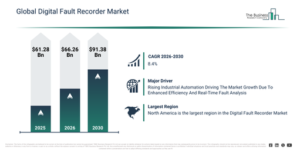
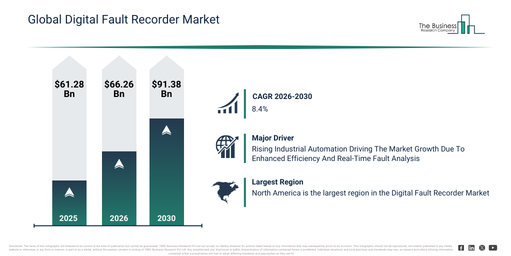
The digital fault recorder market has experienced robust expansion over recent years. Forecasts indicate its expansion from $61.28 billion in 2025 to $66.26 billion in 2026, achieving a compound annual growth rate (CAGR) of 8.1%. This historical growth is primarily driven by factors such as escalating electricity demand, the deterioration of power infrastructure due to age, an increase in power outages, the integration of digital monitoring systems, and mandates for regulatory compliance.
The digital fault recorder market size is poised for significant expansion over the next few years. It is projected to achieve a valuation of $91.38 billion by 2030, advancing at a compound annual growth rate (CAGR) of 8.4%. This growth during the forecast period stems from factors such as increasing renewable energy integration, the escalating need for cybersecurity, a rising emphasis on energy efficiency, the adoption of electric mobility and smart infrastructure, and breakthroughs in AI-driven grid analytics. Noteworthy trends anticipated in this period encompass sophisticated fault analysis, high-speed data acquisition, predictive maintenance solutions, integration with renewable energy systems, and improvements in grid reliability.
Get A Free Sample Report With In-Depth Market Insights:
Digital Fault Recorder Market Growth Catalysts And Demand Drivers
The digital fault recorder market is anticipated to expand, driven by the increasing adoption of industrial automation. Industrial automation involves employing control systems and various technologies to manage industrial processes and equipment, requiring minimal human involvement, which in turn boosts efficiency, output, and safety. The surge in industrial automation stems from the imperative for greater efficiency and productivity. By automating complex and repetitive tasks, manufacturers can achieve higher production volumes with fewer errors, minimize operational costs, and satisfy escalating market demand more rapidly. Digital fault recorders (DFRs) contribute to industrial automation by supplying precise event data and waveform recordings, thereby enabling automated control systems to analyze faults, optimize system performance, and execute real-time decisions to sustain smooth and safe industrial operations. For example, in April 2024, the International Federation of Robotics, a Germany-based international organization, reported that manufacturing companies in the United States significantly increased their automation endeavors, with total industrial robot installations climbing 12% to 44,303 units in 2023. This growth in industrial automation is thus a primary force behind the expansion of the digital fault recorder market.
Digital Fault Recorder Market Segment Breakdown: Which Categories Lead On Revenue?
The digital fault recorder market covered in this report is segmented –
1) By Component: Hardware, Software, Services
2) By Technology: High-Speed Disturbance Recording, Low-Speed Disturbance Recording, Steady-State Recording
3) By Installation: Generation, Transmission, Distribution
4) By Application: Transmission Lines, Distribution Networks, Substations, Industrial Plants And Critical Infrastructure, Renewable Energy Farms
5) By End-User: Electric Utilities, Industrial Manufacturing, Oil And Gas, Transportation, Renewable Energy Operators
Subsegments:
1) By Hardware: Smart Meters, Sensors, Communication Devices, Remote Terminal Units, Controllers
2) By Software: Energy Management Software, Grid Analytics Software, Meter Data Management Software, Asset Management Software, Network Security Software
3) By Services: Consulting Services, System Integration Services, Maintenance Services, Support Services, Training Services
Digital Fault Recorder Market Competitive Landscape: Which Companies Lead The Industry?
Major companies operating in the digital fault recorder market are Siemens AG, Hitachi Ltd., Schneider Electric SE, GE Vernova Inc., ABB Ltd., Eaton Corporation plc, Amtek Inc., Schweitzer Engineering Laboratories, SATEC Ltd., Qualitrol Company LLC, Ducati Energia S.p.A., Elspec, OMICRON, Toshiba Energy Systems & Solutions, KoCoS Messtechnik AG, ERLPhase Power Technologies Ltd., LogicLab s.r.l., Kinkei System Corporation, E-MAX Instruments Incorporated, Leading Edge Sales.
View The Full Digital Fault Recorder Market Report:
Digital Fault Recorder Market Regional Breakdown: Where Is Demand Concentrated?
North America was the largest region in the digital fault recorder market in 2025. Asia-Pacific is expected to be the fastest-growing region in the forecast period. The regions covered in the digital fault recorder market report are Asia-Pacific, South East Asia, Western Europe, Eastern Europe, North America, South America, Middle East, Africa.
Reach Out To Our Team:
The Business Research Company: https://www.thebusinessresearchcompany.com/
Americas: +1 310-496-7795
Asia: +44 7882 955267 & +91 8897263534
Europe: +44 7882 955267
Email us at: marketing@tbrc.info
Follow us on:
LinkedIn: https://in.linkedin.com/company/the-business-research-company
YouTube: https://www.youtube.com/channel/UC24_fI0rV8cR5DxlCpgmyFQ
Global Market Model: https://www.thebusinessresearchcompany.com/global-market-model

Wasay has over a decade of experience in market research, data modelling, and analytics, with prior experience at GlobalData and Decision Tree Consulting Services. At The Business Research Company , he leads research operations across syndicated studies, customized consulting engagements, and the Global Market Model platform. His professional experience includes supporting organizations such as Boston Consulting Group, KPMG, and Ernst & Young. Wasay holds a degree in Electronics and Communications Engineering, postgraduate management qualifications from International Management Institute Belgium and Indian School of Business and Entrepreneurship, and completed the Integrated Program in Business Analytics from Indian Institute of Management Indore.