Backed by market attractiveness analysis, total addressable market sizing, company benchmarking matrices, interactive Excel dashboards, wider supply chain intelligence, emerging startup coverage, and detailed product-level insights, The Business Research Company’s 2026 market reports are designed to offer research that is more actionable and strategically valuable than ever.
#Direct Current (DC) Fast Home Charger Market Size Forecast: How Big Could The Market Get By 2030?#_x000D_
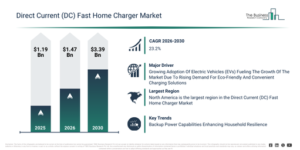
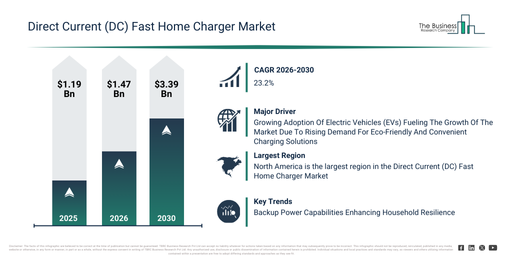
The direct current (DC) fast home charger market size has experienced significant expansion in recent years. It is anticipated to increase from $1.19 billion in 2025 to $1.47 billion in 2026, exhibiting a compound annual growth rate (CAGR) of 23.4%. The historical growth in this market can be linked to rising ev adoption in developed markets, government incentives for home charging, advancements in battery technology, insufficient public charging infrastructure, and a substantial reliance on ac home chargers._x000D_
_x000D_
The market for direct current (DC) fast home chargers is anticipated to experience substantial expansion over the upcoming years. This market is projected to reach $3.39 billion by 2030, demonstrating a compound annual growth rate (CAGR) of 23.2%. The projected expansion during this period stems from factors such as the increasing availability of EV models compatible with fast DC charging, the rise of smart grid integration, greater use of renewable energy for vehicle charging, the standardization of charger connectors, and improvements in modular charger technology. Key developments expected within the forecast timeframe encompass ultra-fast residential charging solutions, the uptake of high-voltage DC power, seamless integration of EV charging within smart homes, modular and scalable charger designs, and advanced energy management along with load balancing capabilities._x000D_
_x000D_
#Get A Free Sample Report With In-Depth Market Insights:#_x000D_
_x000D_
#Direct Current (DC) Fast Home Charger Market Growth Backed By Core Demand Fundamentals#_x000D_
The expanding embrace of electric vehicles (EVs) is anticipated to drive the direct current (DC) fast home charger market’s expansion moving ahead. EVs are vehicles that operate either fully or partially on electric motors, drawing power from rechargeable batteries, in contrast to internal combustion engines that rely on gasoline or diesel. This increasing adoption of EVs is spurred by a rising demand for environmentally friendly and sustainable transport options, highlighting a growing shift towards battery-powered mobility as both consumers and governments focus on cutting carbon emissions and fostering cleaner alternatives for travel. DC fast home chargers facilitate EV adoption by providing quick and convenient charging capabilities within the home, thereby alleviating range anxiety and improving the overall experience for EV owners. As an illustration, in 2024, a report from the International Energy Agency (IEA), a France-based intergovernmental body, indicated that global electric car registrations in 2023 almost hit 14 million, bringing the total to 40 million and demonstrating a 35% increase from 2022. Electric vehicles constituted approximately 18% of all car sales, with battery electric vehicles making up 70% of the complete electric car inventory. Consequently, the expanding use of electric vehicles (EVs) is fueling the expansion of the direct current (DC) fast home charger market._x000D_
_x000D_
#Direct Current (DC) Fast Home Charger Market Segment Breakdown: Which Categories Lead On Revenue?#_x000D_
The direct current (dc) fast home charger market covered in this report is segmented – _x000D_
_x000D_
1) By Charger Type: Wall Mounted, Floor Standing_x000D_
2) By Connector Type: Combined Charging System (CCS), CHAdeMO, GB/T, Tesla_x000D_
3) By Vehicle Type: Battery Electric Vehicles, Plug In Hybrid Electric Vehicles_x000D_
4) By Power Output: Up to 30 kW, 31–60 kW, Above 60 kW_x000D_
5) By Application: Residential, Commercial_x000D_
_x000D_
Subsegments:_x000D_
1) By Wall-Mounted: Single-Port, Dual-Port, Bidirectional, Compact Or Modular_x000D_
2) By Floor-Standing: Single-Port, Dual-Port, High-Power, Modular Or Swappable Unit_x000D_
_x000D_
#Direct Current (DC) Fast Home Charger Market Growth Trends Reshaping The Competitive Landscape#_x000D_
Major companies operating within the direct current (DC) fast home charger market are prioritizing technological innovations, such as bidirectional charging capabilities, to transform electric vehicles into core home energy resources, thereby boosting energy independence and providing critical backup power. This bidirectional charging technology facilitates a dual direction of electricity flow, enabling an electric vehicle’s battery not only to absorb power but also to discharge it to power a residence or contribute to the grid. For instance, in March 2025, Wallbox, an EV charging and energy management firm based in Spain, initiated pre-orders for its Quasar 2 bidirectional DC charger in partnership with Kia. The Quasar 2 offers distinct functionalities, including Vehicle-to-Home (V2H) capability and an emergency power supply during blackouts when combined with the Wallbox Power Recovery Unit, thereby enhancing a household’s energy resilience. It employs sophisticated power electronics to deliver as much as 12 kW of bidirectional power transfer, accommodating both charging and discharging processes, while seamlessly connecting with solar systems for eco-friendly energy consumption. The system intelligently regulates energy movement, allowing it to supply power to a home for as long as three days, contingent on the EV’s battery charge and domestic energy consumption, thus providing homeowners with considerable energy security and possibilities for financial savings._x000D_
_x000D_
#Direct Current (DC) Fast Home Charger Market Leading Players And Competitive Positioning#_x000D_
Major companies operating in the direct current (DC) fast home charger market are Robert Bosch GmbH, Tesla Inc., Schneider Electric SE, ABB Ltd., Delta Electronics Inc., ChargePoint Inc., Kempower Oyj, Efacec Power Solutions S.A., Tritium DCFC Limited, Wallbox Chargers S.L., EVBox Group B.V., Blink Charging Co., Pod Point, Suzhou Star Charge Technology Co. Ltd., Exicom Tele-Systems Limited, dcbel, Emporia Energy LLC, BTC Power Inc., Setec Power Co. Ltd., Teison Energy Technology Co. Ltd., Bacancy Systems, Primecom Tech. _x000D_
_x000D_
#View The Full Direct Current (DC) Fast Home Charger Market Report:#_x000D_
_x000D_
#Direct Current (DC) Fast Home Charger Market Geographic Analysis: Where Is Demand Rising Fastest?#_x000D_
North America was the largest region in the direct current (DC) fast home charger market in 2025. The regions covered in the direct current (DC) fast home charger market report are Asia-Pacific, South East Asia, Western Europe, Eastern Europe, North America, South America, Middle East, Africa._x000D_
_x000D_
#Reach Out To Our Team:#_x000D_
_x000D_
The Business Research Company: https://www.thebusinessresearchcompany.com/_x000D_
Americas: +1 310-496-7795_x000D_
Asia: +44 7882 955267 & +91 8897263534_x000D_
Europe: +44 7882 955267_x000D_
Email us at: marketing@tbrc.info_x000D_
_x000D_
#Follow us on:#_x000D_
_x000D_
LinkedIn: https://in.linkedin.com/company/the-business-research-company_x000D_
YouTube: https://www.youtube.com/channel/UC24_fI0rV8cR5DxlCpgmyFQ_x000D_
Global Market Model: https://www.thebusinessresearchcompany.com/global-market-model

Wasay has over a decade of experience in market research, data modelling, and analytics, with prior experience at GlobalData and Decision Tree Consulting Services. At The Business Research Company , he leads research operations across syndicated studies, customized consulting engagements, and the Global Market Model platform. His professional experience includes supporting organizations such as Boston Consulting Group, KPMG, and Ernst & Young. Wasay holds a degree in Electronics and Communications Engineering, postgraduate management qualifications from International Management Institute Belgium and Indian School of Business and Entrepreneurship, and completed the Integrated Program in Business Analytics from Indian Institute of Management Indore.