Featuring market attractiveness scoring, total addressable market sizing, company benchmarking matrices, interactive Excel dashboards, deeper supply chain intelligence, emerging startup tracking, and granular product-level insights, The Business Research Company’s 2026 market reports are built to deliver research that is both more actionable and more strategically valuable.
Displays Market Size, Value And Growth Trajectory Through 2030
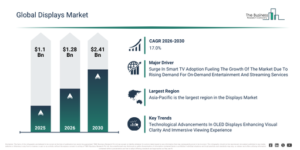
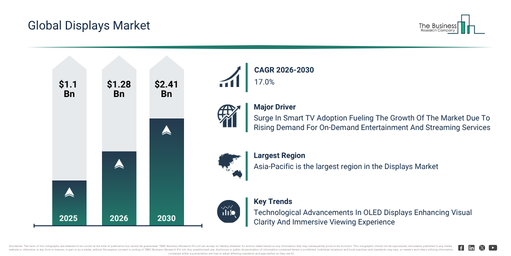
The displays market has observed significant expansion in recent years. This market is expected to expand from $1.1 billion in 2025 to reach $1.28 billion in 2026, exhibiting a compound annual growth rate (CAGR) of 16.8%. Several factors underpin this historical growth, such as the increase in lcd mass production scale, the global surge in consumer electronics adoption, the ongoing decline in display production costs, the expansion of the smartphone and television markets, and enhancements in backlight and panel technologies.
The displays market is projected to experience substantial expansion over the coming years. Its valuation is anticipated to reach $2.41 billion by 2030, demonstrating a compound annual growth rate (CAGR) of 17.0%. This forecasted increase is primarily driven by factors such as the broadening scope of AR VR immersive display applications, a growing appetite for ultra-high resolution content, the proliferation of digital cockpit displays in vehicles, greater uptake of smart retail and signage solutions, and advancements in MicroLED and other next-generation display materials. Key trends expected within this period encompass the accelerated adoption of MicroLED and OLED displays, breakthroughs in flexible and foldable display technologies, the expansion of high-resolution displays beyond 8K, the emergence of energy-efficient e-paper and low-power display options, and the rise of smart interactive and touch-enabled displays.
Get A Free Sample Report With In-Depth Market Insights:
Displays Market Growth Backed By Core Demand Fundamentals
The future expansion of the displays market is expected to be driven by the increasing consumer interest in smart TVs. These television devices integrate internet connectivity and streaming functions, enabling users to directly access online video content and digital services. The growing adoption of smart TVs is fueled by a rising preference for on-demand entertainment, the proliferation of streaming platforms, and improved internet accessibility. Displays are crucial in smart TVs, delivering high-resolution visuals, enhanced color accuracy, and superior viewing experiences, thereby supporting consumer desire for better content consumption. For instance, in December 2024, according to the Australian Communications and Media Authority, an Australia-based regulatory body, smart TV ownership continued to climb, with 58% of users watching online video content at home in 2024, an increase from 52% in 2023. Smart TVs also represented the majority of television imports, and industry projections forecast sustained growth through 2027. Consequently, the escalating demand for smart TVs is propelling the growth of the displays market.
Displays Market Segment Landscape: Which Areas Lead Development?
The displays market covered in this report is segmented –
1) By Display Type: Liquid Crystal Display, Light Emitting Diode, Organic Light Emitting Diode, Micro Light Emitting Diode, Electronic Paper, Other Display Types
2) By Resolution: High Definition (HD), Full High Definition (FHD), 4K, 8K, Other Resolutions
3) By Panel Size: Small And Medium, Large
4) By Application: Consumer Electronics, Automotive, Healthcare, Retail, Industrial, Other Applications
5) By End User: Residential, Commercial, Other End Users
Subsegments:
1) By Liquid Crystal Display: Twisted Nematic Display, In Plane Switching Display, Vertical Alignment Display, Super Twisted Nematic Display, Advanced Fringe Field Switching Display
2) By Light Emitting Diode: Edge Lit Light Emitting Diode Display, Full Array Light Emitting Diode Display, Mini Light Emitting Diode Backlit Display, Direct Lit Light Emitting Diode Display, Quantum Dot Light Emitting Diode Display
3) By Organic Light Emitting Diode: Active Matrix Organic Light Emitting Diode Display, Passive Matrix Organic Light Emitting Diode Display, Transparent Organic Light Emitting Diode Display, Flexible Organic Light Emitting Diode Display, Foldable Organic Light Emitting Diode Display
4) By Micro Light Emitting Diode: Passive Matrix Micro Light Emitting Diode Display, Active Matrix Micro Light Emitting Diode Display, Transparent Micro Light Emitting Diode Display, Flexible Micro Light Emitting Diode Display, Ultra Fine Pitch Micro Light Emitting Diode Display
5) By Electronic Paper: Electrophoretic Electronic Paper Display, Electrowetting Electronic Paper Display, Cholesteric Electronic Paper Display, Interferometric Modulator Electronic Paper Display, Flexible Electronic Paper Display
6) By Other Display Type: Quantum Dot Display, Laser Display, Field Emission Display, Digital Light Processing Display, Plasma Display
Displays Market Growth Trends Reshaping The Competitive Landscape
Major companies operating in the displays market are prioritizing technological advancements in OLED displays, such as OLED glare-free technology, to improve visual clarity, reduce reflections, and enhance the overall user viewing experience. OLED glare-free technology represents an advanced display innovation designed to minimize screen reflections while preserving high color accuracy and brightness, thereby enabling clearer and more immersive visuals even in brightly lit environments. For instance, in January 2024, Samsung Electronics, a South Korea-based electronics company, unveiled its 2024 OLED display lineup, underscoring its dedication to next-generation display innovation. This launch highlights the company’s focus on integrating sophisticated visual technologies to address the evolving consumer demand for premium viewing experiences. The new lineup features OLED glare-free technology that lessens reflections while upholding color accuracy, provides enhanced brightness with deeper blacks for improved contrast, and supports high refresh rates of up to 144 hertz for smoother motion and superior gaming and viewing performance.
Displays Market Competitive Landscape: Who Leads The Industry?
Major companies operating in the displays market are Samsung Electronics; Sony Corporation; Panasonic Holdings Corporation; DENSO Corporation; Continental AG; Mitsubishi Electric Corporation (Japan); Fujitsu Limited; BOE Technology Group; LG Display; Kyocera Corporation; Corning Incorporated; AU Optronics; Innolux Corporation; Visteon Corporation; Nippon Seiki; Advantech Co. Ltd; Japan Display Inc. (JDI); Barco NV; Leyard Optoelectronic; Hisense Group; Universal Display Corporation; Hannstar Display Corporation; TCL China Star Optoelectronics Technology (CSOT)
View The Full Displays Market Report:
Displays Market Geographic Landscape: Which Region Dominates Industry Growth?
Asia-Pacific was the largest region in the displays market in 2025, and it is expected to be the fastest-growing region in the forecast period. The regions covered in the displays market report are Asia-Pacific, South East Asia, Western Europe, Eastern Europe, North America, South America, Middle East, Africa.
Reach Out To Our Team:
The Business Research Company: https://www.thebusinessresearchcompany.com/
Americas: +1 310-496-7795
Asia: +44 7882 955267 & +91 8897263534
Europe: +44 7882 955267
Email us at: marketing@tbrc.info
Follow us on:
LinkedIn: https://in.linkedin.com/company/the-business-research-company
YouTube: https://www.youtube.com/channel/UC24_fI0rV8cR5DxlCpgmyFQ
Global Market Model: https://www.thebusinessresearchcompany.com/global-market-model

Wasay has over a decade of experience in market research, data modelling, and analytics, with prior experience at GlobalData and Decision Tree Consulting Services. At The Business Research Company , he leads research operations across syndicated studies, customized consulting engagements, and the Global Market Model platform. His professional experience includes supporting organizations such as Boston Consulting Group, KPMG, and Ernst & Young. Wasay holds a degree in Electronics and Communications Engineering, postgraduate management qualifications from International Management Institute Belgium and Indian School of Business and Entrepreneurship, and completed the Integrated Program in Business Analytics from Indian Institute of Management Indore.