Delivering more actionable and strategically valuable research, The Business Research Company’s 2026 market reports feature market attractiveness analysis, total addressable market evaluation, company benchmarking matrices, interactive Excel dashboards, expanded supply chain intelligence, emerging startup coverage, and detailed product insights.
Electric Vehicle Power Inverter Market Forecast: What Market Value Is Expected By 2030?
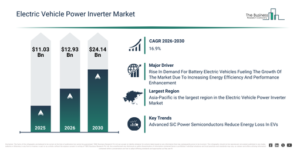
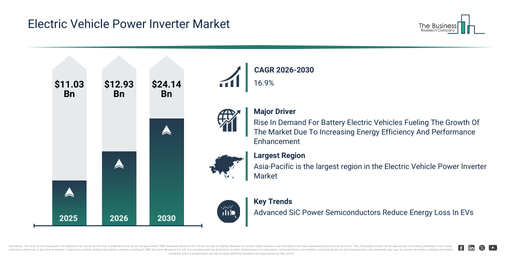
The electric vehicle power inverter market size has experienced significant expansion recently. This market is projected to expand from $11.03 billion in 2025 to $12.93 billion in 2026, demonstrating a compound annual growth rate (CAGR) of 17.2%. Historically, this growth was driven by factors such as early electrification efforts for passenger vehicles, the initial introduction of hybrid vehicle inverters, the widespread use of single-level inverter modules, governmental incentives promoting clean transportation, and advancements in low-power traction inverters.
The electric vehicle power inverter market size is anticipated to experience substantial growth over the next few years, reaching $24.14 billion by 2030, exhibiting a compound annual growth rate (CAGR) of 16.9%. This expansion in the forecast period is attributed to several factors including rising battery electric vehicle sales, an increasing demand for high-power inverters exceeding 600 kW, the integration of advanced multi-level inverter technologies, an expansion within commercial and heavy-duty EV segments, and innovations in soft switching and resonant inverter systems. Key trends expected during this period include the adoption of high-efficiency traction inverters for battery electric vehicles, the incorporation of soft switching inverters to minimize power losses and heat, the development of multi-level and modular inverter architectures, the growing application of inverters in hybrid and plug-in hybrid electric vehicles, and a sustained demand for scalable inverter solutions for passenger and commercial EVs.
Download A Free Sample Report For Comprehensive Market Insights:
#Electric Vehicle Power Inverter Market Demand Drivers Creating New Revenue Opportunities
The increasing demand for battery electric vehicles is anticipated to fuel the expansion of the electric vehicle power inverter market moving forward. Battery electric vehicles (BEVs) are electric vehicles that solely rely on electricity stored in onboard rechargeable batteries, which supply power to one or more electric motors for propulsion, thereby eliminating the need for internal combustion engines. The widespread embrace of battery electric vehicles is escalating because decreasing battery expenses are making electric cars more economical and available to a wider spectrum of consumers. Electric vehicle power inverters facilitate BEV adoption by efficiently transforming battery power to energize the electric motor. These inverters improve vehicle performance via precise speed and torque management, support energy recovery through regenerative braking, and boost overall energy efficiency, thereby hastening the transition to sustainable transport. For instance, in October 2024, the European Environment Agency (EEA), a Denmark-based intergovernmental organization, reported that electric vehicles constituted nearly 23% of newly registered passenger cars in the European Union in 2023, with battery electric vehicles (BEVs) specifically making up about 15%. Consequently, the growing demand for battery electric vehicles is propelling the electric vehicle power inverter market’s growth.
Electric Vehicle Power Inverter Market Segment Analysis Highlighting Growth Areas
The electric vehicle power inverter market covered in this report is segmented –
1) By Inverter Type: Traction Inverters, Soft Switching Inverters
2) By Propulsion Type: Hybrid Electric Vehicles, Plug-in Hybrid Electric Vehicles, Battery Electric Vehicles, Fuel Cell Electric Vehicles
3) By Vehicle Type: Passenger Cars, Light Commercial Vehicles, Heavy Commercial Vehicles And Buses
4) By Power Output: Up To 100 kilowatt (kW), 101- 300 kilowatt (kW), 301- 600 kilowatt (kW), 601 kilowatt (kW) And Above
5) By Distribution Channel: Original Equipment Manufacturer (OEM), Aftermarket
Subsegments:
1) By Traction Inverters: Single-Level Inverters, Multi-Level Inverters, Integrated Inverter Modules, Centralized Inverters, Distributed Inverters
2) By Soft Switching Inverters: Zero Voltage Switching Inverters, Zero Current Switching Inverters, Resonant Inverters, Phase-Shifted Inverters, Quasi-Resonant Inverters
Electric Vehicle Power Inverter Market Industry Trends Shaping Future Revenue Growth
Major companies in the electric vehicle power inverter market are focused on developing advanced products, such as metal–oxide–semiconductors, to improve energy efficiency, thermal management, and overall performance. Metal–oxide–semiconductors (MOS) are electronic structures that utilize a metal gate, an insulating oxide layer, and a semiconductor substrate to manage electrical current flow. For instance, in March 2023, DENSO Corporation, a Japan-based automotive components manufacturer, introduced its first inverter incorporating SiC power semiconductors. This device employs a next-generation power conversion technology aimed at boosting energy efficiency and extending the driving range of battery electric vehicles. The product features a proprietary trench-type metal–oxide–semiconductor (MOS) structure, high-quality SiC epitaxial wafers with fewer crystal defects, and is integrated into an eAxle module for the Lexus RZ model. The SiC-based inverter achieved more than a 50% reduction in power loss compared to a conventional silicon inverter. This leads to enhanced power consumption and a longer driving range for electric vehicles, thereby expediting the shift to an electrified automotive future.
Electric Vehicle Power Inverter Market Leading Companies: Who Holds Significant Market Presence?
Major companies operating in the electric vehicle power inverter market are HyundAI Motor Group, Robert Bosch GmbH, DENSO Corporation, Continental AG, ZF Friedrichshafen AG, Magna International Inc., Mitsubishi Electric Corporation, Valeo SA, Eaton Corporation plc, Schaeffler AG, STMicroelectronics NV, Nidec Corporation, BorgWarner Inc., Delta Electronics Inc., Dana Incorporated, Hitachi Astemo Ltd, CWB Automotive Electronics Co Ltd., Meidensha Corporation, Sungchang Autotech Co Ltd., Lucid Group Inc.
Access The Complete Electric Vehicle Power Inverter Market Report:
#Electric Vehicle Power Inverter Market Largest Region: Which Geography Holds The Highest Market Share?
Asia-Pacific was the largest region in the electric vehicle power inverter market in 2025. Asia-Pacific is expected to be the fastest-growing region in the forecast period. The regions covered in the electric vehicle power inverter market report are Asia-Pacific, South East Asia, Western Europe, Eastern Europe, North America, South America, Middle East, Africa.
Get in touch with us:
The Business Research Company: https://www.thebusinessresearchcompany.com/
Americas: +1 310-496-7795
Asia: +44 7882 955267 & +91 8897263534
Europe: +44 7882 955267
Email us at: marketing@tbrc.info
Follow us on:
LinkedIn: https://in.linkedin.com/company/the-business-research-company
YouTube: https://www.youtube.com/channel/UC24_fI0rV8cR5DxlCpgmyFQ
Global Market Model: https://www.thebusinessresearchcompany.com/global-market-model

Wasay has over a decade of experience in market research, data modelling, and analytics, with prior experience at GlobalData and Decision Tree Consulting Services. At The Business Research Company , he leads research operations across syndicated studies, customized consulting engagements, and the Global Market Model platform. His professional experience includes supporting organizations such as Boston Consulting Group, KPMG, and Ernst & Young. Wasay holds a degree in Electronics and Communications Engineering, postgraduate management qualifications from International Management Institute Belgium and Indian School of Business and Entrepreneurship, and completed the Integrated Program in Business Analytics from Indian Institute of Management Indore.