Delivering more actionable and strategically valuable research, The Business Research Company’s 2026 market reports feature market attractiveness analysis, total addressable market evaluation, company benchmarking matrices, interactive Excel dashboards, expanded supply chain intelligence, emerging startup coverage, and detailed product insights.
Electromagnetic Wave Absorbing Material Market Size Forecast: How Large Could The Market Become By 2030?
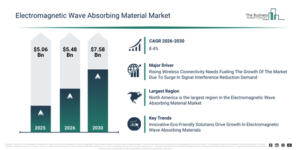
The electromagnetic wave absorbing material market has seen considerable expansion in recent years. Its size is expected to increase from $5.06 billion in 2025 to $5.48 billion in 2026, achieving a compound annual growth rate (CAGR) of 8.4%. In previous periods, this growth was influenced by factors including a rise in military and defense applications, increasing demand for consumer electronics, the expansion of telecommunication infrastructure, new developments in aerospace, and the initial implementation of EMI shielding solutions.
The electromagnetic wave absorbing material market is projected to experience substantial expansion over the coming years. This market is set to reach $7.58 billion by 2030, exhibiting a compound annual growth rate (CAGR) of 8.4%. This anticipated growth during the forecast period is primarily driven by an increasing need for 5G and 6G networks, the expansion of automotive electronics, greater application in wearable and smart devices, the advancement of next-generation radar and stealth technologies, and its integration into healthcare imaging and diagnostic equipment. Key developments anticipated in this period encompass sophisticated EMI shielding solutions, light and adaptable absorbing materials, the absorption of high-frequency waves, the incorporation of thermal management, and noise reduction in electronic systems.
Download A Free Sample Report For Comprehensive Market Insights:
Electromagnetic Wave Absorbing Material Market Expansion Drivers: What Is Shaping Future Growth?
The rising requirement for wireless communication systems is anticipated to drive the expansion of the electromagnetic wave absorbing material market in the future. Wireless communication systems encompass technologies that transmit information over distances without physical links, utilizing electromagnetic waves like radio or infrared signals. The need for these systems is growing due to the ongoing increase in mobile device adoption, as a greater number of individuals depend on smartphones and tablets for their daily communication, entertainment, and work activities. Electromagnetic wave absorbing materials offer advantages to wireless communication systems by lessening interference and signal degradation, thereby enhancing the clarity and dependability of transmissions. As an illustration, in September 2024, data from the Cellular Telecommunications Industry Association, a US-based trade association, indicated that nearly 40% of all wireless devices were linked to 5G in 2023, representing a 34% increase from the prior year. This substantial growth led to a grand total of 558 million wireless connections, which is equivalent to more than 1.6 connections per person in the U.S. Consequently, the increasing demand for wireless communication systems is propelling the growth of the electromagnetic wave absorbing material market.
Electromagnetic Wave Absorbing Material Market Segment Landscape: Which Areas Lead Market Development?
The electromagnetic wave absorbing material market covered in this report is segmented –
1) By Material Type: Conductive Materials, Magnetic Materials, Dielectric Materials, Composite Materials
2) By Form Factor: Sheets And Panels, Coatings, Films, Powders
3) By Application: Shielding, Radome, High-Frequency Absorption, Noise Reduction, Thermal Management
4) By End-Use Industry: Aerospace And Defense, Telecommunications, Automotive, Consumer Electronics, Healthcare
Subsegments:
1) By Conductive Materials: Carbon-Based Materials, Metal-Based Materials, Conductive Polymers
2) By Magnetic Materials: Ferrites, Metallic Magnetic Materials, Spinel And Hexaferrite Materials
3) By Dielectric Materials: Ceramic Dielectrics, Polymer-Based Dielectrics, Metal Oxide Dielectrics
4) By Composite Materials: Polymer-Matrix Composites, Metal-Matrix Composites, Hybrid Nanocomposites
Electromagnetic Wave Absorbing Material Market Transformation Trends: Which Innovations Are Driving Change?
Leading firms within the electromagnetic wave absorbing material market are concentrating on creating novel solutions, including environmentally sustainable radio wave absorbers, to comply with strict environmental regulations and cater to the increasing need for eco-friendly electronic components. These sustainable radio wave absorbers are materials engineered to lessen electromagnetic interference, all while being composed of eco-friendly, recyclable, or biodegradable elements that diminish environmental harm. A notable example is TDK Corporation, a Japan-based electronics corporation, which unveiled the IS-BP series in May 2024. This series represents the industry’s premier radio wave absorbers fabricated with over 25% biomass polyethylene sourced from sugarcane, thereby substituting conventional petroleum-derived substances. These environmentally conscious absorbers offer equivalent high performance, durability, and flame resistance compared to standard products, concurrently cutting CO2 emissions by 13%. The IS-BP series is intended for application in microwave anechoic chambers for testing antennas, wireless devices, and automotive radar, thus contributing to sustainability and climate change initiatives within the electronics sector.
Electromagnetic Wave Absorbing Material Market Industry Leaders And Market Competition
Major companies operating in the electromagnetic wave absorbing material market are Panasonic Holdings Corporation, 3M Company, TDK Corporation, Molex LLC, Murata Manufacturing Co. Ltd., Mast Technologies, Furukawa Electric Co. Ltd., HEICO Corporation, VACUUMSCHMELZE GmbH & Co. KG, RTP Company, TOKIN Corporation, Cuming Microwave Corporation, Schaffner Holding AG, Kitagawa Industries Co. Ltd., ETS-Lindgren, Tech-Etch Inc., FRD Co. Ltd., Laird Technologies Inc., KGS Kitagawa Industries Co. Ltd., Guangzhou Fangbang Electronics Co. Ltd., SEKISUI POLYMATECH CO. LTD., The Zippertubing Company.
Access The Complete Electromagnetic Wave Absorbing Material Market Report:
Electromagnetic Wave Absorbing Material Market Geographic Distribution And Regional Opportunities
North America was the largest region in the electromagnetic wave absorbing material market in 2025. Asia-Pacific is expected to be the fastest-growing region in the forecast period. The regions covered in the electromagnetic wave absorbing material market report are Asia-Pacific, South East Asia, Western Europe, Eastern Europe, North America, South America, Middle East, Africa.
Get in touch with us:
The Business Research Company: https://www.thebusinessresearchcompany.com/
Americas: +1 310-496-7795
Asia: +44 7882 955267 & +91 8897263534
Europe: +44 7882 955267
Email us at: marketing@tbrc.info
Follow us on:
LinkedIn: https://in.linkedin.com/company/the-business-research-company
YouTube: https://www.youtube.com/channel/UC24_fI0rV8cR5DxlCpgmyFQ
Global Market Model: https://www.thebusinessresearchcompany.com/global-market-model

Wasay has over a decade of experience in market research, data modelling, and analytics, with prior experience at GlobalData and Decision Tree Consulting Services. At The Business Research Company , he leads research operations across syndicated studies, customized consulting engagements, and the Global Market Model platform. His professional experience includes supporting organizations such as Boston Consulting Group, KPMG, and Ernst & Young. Wasay holds a degree in Electronics and Communications Engineering, postgraduate management qualifications from International Management Institute Belgium and Indian School of Business and Entrepreneurship, and completed the Integrated Program in Business Analytics from Indian Institute of Management Indore.