Built to provide research that’s more actionable and strategically valuable, The Business Research Company’s 2026 market reports include market attractiveness analysis, total addressable market sizing, company benchmarking matrices, interactive Excel dashboards, broader supply chain intelligence, emerging startup tracking, and in-depth product insights.
Electronics, Photonics And Quantum Market Poised To Hit $227.89 Billion By 2030 With A 11.3% CAGR
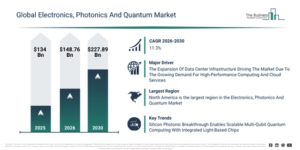
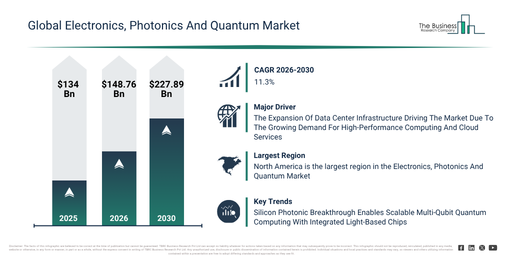
The market size for electronics, photonics, and quantum technologies has experienced rapid expansion in recent years. This market is projected to grow from $134 billion in 2025 to $148.76 billion in 2026, achieving a compound annual growth rate (CAGR) of 11.0%. Historically, this growth can be ascribed to several factors, including the escalating demand for faster computing and communication systems, advancements in semiconductor manufacturing capabilities, the increasing adoption of fiber optic communication networks, the broadening consumer electronics industry, and greater investment in research and development concerning photonics and electronics.
The market size for electronics, photonics, and quantum technologies is predicted to undergo rapid expansion over the next few years. It is expected to reach $227.89 billion by 2030, demonstrating a compound annual growth rate (CAGR) of 11.3%. This growth during the forecast period can be attributed to the increasing embrace of quantum computing and quantum communication systems, a rising demand for ultra-low latency data transmission, the development of AI-optimized chip design and fabrication, the broader application of high-performance computing, and the deeper integration of photonics within telecom and data infrastructure. Prominent trends for this period involve the increasing adoption of silicon photonics for high-speed data transfer, the expanding integration of quantum key distribution into secure communication, a greater deployment of photonic integrated circuits in data centers, the proliferation of AI-driven semiconductor design and optimization, and an escalating demand for miniaturized high-performance sensors and chips.
Get A Free Sample Report With In-Depth Market Insights:
Electronics, Photonics And Quantum Market Growth Catalysts And Demand Drivers
The expanding infrastructure of data centers is projected to drive the growth of the electronics, photonics and quantum market going forward. This infrastructure consists of the physical and virtual resources, such as servers, storage systems, networking equipment, and cooling systems, which are vital for supporting the storage, processing, and management of large volumes of digital information. The expansion of data center infrastructure stems from the rapid growth of cloud computing, which requires extensive computing, storage, and networking resources to support increasing digital workloads and online services. Electronics, photonics, and quantum technologies enhance data center infrastructure by enabling high-performance computing, ultra-fast optical communication, and advanced processing capabilities, which in turn improve data transfer speed, system efficiency, scalability, and the ability to manage massive and complex digital workloads. For instance, in September 2024, according to the National Telecommunications and Information Administration, a US-based government agency, the United States has around 5,000 data centers, and demand for these facilities is expected to increase by approximately 9% annually until 2030. Therefore, the expansion of data center infrastructure is a key driver for the growth of the electronics, photonics and quantum market.
Electronics, Photonics And Quantum Market Segment Analysis: What Are The Core Market Categories?
The electronics, photonics and quantum market covered in this report is segmented –
1) By Component: Processors And Chipsets, Sensors, Communication Modules, Lasers And Optical Devices, Quantum Processors And Qubits, Integrated Photonic Circuits, Control And Measurement Systems
2) By Integration Level: Discrete Components, Integrated Systems, Hybrid Systems
3) By Application: High-Performance Computing (HPC), Telecommunications And Data Transmission, Imaging And Diagnostics, Navigation And Sensing, Cybersecurity And Encryption, Consumer Electronics, Industrial Automation And Robotics
4) By End-Use Industry: Information Technology And Telecommunications, Healthcare And Life Sciences, Aerospace And Defense, Automotive, Manufacturing And Industrial, Energy And Utilities, Research And Academia
Subsegments:
1) By Processors And Chipsets: Central Processing Units, Graphics Processing Units, Application Specific Integrated Circuits, Field Programmable Gate Arrays, System On Chip Processors, Neural Network Processors
2) By Sensors: Temperature Sensors, Pressure Sensors, Motion Sensors, Image Sensors, Optical Fiber Sensors, Quantum Magnetic Sensors, Quantum Gravimetric Sensors
3) By Communication Modules: Wireless Communication Modules, Cellular Communication Modules, Satellite Communication Modules, Optical Communication Modules, Short Range Communication Modules, Long Range Communication Modules
4) By Lasers And Optical Devices: Semiconductor Lasers, Fiber Lasers, Solid State Lasers, Light Emitting Diodes, Photodetectors, Optical Amplifiers
5) By Quantum Processors And Qubits: Superconducting Qubits, Trapped Ion Qubits, Photonic Qubits, Topological Qubits, Spin Based Qubits, Neutral Atom Qubits
6) By Integrated Photonic Circuits: Silicon Photonic Circuits, Indium Phosphide Photonic Circuits, Hybrid Photonic Circuits, Passive Photonic Circuits, Active Photonic Circuits, Programmable Photonic Circuits
7) By Control And Measurement Systems: Data Acquisition Systems, Signal Generators, Oscilloscopes, Spectrum Analyzers, Quantum Control Systems, Precision Measurement Instruments
Electronics, Photonics And Quantum Market Trends Shaping Long-Term Demand
Leading companies in the electronics, photonics, and quantum markets are concentrating on developing innovative products, such as silicon-photonic quantum integrated circuit chips, to enable scalable, high-speed quantum computing and efficient photonic-based information processing. These advanced microchips utilize photons (light particles) traveling through silicon-based optical circuits instead of electrons to process and transmit information. This approach contributes to faster, more scalable, and energy-efficient quantum computing by reducing signal loss, improving qubit control, and enabling complex quantum operations through integrated photonic components on a single chip. For instance, in November 2024, the Electronics and Telecommunications Research Institute (ETRI), a South Korea-based government-funded research institute, developed an 8-photon qubit silicon photonic quantum integrated circuit chip designed for advanced quantum computation and scalable photonic quantum information processing. This chip is built on a silicon photonics platform that integrates optical waveguides, photon sources, phase shifters, and linear optical quantum gates onto a single compact semiconductor substrate. It operates by encoding quantum information into photons and manipulating them through controlled interference and entanglement, enabling multi-qubit quantum operations within a highly stable optical architecture. Unlike traditional electronic processors that rely on electron charge and classical binary states, this photonic quantum chip leverages the quantum properties of light, allowing for potentially faster computations, reduced energy loss, and improved resistance to thermal noise.
Electronics, Photonics And Quantum Market Competitive Landscape: Who Leads The Industry?
Major companies operating in the electronics, photonics and quantum market are Nippon Telegraph and Telephone Corporation; NEC Corporation; Quantum Source; Thorlabs Inc.; PsiQuantum Corp.; Quantum Brilliance Pty Ltd; PASQAL SAS; ID Quantique SA; Silicon Quantum Computing Pty Ltd; Alice & Bob SAS; Quandela SAS; Equal1 Laboratories Ltd; Quantum Motion Technologies Ltd; MagiQ Technologies Inc.; Menlo Systems GmbH; ORCA Computing Ltd; QuiX Quantum B.V.; AegiQ Ltd; planqc GmbH; Nord Quantique Inc.; Alpine Quantum Technologies GmbH; Xanadu Quantum Technologies Inc.; TuringQ; QBoson.
View The Full Electronics, Photonics And Quantum Market Report:
Electronics, Photonics And Quantum Market Geographic Landscape: Which Region Leads Industry Growth?
North America was the largest region in the electronics, photonics and quantum market in 2025. Asia-Pacific is expected to be the fastest-growing region in the forecast period. The regions covered in the electronics, photonics and quantum market report are Asia-Pacific, South East Asia, Western Europe, Eastern Europe, North America, South America, Middle East, Africa.
Reach Out To Our Team:
The Business Research Company: https://www.thebusinessresearchcompany.com/
Americas: +1 310-496-7795
Asia: +44 7882 955267 & +91 8897263534
Europe: +44 7882 955267
Email us at: marketing@tbrc.info
Follow us on:
LinkedIn: https://in.linkedin.com/company/the-business-research-company
YouTube: https://www.youtube.com/channel/UC24_fI0rV8cR5DxlCpgmyFQ
Global Market Model: https://www.thebusinessresearchcompany.com/global-market-model

Wasay has over a decade of experience in market research, data modelling, and analytics, with prior experience at GlobalData and Decision Tree Consulting Services. At The Business Research Company , he leads research operations across syndicated studies, customized consulting engagements, and the Global Market Model platform. His professional experience includes supporting organizations such as Boston Consulting Group, KPMG, and Ernst & Young. Wasay holds a degree in Electronics and Communications Engineering, postgraduate management qualifications from International Management Institute Belgium and Indian School of Business and Entrepreneurship, and completed the Integrated Program in Business Analytics from Indian Institute of Management Indore.