
Built to provide research that’s more actionable and strategically valuable, The Business Research Company’s 2026 market reports include market attractiveness analysis, total addressable market sizing, company benchmarking matrices, interactive Excel dashboards, broader supply chain intelligence, emerging startup tracking, and in-depth product insights.
Elevator Door Sensors Market Size Outlook: How Quickly Will Revenue Expand Through 2030?
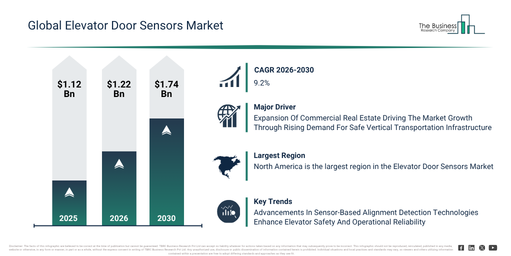
The market size for elevator door sensors has shown robust growth in recent years. It is anticipated to expand from $1.12 billion in 2025 to $1.22 billion in 2026, achieving a compound annual growth rate (CAGR) of 9.0%. The expansion observed in prior periods is attributable to the increasing installation of elevators in commercial buildings, a heightened focus on passenger safety regulations, the rising demand for modernizing existing elevator systems, the broadening of urban infrastructure projects, and the growing integration of automated building systems.
The market for elevator door sensors is projected to experience robust expansion over the coming years. Its size is anticipated to reach $1.74 billion by 2030, exhibiting a compound annual growth rate (CAGR) of 9.2%. This growth during the forecast timeframe is attributable to a rising need for smart safety solutions in elevators, an expanding embrace of connected monitoring systems for elevators, a heightened demand for sophisticated passenger protection technologies, the ongoing development of energy-efficient elevator systems, and an escalating call for predictive maintenance functionalities. Key trends for the forecast period encompass a greater uptake of advanced safety detection systems within elevator operations, a developing need for dependable and precise obstruction detection solutions, an intensified emphasis on enhancing both passenger safety and elevator performance, a broadened integration of diverse sensing technologies for improved door monitoring, and an increasing favoritism towards low-maintenance and robust elevator safety components.
Get A Free Sample Report With In-Depth Market Insights:
Elevator Door Sensors Market Demand Drivers Opening New Revenue Streams
The expanding commercial real estate sector is anticipated to drive the advancement of the elevator door sensors market moving ahead. Commercial real estate encompasses properties utilized for various business endeavors, such as office structures, retail complexes, storage facilities, hotels, and mixed-use projects designed to generate revenue or support commercial functions. The surge in commercial real estate is attributed to increased business spending on contemporary office, logistics, and retail infrastructure to meet economic expansion and changing workplace demands. Elevator door sensors play a crucial role in commercial real estate by improving passenger security, minimizing incidents related to doors, boosting elevator effectiveness, and assisting property owners in adhering to strict safety regulations within busy commercial settings. For example, in June 2025, data from the Australian Bureau of Statistics (ABS), an Australia-based government agency, revealed that the valuation of non-residential building approvals climbed by 14.7% to AUD 7.91 billion (USD 5.14 billion) in April 2025, signifying ongoing investment in commercial structures, offices, industrial sites, and other non-residential infrastructure initiatives. Consequently, the proliferation of commercial real estate is propelling the expansion of the elevator door sensors market. The increase in modernization and retrofit endeavors is anticipated to boost the expansion of the elevator door sensors market in the future. Modernization and retrofit initiatives involve updating, replacing, or improving existing building systems and equipment to enhance safety, performance, energy efficiency, and adherence to current benchmarks. The rise in these projects stems from the aging existing base of elevators and building infrastructure, which necessitates upgrades to fulfill contemporary operational and safety needs. Elevator door sensors support modernization and retrofit projects by elevating passenger safety, reducing door-related incidents, enhancing operational dependability, and assisting older elevators in meeting modern safety regulations while extending their lifespan. For instance, in September 2024, according to the Sustainable Energy Authority of Ireland (SEAI), an Ireland-based government agency, 25,750 property retrofit upgrades had been completed by mid-year 2024, marking an 18% rise compared to the corresponding period in 2023, while spending on retrofit programs surged by 44% year-over-year to $214.76 million (€186 million). Consequently, the surge in modernization and retrofit projects is stimulating the growth of the elevator door sensors market.
Elevator Door Sensors Market Segment Outlook: Which Categories Are Growing Fastest?
The elevator door sensors market covered in this report is segmented –
1) By Product Type: Infrared Sensors, Light Curtain Sensors, Mechanical Sensors, Ultrasonic Sensors, Other Product Types
2) By Technology: Active Sensors, Passive Sensors
3) By Sales Channel: Original Equipment Manufacturer, Aftermarket
4) By Application: Residential Elevators, Commercial Elevators, Industrial Elevators, Hospital Elevators
5) By End User: Elevator Manufacturers, Building Owners And Facility Managers, Maintenance And Service Providers, Infrastructure Developers
Subsegments:
1) By Infrared Sensors: Active Infrared Sensors, Passive Infrared Sensors, Diffuse Infrared Sensors, Retroreflective Infrared Sensors, Through Beam Infrared Sensors
2) By Light Curtain Sensors: Standard Light Curtains, Safety Light Curtains, Multibeam Light Curtains, High Resolution Light Curtains, Compact Light Curtains
3) By Mechanical Sensors: Limit Switch Based Sensors, Contact Switch Sensors, Spring Loaded Sensors, Magnetic Mechanical Sensors, Lever Arm Mechanical Sensors
4) By Ultrasonic Sensors: Proximity Ultrasonic Sensors, Diffuse Ultrasonic Sensors, Through Beam Ultrasonic Sensors, Multi Reflection Ultrasonic Sensors, Long Range Ultrasonic Sensors
5) By Other Product Types: Capacitive Sensors, Radar Based Sensors, Optical Time Of Flight Sensors, Laser Based Sensors, Hybrid Sensor Systems
Elevator Door Sensors Market Trends Powering Strategic Industry Growth
Leading companies in the elevator door sensors market are focusing on developing sophisticated sensor-based safety solutions, including sill-mounted alignment detection systems, to improve elevator leveling accuracy, passenger safety, and operational reliability. Sill-mounted alignment detection systems refer to sensor-enabled technologies installed at the elevator door sill that continuously monitor elevator car alignment and positioning, helping prevent leveling errors and ensuring safe elevator operation. For instance, in May 2026, Fail Safe Elevator Systems, Inc., a US-based elevator safety systems company, launched the FailSafe Alignment System at the International Association of Elevator Consultants (IAEC) Forum 2026. This system is designed to enhance elevator safety and leveling accuracy and features a sill-mounted sensor array, AI-assisted pattern-recognition detection technology, multi-sensor redundancy, and retrofit-compatible integration with existing elevator controllers. The solution replaces conventional shaft-mounted leveling sensors by anchoring detection geometry directly to the elevator door sill, helping eliminate alignment drift caused by building settlement and mechanical vibration while improving passenger safety and operational reliability.
Elevator Door Sensors Market Leading Companies And Competitive Benchmarking
Major companies operating in the elevator door sensors market are Otis Elevator Company, KONE Oyj, Schindler Holding AG, TK Elevator GmbH, Mitsubishi Electric Corporation, Hitachi Ltd., Fujitec Co. Ltd., Toshiba Elevator and Building Systems Corporation, Wittur Holding GmbH, CEDES AG, Avire Global Ltd., SICK AG, Schmersal GmbH & Co. KG, Autonics Corporation, CENTA Elevator, WECO Elevator Products, Dewhurst Group plc
View The Full Elevator Door Sensors Market Report:
Elevator Door Sensors Market Regional Breakdown: Where Is Demand Concentrated?
North America was the largest region in the elevator door sensors market in 2025. Asia-Pacific is expected to be the fastest-growing region in the forecast period. The regions covered in the elevator door sensors market report are Asia-Pacific, South East Asia, Western Europe, Eastern Europe, North America, South America, Middle East, Africa.
Reach Out To Our Team:
The Business Research Company: https://www.thebusinessresearchcompany.com/
Americas: +1 310-496-7795
Asia: +44 7882 955267 & +91 8897263534
Europe: +44 7882 955267
Email us at: marketing@tbrc.info
Follow us on:
LinkedIn: https://in.linkedin.com/company/the-business-research-company
YouTube: https://www.youtube.com/channel/UC24_fI0rV8cR5DxlCpgmyFQ
Global Market Model: https://www.thebusinessresearchcompany.com/global-market-model

Wasay has over a decade of experience in market research, data modelling, and analytics, with prior experience at GlobalData and Decision Tree Consulting Services. At The Business Research Company , he leads research operations across syndicated studies, customized consulting engagements, and the Global Market Model platform. His professional experience includes supporting organizations such as Boston Consulting Group, KPMG, and Ernst & Young. Wasay holds a degree in Electronics and Communications Engineering, postgraduate management qualifications from International Management Institute Belgium and Indian School of Business and Entrepreneurship, and completed the Integrated Program in Business Analytics from Indian Institute of Management Indore.