Market attractiveness scoring, total addressable market sizing, company benchmarking matrices, interactive Excel dashboards, deeper supply chain intelligence, emerging startup tracking, and granular product-level insights are among the key offerings featured in The Business Research Company’s 2026 market reports, designed to deliver more actionable and strategically valuable research.
What Is The Embedded Non Volatile Memory Market Size In 2026, And Where Is It Heading By 2030?
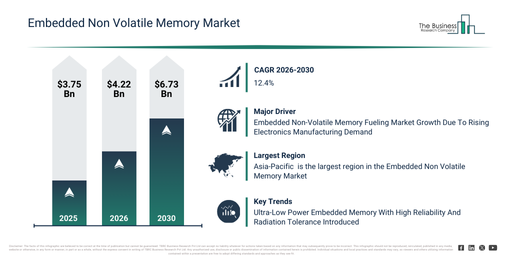
The embedded non volatile memory market size has experienced rapid growth in recent years. It is projected to expand from $3.75 billion in 2025 to $4.22 billion in 2026, demonstrating a compound annual growth rate (CAGR) of 12.5%. The growth observed in the historic period can be attributed to factors such as escalating consumer electronics demand, the expanding automotive electronics sector, increased utilization of industrial automation, the rising adoption of medical devices, and developments in aerospace and defense electronics.
The embedded non volatile memory market is anticipated to experience swift expansion over the coming years. This market is projected to reach $6.73 billion in 2030, exhibiting a compound annual growth rate (CAGR) of 12.4%. Key factors driving this growth during the forecast period include the increasing integration with AI-enabled systems, the widespread proliferation of IoT-connected devices, a rising demand for electric and autonomous vehicles, the growing adoption of smart home and industrial sensors, and ongoing advancements in high-density memory technologies. Significant trends expected during this period involve embedded memory miniaturization, the development of low-power embedded storage solutions, advancements in high-speed data retention technologies, sophisticated firmware storage integration, and improved security measures for embedded memory.
Request Your Free Embedded Non Volatile Memory Market Sample With Segment And Regional Data:
Embedded Non Volatile Memory Market Growth Drivers And Their Impact On Future Demand
The embedded non volatile memory market is anticipated to experience future growth, largely propelled by the escalating electronics manufacturing. This manufacturing process involves the production of electronic components and devices, including the assembly of circuit boards, semiconductors, and comprehensive systems. The uptick in electronics manufacturing is driven by the rapid worldwide shift towards digitalization, which in turn stimulates demand for intelligent, interconnected, and automated devices across various industries. Embedded non-volatile memory supports electronics manufacturing by enabling reliable, compact, and energy-efficient data storage directly within chips, which is essential for advanced electronic products like IoT devices, automotive systems, and smart appliances. For instance, in May 2023, the Japan Electronics and Information Technology Industries Association, a Japan-based trade association, reported that Japan’s consumer electronic equipment production reached $218.31 million (32,099 million yen), indicating a 127.0% increase compared to May 2022. Consequently, the expansion of electronics manufacturing is a significant impetus behind the growth of the embedded non volatile memory market.
What Categories Define The Embedded Non Volatile Memory Market?
The embedded non volatile memory market covered in this report is segmented –
1) By Product Type: Flash Memory, Electrically Erasable Programmable Read-Only Memory, Ferroelectric Random Access Memory, Resistive Random Access Memory, Phase Change Memory, Other Product Types
2) By Wafer Size: <100 Mm, >100 Mm
3) By Application: Smartphones, Wearables, Smart Tvs, Advanced Driver Assistance System (ADAS), Infotainment System, Networking, Smart Home Devices, Industrial Sensors, Medical Appliances, Other Applications
4) By End-Use Industry: Consumer Electronics, Automotive, Industrial, Healthcare, Aerospace And Defense, Communication, Other End-Users
Subsegments:
1) By Flash Memory: Not OR Flash Memory (NOR) Flash, Not AND Flash Memory (NAND) Flash
2) By Electrically Erasable Programmable Read-Only Memory (EEPROM): Serial Electrically Erasable Programmable Read-Only Memory, Parallel Electrically Erasable Programmable Read-Only Memory
3) By Ferroelectric Random Access Memory (FeRAM): Standalone Ferroelectric Random Access Memory, Embedded Ferroelectric Random Access Memory
4) By Resistive Random Access Memory (ReRAM): Discrete Resistive Random Access Memory, Embedded Resistive Random Access Memory
5) By Type Phase Change Memory (PCM): Single-Level Cell Phase Change Memory, Multi-Level Cell Phase Change Memory
6) By Other Product Types: Magnetoresistive Random Access Memory, Nano Random Access Memory, Programmable Metallization Cell Memory, Three-Dimensional Cross Point Memory
What New Developments Are Emerging In The Embedded Non Volatile Memory Market?
Leading firms in the embedded non-volatile memory (NVM) market are prioritizing technological innovations, including resistive random-access memory (ReRAM), to provide enhanced speed, energy efficiency, reliability, and security for memory solutions in system-on-chip (SoC) designs across various applications. Resistive random-access memory (ReRAM) is defined as a non-volatile memory (NVM) variant that stores data through altering a material’s resistance, thus delivering rapid, power-efficient, and long-lasting storage for electronic devices. As an illustration, in March 2023, Weebit Nano Limited, an Israel-based semiconductor IP firm, in collaboration with SkyWater Technology, a US-based semiconductor manufacturer, launched its initial embedded non-volatile memory module. This module provides extremely low power usage, a substantial write endurance reaching up to 100,000 cycles, and rapid access and programming capabilities, coupled with robust protection against radiation and electromagnetic interference. Its secure and modular architecture renders it highly suitable for system-on-chip applications in analogue and mixed-signal, Internet of Things (IoT), automotive, industrial, and medical sectors.
Major Players Driving Competition In The Embedded Non Volatile Memory Market
Major companies operating in the embedded non volatile memory market are Samsung Electronics Co. Ltd., Taiwan Semiconductor Manufacturing Company Limited, Intel Corporation, Fujitsu Ltd., SK Hynix Inc., Infineon Technologies AG, STMicroelectronics N.V, Micron Technology Inc., GlobalFoundries Inc., Western Digital Technologies Inc., Rohm Co. Ltd., Winbond Electronics Corporation, HHGrace Co. Ltd., Tower Semiconductor Ltd., eMemory Technology Inc., Everspin Technologies Inc., Macronix International Co. Ltd., Avalanche Technology Inc., Weebit Nano Ltd., Floadia Corporation
View The Comprehensive Embedded Non Volatile Memory Market Analysis:
Embedded Non Volatile Memory Market Regional Leaders: Insights From The 2026 Report
Asia-Pacific was the largest region in the embedded non volatile memory market in 2025. North America is expected to be the fastest-growing region in the forecast period. The regions covered in the embedded non volatile memory market report are Asia-Pacific, South East Asia, Western Europe, Eastern Europe, North America, South America, Middle East, Africa.
Reach Out To Our Team:
The Business Research Company: https://www.thebusinessresearchcompany.com/
Americas: +1 310-496-7795
Asia: +44 7882 955267 & +91 8897263534
Europe: +44 7882 955267
Email us at: marketing@tbrc.info
Follow us on:
LinkedIn: https://in.linkedin.com/company/the-business-research-company
YouTube: https://www.youtube.com/channel/UC24_fI0rV8cR5DxlCpgmyFQ
Global Market Model: https://www.thebusinessresearchcompany.com/global-market-model

Wasay has over a decade of experience in market research, data modelling, and analytics, with prior experience at GlobalData and Decision Tree Consulting Services. At The Business Research Company , he leads research operations across syndicated studies, customized consulting engagements, and the Global Market Model platform. His professional experience includes supporting organizations such as Boston Consulting Group, KPMG, and Ernst & Young. Wasay holds a degree in Electronics and Communications Engineering, postgraduate management qualifications from International Management Institute Belgium and Indian School of Business and Entrepreneurship, and completed the Integrated Program in Business Analytics from Indian Institute of Management Indore.