The Business Research Company’s 2026 market reports combine market attractiveness scoring, total addressable market sizing, company benchmarking matrices, interactive Excel dashboards, deeper supply chain intelligence, emerging startup tracking, and granular product-level insights to deliver research that is more actionable and strategically valuable.
What Is The Extended Reality (XR) Hardware Market Growth Rate? A 36.4% CAGR Outlook Through 2030
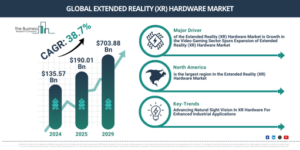
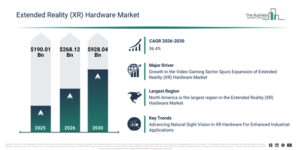
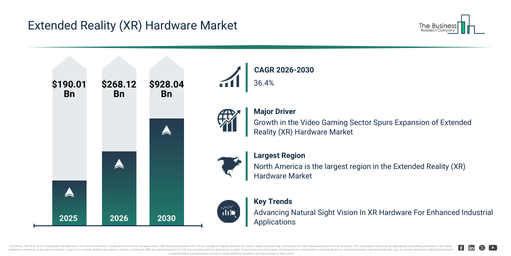
The extended reality (XR) hardware market size has experienced rapid growth in recent years. It is projected to expand from $190.01 billion in 2025 to $268.12 billion in 2026, showing a compound annual growth rate (CAGR) of 41.1%. Historically, this growth can be ascribed to elements such as the early adoption of VR gaming devices, continuous advancements in display and optics technology, the proliferation of digital content platforms, increased investment in immersive technologies, and a rising consumer demand for interactive user experiences.
The extended reality (xr) hardware market is projected for significant expansion in the coming years, forecast to reach $928.04 billion by 2030, exhibiting a compound annual growth rate (CAGR) of 36.4%. Key drivers for this growth include the expansion of metaverse applications, increasing enterprise demand for immersive training, innovations in spatial computing, the growing acceptance of mixed reality solutions, and increased investment in xr hardware development. Significant trends observed during this period involve the increasing uptake of xr headsets for consumer entertainment, the expanded application of xr hardware in corporate training, a rising preference for lightweight and ergonomic xr devices, the wider deployment of xr hardware in remote collaboration, and the growing incorporation of sophisticated sensors into xr devices.
Access A Free Sample Of The Latest Extended Reality (XR) Hardware Market Analysis:
Why Is The Extended Reality (XR) Hardware Market Growing? The Key Demand Driver Explained
The extended reality (XR) hardware market is anticipated to experience growth, propelled by the expanding video gaming sector. This industry encompasses the development, marketing, and monetization of video games. The internet has significantly transformed the gaming landscape, facilitating online multiplayer experiences, game streaming, and digital distribution platforms, which have redefined business models and enhanced player engagement. XR hardware elevates the video gaming sector by offering immersive and interactive experiences, enabling realistic graphics and innovative game mechanics, and fostering social interaction and physical activity. For instance, data from February 2024, sourced from the US-based Entertainment Software Association and Circana, a US-based media company, indicated that US total video game sales reached $57.2 billion in 2023, an increase from $56.6 billion in 2022. Additionally, spending on video game content climbed to $48.0 billion from $47.5 billion, driven by a 13% rise in digital download spending on console platforms and an 11% increase in digital premium downloads across PC, cloud, and non-console VR platforms. Consequently, the expansion of the video gaming sector is a primary force behind the growth of the extended reality (XR) hardware market.
What Are The Main Segments Of The Extended Reality (XR) Hardware Market?
The extended reality (xr) hardware market covered in this report is segmented –
1) By Solution: Consumer Engagement, Business Engagement
2) By Application: Virtual Reality (VR), Augmented Reality (AR), Mixed Reality (MR)
3) By End-User: Education, Retail, Industrial And Manufacturing, Healthcare, Media And Entertainment, Other End-Users
Subsegments:
1) By Consumer Engagement: Gaming And Entertainment, Virtual Tours, Social Media Experiences, Retail And E-commerce, Education And E-learning
2) By Business Engagement: Employee Training And Development, Remote Collaboration, Product Design And Prototyping, Sales And Marketing, Customer Support And Service
Extended Reality (XR) Hardware Market Trend Analysis: Where Leading Companies Are Focusing
Leading companies within the XR hardware market are developing innovative products utilizing advanced technologies, such as natural sight vision, to enhance user experiences in virtual and augmented environments. Natural sight vision technologies prioritize delivering superior resolution and clarity, thereby strengthening the realism and immersion of the XR experience. For instance, in November 2023, Varjo, a Finland-based manufacturer of virtual reality, augmented reality, and mixed reality headsets, unveiled its XR-4 series, which includes the XR-4, XR-4 Focal Edition, and XR-4 Secure Edition. This series incorporates features like high-resolution displays, foveated capture, advanced LiDAR depth sensing, and gaze-directed autofocus cameras. The XR-4 series is designed to provide mixed reality experiences that are virtually indistinguishable from natural sight, primarily targeting industrial applications.
Which Companies Are Major Players In The Extended Reality (XR) Hardware Market?
Major companies operating in the extended reality (xr) hardware market are Apple Inc., Google LLC, Samsung Electronics Co. Ltd., Microsoft Corporation, Dell Technologies Inc., Sony Group Corporation, Lenovo Group Limited, Intel Corporation, Qualcomm Incorporated, ASUSTeK Computer Inc., Epson America Inc., Acer Inc., SoftServe Inc., Unity Software Inc., Dynabook Inc., Tata Elxsi, Magic Leap Inc., High Tech Computer Corporation (HTC), Varjo Technologies Oy, SphereGen Technologies LLC, Vuzix Corporation, Xreal Inc
Get The Complete Extended Reality (XR) Hardware Market Analysis Here:
Which Region Held The Largest Share Of The Extended Reality (XR) Hardware Market In 2025?
North America was the largest region in the extended reality (XR) hardware market in 2025. Asia-Pacific is expected to be the fastest-growing region in the forecast period. The regions covered in the extended reality (xr) hardware market report are Asia-Pacific, South East Asia, Western Europe, Eastern Europe, North America, South America, Middle East, Africa.
Reach Out To Our Team:
The Business Research Company: https://www.thebusinessresearchcompany.com/
Americas: +1 310-496-7795
Asia: +44 7882 955267 & +91 8897263534
Europe: +44 7882 955267
Email us at: marketing@tbrc.info
Follow us on:
LinkedIn: https://in.linkedin.com/company/the-business-research-company
YouTube: https://www.youtube.com/channel/UC24_fI0rV8cR5DxlCpgmyFQ
Global Market Model: https://www.thebusinessresearchcompany.com/global-market-model

Wasay has over a decade of experience in market research, data modelling, and analytics, with prior experience at GlobalData and Decision Tree Consulting Services. At The Business Research Company , he leads research operations across syndicated studies, customized consulting engagements, and the Global Market Model platform. His professional experience includes supporting organizations such as Boston Consulting Group, KPMG, and Ernst & Young. Wasay holds a degree in Electronics and Communications Engineering, postgraduate management qualifications from International Management Institute Belgium and Indian School of Business and Entrepreneurship, and completed the Integrated Program in Business Analytics from Indian Institute of Management Indore.