Designed to make market research more actionable and strategically valuable, The Business Research Company’s 2026 market reports feature market attractiveness scoring, total addressable market sizing, company benchmarking matrices, interactive Excel dashboards, deeper supply chain intelligence, emerging startup tracking, and granular product-level insights.
What Is The Projected CAGR Of The Factory Automation Sensor Market Through 2030?
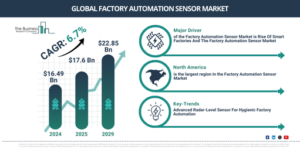
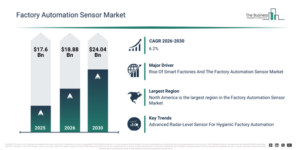
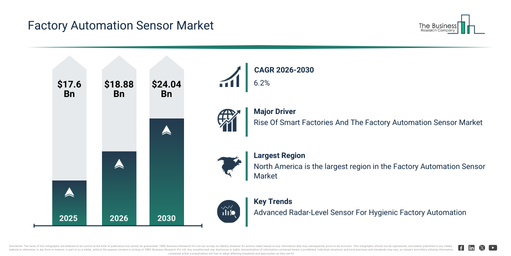
The factory automation sensor market has demonstrated robust growth in recent years. It is projected to increase from $17.6 billion in 2025 to $18.88 billion in 2026, with a compound annual growth rate (CAGR) of 7.2%. The historical expansion of this market is attributable to the early adoption of industrial automation, a rising demand for process optimization, the increasing application of sensors in manufacturing lines, a heightened emphasis on workplace safety monitoring, and the growing integration of robotics in factories.
The factory automation sensor market size is anticipated to experience robust expansion over the coming years. This sector is projected to reach $24.04 billion by 2030, demonstrating a compound annual growth rate (CAGR) of 6.2%. The expansion during the forecast period is primarily driven by the increasing demand for smart factories, a growing shift towards real-time data-driven operations, the rising integration of AI-enabled sensors, the broader deployment of remote monitoring systems, and an enhanced focus on energy-efficient automation. Significant trends expected during this period include the escalating deployment of smart sensing technologies, a growing demand for predictive maintenance solutions, the increasing adoption of high-precision sensors, the expansion of automated quality inspection systems, and the rising integration of multi-sensor platforms.
Claim Your Free Factory Automation Sensor Market Sample Report With Key Data And Trends:
Factory Automation Sensor Market Demand Analysis: The Driving Force Behind Expansion
The increasing need for smart factories is expected to drive the expansion of the factory automation sensor market. Smart factories are defined as manufacturing facilities that integrate cutting-edge technologies like the Internet of Things (IoT), artificial intelligence (AI), and automation to optimize their production processes. The demand for these facilities originates from the pursuit of enhanced efficiency, flexibility, and competitiveness within manufacturing, driven by the potential to refine operations, decrease costs, and improve product quality through the integration of advanced technologies such as automation, data analytics, and connectivity. Within smart factories, automation sensors are utilized to gather real-time data concerning machinery performance, production workflows, and environmental parameters, thereby enabling proactive monitoring, predictive maintenance, and the optimization of manufacturing operations for increased efficiency, productivity, and stringent quality control. For example, a survey conducted in June 2025 by Rockwell Automation, Inc., a US-based industrial automation company, indicated that 95% of manufacturers have either committed capital to or plan to invest in artificial intelligence and machine learning (AI/ML) over the next five years to navigate market uncertainties and expedite smart manufacturing efforts. Additionally, 81% of manufacturers reported that both external and internal pressures are accelerating their digital transformation journeys, and 49% intend to deploy AI for cybersecurity in 2025, marking an increase from 40% in 2024. Therefore, the rising demand for smart factories is a significant catalyst for the growth of the factory automation sensor market.
Breaking Down The Factory Automation Sensor Market By Segment
The factory automation sensor market covered in this report is segmented –
1) By Sensors Type: Temperature Sensors, Vibration Sensors, Humidity Sensors, Proximity Sensors, Pressure Sensors, Vision Sensors, Other Sensor Types
2) By Type: Contact, Noncontact
3) By Application: Manufacturing, Automotive, Chemicals, Energy And Power, Food And Beverages, Oil And Gas, Aerospace And Defense, Pharmaceuticals, Other Applications
Subsegments:
1) By Temperature Sensors: RTD Sensors (Resistance Temperature Detectors), Thermocouples, Infrared Temperature Sensors
2) By Vibration Sensors: Accelerometers, Displacement Sensors, Velocity Sensors
3) By Humidity Sensors: Capacitive Humidity Sensors, Resistive Humidity Sensors, Thermal Conductivity Sensors
4) By Proximity Sensors: Inductive Proximity Sensors, Capacitive Proximity Sensors, Ultrasonic Proximity Sensors
5) By Pressure Sensors: Piezoelectric Pressure Sensors, Strain Gauge Pressure Sensors, Capacitive Pressure Sensors
6) By Vision Sensors: Machine Vision Sensors, Optical Sensors, Image Processing Sensors
7) By Other Sensor Types: Flow Sensors, Gas Sensors, Level Sensors
Top Trend Influencing The Factory Automation Sensor Market Outlook
Leading companies in the factory automation sensor market are concentrating on advancing sensor technologies, specifically radar-level sensor technology, which is engineered for highly automated operations requiring strict hygiene. Radar-level sensors are adaptable and dependable, offering high precision, consistent performance, and minimal upkeep due to their lack of moving components. They are well-suited for diverse industrial and commercial level measurement uses. For instance, in March 2023, VEGA Grieshaber KG, a manufacturing firm from Germany, introduced a novel radar-level sensor technology, VEGAPULS 42. This sensor is intended for non-contact level measurement within factory automation, particularly in food and pharmaceutical sectors. Featuring IO-Link and various hygienic adapters, the sensor fulfills essential factory automation criteria, such as executing intricate measurement tasks more rapidly, ensuring ease of operation, and being more economical.
Factory Automation Sensor Market Competitive Landscape And Major Players
Major companies operating in the factory automation sensor market are Robert Bosch GmbH, Siemens AG, Sony Corporation, Panasonic Corporation, Schneider Electric SE, Honeywell International Inc., ABB Ltd., STMicroelectronics N.V., Infineon Technologies AG, TDK Electronics Co. Ltd., Murata Manufacturing Co. Ltd., TE Connectivity Ltd., Amphenol Corporation, Analog Devices Inc., Seiko Epson Corporation, Alps Electric Co. Ltd., Rockwell Automation Inc., Microchip Technology Inc., Omron Corporation, FANUC Corporation, Texas Instruments Incorporated, Vishay Intertechnology Inc., Stäubli International AG, Pepperl+Fuchs SE, Sensirion AG
Read The Full Factory Automation Sensor Market Report By The Business Research Company:
Where Is The Factory Automation Sensor Market Largest? Key Regional Insights
North America was the largest region in the factory automation sensor market in 2025. Asia-Pacific is expected to be the fastest-growing region in the forecast period. The regions covered in the factory automation sensor market report are Asia-Pacific, South East Asia, Western Europe, Eastern Europe, North America, South America, Middle East, Africa.
Reach Out To Our Team:
The Business Research Company: https://www.thebusinessresearchcompany.com/
Americas: +1 310-496-7795
Asia: +44 7882 955267 & +91 8897263534
Europe: +44 7882 955267
Email us at: marketing@tbrc.info
Follow us on:
LinkedIn: https://in.linkedin.com/company/the-business-research-company
YouTube: https://www.youtube.com/channel/UC24_fI0rV8cR5DxlCpgmyFQ
Global Market Model: https://www.thebusinessresearchcompany.com/global-market-model

Wasay has over a decade of experience in market research, data modelling, and analytics, with prior experience at GlobalData and Decision Tree Consulting Services. At The Business Research Company , he leads research operations across syndicated studies, customized consulting engagements, and the Global Market Model platform. His professional experience includes supporting organizations such as Boston Consulting Group, KPMG, and Ernst & Young. Wasay holds a degree in Electronics and Communications Engineering, postgraduate management qualifications from International Management Institute Belgium and Indian School of Business and Entrepreneurship, and completed the Integrated Program in Business Analytics from Indian Institute of Management Indore.