With a focus on actionable insights and strategic value, The Business Research Company’s 2026 market reports include market attractiveness scoring, total addressable market sizing, company benchmarking matrices, interactive Excel dashboards, deeper supply chain intelligence, emerging startup tracking, and granular product-level insights.
How Much Will The Fault Current Limiter Market Be Worth By 2030?
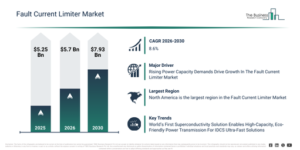
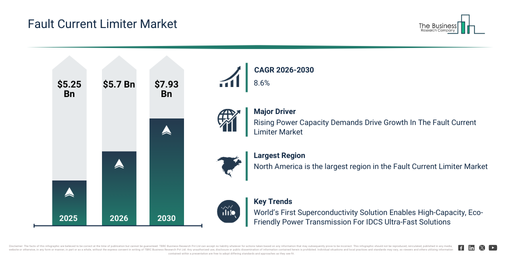
The fault current limiter market size has experienced robust expansion in recent years. It is projected to increase from $5.25 billion in 2025 to $5.7 billion in 2026, demonstrating a compound annual growth rate (CAGR) of 8.6%. Historically, this growth was primarily driven by increasing industrialization, rising electricity demand, frequent power outages, aging electrical infrastructure, and the early adoption of power protection devices.
The fault current limiter market is set to experience significant expansion over the next few years. It is projected to achieve a market size of $7.93 billion by 2030, advancing at a compound annual growth rate (CAGR) of 8.6%. This anticipated growth during the forecast period is driven by the expansion of smart grids, increasing integration of renewable energy, the rising demand for power system reliability, continuous advancements in FCL technology, and stricter electrical safety regulations. Noteworthy trends for this period include rapid fault current detection, enhanced grid safety measures, the development of compact and modular FCL designs, improved integration with renewable energy systems, and the availability of highly reliable and low-maintenance FCLs.
Get Access To A Free Fault Current Limiter Market Report Sample:
The Key Driver Behind The Fault Current Limiter Market’s 8.6% CAGR
The anticipated growth of the fault current limiter market is fueled by an increasing requirement for advanced and sophisticated power grid infrastructure. Power grid infrastructure encompasses the intricate system of power generation, transmission, and distribution networks, designed to deliver electricity from its source to end-users reliably and efficiently. This rising demand for advanced grid infrastructure stems from various factors, including escalating energy consumption, the incorporation of renewable and distributed energy sources, the imperative for greater grid reliability and resilience, and the need to upgrade outdated infrastructure to accommodate technological progress and ensure effective energy distribution. Within power grid infrastructure, fault current limiters play a crucial role in safeguarding equipment by mitigating excessive fault currents, thereby maintaining system stability and averting disruptions. As an illustration, a report released in April 2024 by the Lawrence Berkeley National Laboratory, a US Department of Energy (DOE) lab, indicated that the total cumulative active capacity in power project queues reached nearly 2,600 GW (2.6 TW) in 2023, a significant increase from 2.05 TW in 2022 and 1.46 TW in 2021. This also included active nuclear capacity seeking grid connection, which expanded to 10 GW from approximately 6.5 GW, while hydropower capacity remained stable at around 5.7 GW. Consequently, the escalating requirement for enhanced and sophisticated power grid infrastructure is propelling the fault current limiter market.
Fault Current Limiter Market Classification: Main Segments And Detailed Subsegments
The fault current limiter market covered in this report is segmented –
1) By Type: Superconducting Fault Current Limiter (SFCL), Non-Superconducting Fault Current Limiter (NSFCL)
2) By Power Rating: Low (Less Than 1 kV), Medium (1-40 kV), High (More Than 40 kV)
3) By End Use: Power Stations, Automotive, Oil And Gas, Steel And Aluminum, Paper Mills, Other End Uses
Subsegments:
1) By Superconducting Fault Current Limiter (SFCL): Resistive SFCL, Inductive SFCL, Hybrid SFCL, Cryogenic SFCL
2) By Non-Superconducting Fault Current Limiter (NSFCL): Fuse-Based NSFCL, Circuit Breaker-Based NSFCL, Thyristor-Based NSFCL, Active Series Compensator-Based NSFCL
Fault Current Limiter Market Strategic Shifts: What Leading Players Are Prioritizing
Leading companies in the fault current limiter market are forging strategic partnerships to enable high-capacity power transmission, equivalent to 154 kV, at a low voltage of 22.9 kV. This approach facilitates an expanded electricity supply to inner-city areas without necessitating the construction of new substations. For instance, in July 2024, LS Cable & System, a South Korea-based manufacturer, partnered with LS Electric to introduce the world’s first superconductivity solution for Internet Data Centers (IDCs). This system utilizes superconducting cables that transmit electricity with nearly zero loss and no electromagnetic interference, effectively addressing urban NIMBY concerns and lowering environmental impact. The superconducting fault current limiter promptly controls fault currents, thereby protecting power infrastructure and ensuring IDC service stability. By eliminating transformers, the solution reduces substation size to one-tenth or less of conventional designs, significantly cutting construction costs and improving economic efficiency. Designed for dense urban areas and AI-era data centers, this compact, eco-friendly superconductivity infrastructure enhances power stability, scalability, and public acceptance domestically and internationally.
Fault Current Limiter Market Company Analysis: Major Industry Participants
Major companies operating in the fault current limiter market are Siemens AG, Mitsubishi Electric Corporation, ABB Ltd., Applied Materials Inc., Toshiba Corporation, Eaton Corporation PLC, Nexans, LeGrand SA, Furukawa Electric Co., Hubbell Incorporated, GE Grid Solutions LLC, LS Electric Co Ltd, S&C Electric Company, NR Electric Co. Ltd., Wilson Transformer Company, G&W Electric Co., American Superconductor Corporation (AMSC), Zenergy Power Electric Co., Rongxin Power Electronic Co. Ltd., Stirling Cryogenics, Theva Dünnschichttechnik GmbH, SuperPower Inc., Gridon Ltd.
Get Full Access To The Fault Current Limiter Market Report 2026:
Fault Current Limiter Market Global Regional Breakdown: Key Regions Analyzed
North America was the largest region in the fault current limiter market in 2025. Asia-Pacific is expected to be the fastest-growing region in the forecast period. The regions covered in the fault current limiter market report are Asia-Pacific, South East Asia, Western Europe, Eastern Europe, North America, South America, Middle East, Africa.
Reach Out To Our Team:
The Business Research Company: https://www.thebusinessresearchcompany.com/
Americas: +1 310-496-7795
Asia: +44 7882 955267 & +91 8897263534
Europe: +44 7882 955267
Email us at: marketing@tbrc.info
Follow us on:
LinkedIn: https://in.linkedin.com/company/the-business-research-company
YouTube: https://www.youtube.com/channel/UC24_fI0rV8cR5DxlCpgmyFQ
Global Market Model: https://www.thebusinessresearchcompany.com/global-market-model

Wasay has over a decade of experience in market research, data modelling, and analytics, with prior experience at GlobalData and Decision Tree Consulting Services. At The Business Research Company , he leads research operations across syndicated studies, customized consulting engagements, and the Global Market Model platform. His professional experience includes supporting organizations such as Boston Consulting Group, KPMG, and Ernst & Young. Wasay holds a degree in Electronics and Communications Engineering, postgraduate management qualifications from International Management Institute Belgium and Indian School of Business and Entrepreneurship, and completed the Integrated Program in Business Analytics from Indian Institute of Management Indore.