Featuring market attractiveness scoring, total addressable market sizing, company benchmarking matrices, interactive Excel dashboards, deeper supply chain intelligence, emerging startup tracking, and granular product-level insights, The Business Research Company’s 2026 market reports are built to deliver research that is both more actionable and more strategically valuable.
Flat Panel Antenna Chipset Market Size, Value And Growth Trajectory Through 2030
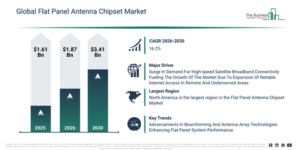
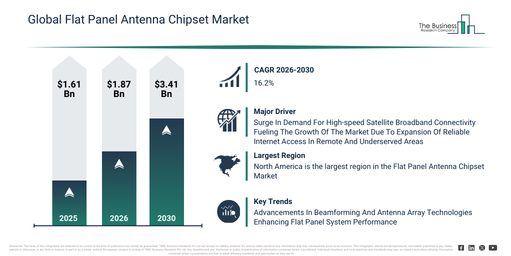
The flat panel antenna chipset market has experienced rapid expansion in recent years. This market is expected to expand from $1.61 billion in 2025 to $1.87 billion in 2026, achieving a compound annual growth rate (CAGR) of 16.0%. Historically, this growth has been driven by factors such as the increasing demand for high-speed wireless communication, the growth of satellite and telecommunication networks, the early adoption of phased array and planar antennas, the rising need for compact antenna solutions in constrained platforms, and the expansion of military and defense communication infrastructure.
The flat panel antenna chipset market is projected to experience significant expansion over the coming years. Its valuation is anticipated to reach $3.41 billion by 2030, demonstrating a compound annual growth rate (CAGR) of 16.2%. This projected increase during the forecast period stems from factors such as the rollout of 5G and next-generation networks, the integration of AI-powered signal processing, the expansion of L-band to Ka-band satellite communications, a rising need for integrated semiconductor chipsets, and the growing utility of flat panel antennas in both commercial and military sectors. Key developments expected within this period involve enhanced beamforming capabilities, advanced high-frequency signal processing, the incorporation of miniaturized antennas, support for multi-band communications, and the provision of low-profile antenna solutions.
Get A Free Sample Report With In-Depth Market Insights:
Flat Panel Antenna Chipset Market Expansion Drivers: What’s Shaping Future Growth?
The growing requirement for high-speed satellite broadband connectivity is projected to drive the expansion of the flat panel antenna chipset market in the upcoming period. High-speed satellite broadband connectivity represents internet access delivered through satellites, providing quick and dependable data transmission to users irrespective of their location, including remote and underserved areas. The demand for high-speed satellite broadband connectivity is escalating as it delivers reliable internet access in distant and underdeveloped regions where terrestrial networks are either limited or unavailable. Flat panel antenna chipsets play a role in fulfilling the increasing need for high-speed satellite broadband connectivity by facilitating small, electronically adjustable antennas to enable reliable and fast satellite communication. For instance, in June 2023, NBN, an Australia-based broadband network company, rolled out its Sky Muster Plus Premium satellite plan, which offers uncapped data to approximately 400,000 households and supports burst download speeds of up to 100 Mbps, following a successful trial involving 10,700 users. Therefore, the rising demand for high-speed satellite broadband connectivity is stimulating the growth of the flat panel antenna chipset market.
Flat Panel Antenna Chipset Market Segment Analysis And Revenue Potential
The flat panel antenna chipset market covered in this report is segmented –
1) By Component: Transceivers, Phase Shifters, Beamformers, Power Amplifiers, Other Components
2) By Technology: Microstrip Antenna, Planar Antenna, Phased Array Antenna, Reflector Antenna
3) By Frequency Band: L-Band, S-Band, C-Band, Ku-Band, Ka-Band
4) By Application: Telecommunications, Satellite Communication, Broadcasting, Internet Of Things, Military Applications
5) By End-User: Commercial, Government, Defense, Other End-Users
Subsegments:
1) By Transceivers: Frequency Band, Integration Level, Duplexing Method, Modulation And Coding Support, Application Type, Power Class
2) By Phase Shifters: Analog Phase Shifters, Digital Phase Shifters, True-Time-Delay Units, Phase Resolution (Bit Depth), Integration Type, Control Interface
3) By Beamformers: Analog Beamformers, Digital Beamformers, Hybrid Beamformers, Channel Or Element Count, Architecture Type, Adaptive Beamforming Capability
4) By Power Amplifiers: Semiconductor Technology, Class Of Operation, Output Power Range, Bandwidth Type, Linearity Enhancement Support, Thermal Or Packaging Type
5) By Others Components: Low-Noise Amplifiers (LNAs), Radio Frequency (RF) Switches And Multiplexers, Filters And Duplexers, Antenna Control And Calibration Integrated Circuits (ICs), Power Management Integrated Circuits (ICs), Thermal Management Components
Flat Panel Antenna Chipset Market Strategic Trends: What Defines The Next Growth Phase?
Leading companies in the flat panel antenna chipset market are concentrating on developing highly integrated antenna array solutions. Their objective is to enhance beam steering efficiency, decrease system complexity, and support multi-band satellite and 5G communications. Antenna arrays describe configurations where multiple antenna elements collaborate to electronically steer and shape radio beams, thereby improving signal directionality and performance without mechanical movement. For instance, in March 2025, Sivers Semiconductors AB, a semiconductor firm from Sweden, introduced new SATCOM and 5G antenna array chipsets at Mobile World Congress (MWC) 2025. This leverages its proprietary RFIC and beamforming technologies, specifically designed for flat panel antennas that operate across Ku-, Ka-, and mmWave frequency bands. These solutions facilitate rapid electronic beam switching, improved link stability, and compact form factors, making them ideal for satellite broadband terminals, mobility and fixed wireless access (FWA) platforms, and future 5G infrastructure.
Flat Panel Antenna Chipset Market Competitive Overview And Top Companies
Major companies operating in the flat panel antenna chipset market are Samsung Electronics Co. Ltd., Qualcomm Incorporated, Texas Instruments Incorporated, NXP Semiconductors N.V., Analog Devices Inc, Renesas Electronics Corporation, Qorvo Inc, Viasat Inc, MACOM Technology Solutions Holdings Inc, Laird Connectivity Inc, Anokiwave Inc, Pivotal Commware Inc, Kymeta Corporation, EnSilica Ltd, Intellian Technologies Inc, Sivers Semiconductors AB, RFCore Inc, C-COM Satellite Systems Inc, Pharrowtech SA, ALCAN Systems GmbH, and ThinKom Solutions Inc.
View The Full Flat Panel Antenna Chipset Market Report:
Flat Panel Antenna Chipset Market Top Region: Where Does Most Revenue Come From?
North America was the largest region in the flat panel antenna chipset market in 2025. Asia-Pacific is expected to be the fastest-growing region in the forecast period. The regions covered in the flat panel antenna chipset market report are Asia-Pacific, South East Asia, Western Europe, Eastern Europe, North America, South America, Middle East, Africa.
Reach Out To Our Team:
The Business Research Company: https://www.thebusinessresearchcompany.com/
Americas: +1 310-496-7795
Asia: +44 7882 955267 & +91 8897263534
Europe: +44 7882 955267
Email us at: marketing@tbrc.info
Follow us on:
LinkedIn: https://in.linkedin.com/company/the-business-research-company
YouTube: https://www.youtube.com/channel/UC24_fI0rV8cR5DxlCpgmyFQ
Global Market Model: https://www.thebusinessresearchcompany.com/global-market-model

Wasay has over a decade of experience in market research, data modelling, and analytics, with prior experience at GlobalData and Decision Tree Consulting Services. At The Business Research Company , he leads research operations across syndicated studies, customized consulting engagements, and the Global Market Model platform. His professional experience includes supporting organizations such as Boston Consulting Group, KPMG, and Ernst & Young. Wasay holds a degree in Electronics and Communications Engineering, postgraduate management qualifications from International Management Institute Belgium and Indian School of Business and Entrepreneurship, and completed the Integrated Program in Business Analytics from Indian Institute of Management Indore.