Built to provide research that’s more actionable and strategically valuable, The Business Research Company’s 2026 market reports include market attractiveness analysis, total addressable market sizing, company benchmarking matrices, interactive Excel dashboards, broader supply chain intelligence, emerging startup tracking, and in-depth product insights.
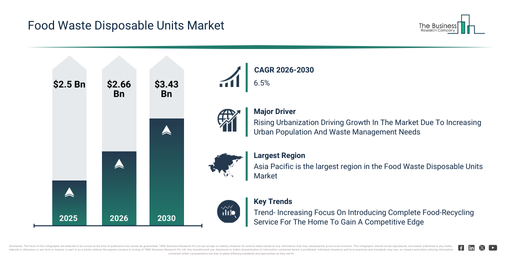
Food Waste Disposable Units Market Growth From $2.66 Billion In 2026 To $3.43 Billion By 2030 At A CAGR Of 6.5%
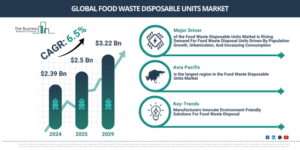
The market for food waste disposable units has experienced substantial growth recently. Projections indicate it will expand from $2.5 billion in 2025 to $2.66 billion by 2026, demonstrating a compound annual growth rate (CAGR) of 6.6%. Historically, this expansion can be linked to factors such as increasing urbanization, a heightened awareness of kitchen hygiene, the embrace of modern kitchen designs, governmental waste management regulations, and an increase in residential construction activities.
The food waste disposable units market is anticipated to experience substantial expansion over the upcoming years. This market is projected to reach $3.43 billion by 2030, exhibiting a compound annual growth rate (CAGR) of 6.5%. Key factors driving this growth during the forecast period include advances in sensor technology, the incorporation of smart home systems, the rising demand for energy-efficient appliances, the expansion of commercial kitchens, and a heightened emphasis on sustainable waste management. Notable trends expected in this period encompass smart kitchen integration, the adoption of energy-efficient disposal systems, improved odor and hygiene management, the development of compact and space-saving designs, and IOT-enabled monitoring capabilities.
Get A Free Sample Report With In-Depth Market Insights:
Food Waste Disposable Units Market Demand Drivers Opening New Revenue Streams
The expansion of cities and migration from rural to urban areas, known as urbanization, is anticipated to fuel the growth of the Food Waste Disposal Units Market. This increase in urbanization necessitates more housing and infrastructure to accommodate larger urban populations. Food waste disposal units play a crucial role in supporting this trend by enabling households to efficiently manage growing amounts of organic waste, thereby easing the burden on municipal waste systems and fostering cleaner, more sustainable urban environments. The United Nations, a US-based intergovernmental organization, noted that 55% of the world’s population currently resides in urban areas, a figure expected to rise to 68% by 2050. Consequently, the increasing rate of urbanization is a key driver for the Food Waste Disposal Units Market.
Food Waste Disposable Units Market Driver: The Growing Restaurant Count Boosts The Food Waste Disposal Units Market
Food Waste Disposable Units Market Segment Analysis: What Are The Core Market Categories?
The food waste disposable units market covered in this report is segmented –
1) By Type: Shattered Type Disposers, Dry Type Disposers, Grinding Type Disposers
2) By Application: Commercial, Residential
3) By End-User Installation: Household Kitchens, Restaurants And Hotels, Institutional, Food Processing And Catering Facilities
Subsegments:
1) By Shattered Type Disposers: Single-Stage Shattered Disposers, Multi-Stage Shattered Disposers
2) By Dry Type Disposers: Manual Dry Type Disposers, Automatic Dry Type Disposers
3) By Grinding Type Disposers: Batch Feed Grinding Disposers, Continuous Feed Grinding Disposers
Food Waste Disposable Units Market Trends Powering Strategic Industry Growth
Major companies operating within the food waste disposable units market are concentrating on establishing comprehensive food-recycling services for residential use to secure a competitive advantage. These complete home food recycling services present an environmentally sound approach to diminish waste and foster sustainability. For instance, in January 2023, Mill Industries Inc., a US-based waste management company, unveiled its Mill Kitchen Bin. This innovative bin is engineered to efficiently manage a wide array of food waste materials, including plate scrapings, fruits, vegetables, dairy products, eggs, and even meats like chicken. Users have the flexibility to continually add food scraps to the bin until it is full, at which point the company collects these food grounds for subsequent processing.
Food Waste Disposable Units Market Top Companies Driving Competitive Growth
Major companies operating in the food waste disposable units market are Emerson Electric, Waste King (Anaheim Manufacturing Co.), Franke Holding AG, BLANCO America Inc., TEKA Group, Whirlpool, Moen Incorporated, Miele & Cie. KG, Electrolux AB, GE Appliances, Hobart Corporation (ITW), Salvajor Company, BinCrusher, Joneca Corporation, ShenZhen Honica Technology Co., Ltd., Flanders Electric, Becbas, Hindware Appliances, Carysil, Xiaomi (Mijia), Disperator AB, Seiko Commercial, Sharp Crusher, Unistone Electric Company, Joraform AB
View The Full Food Waste Disposable Units Market Report:
Food Waste Disposable Units Market Geographic Spread And Regional Opportunities
Asia Pacific was the largest region in the food waste disposable units market in 2025. The regions covered in the food waste disposable units market report are Asia-Pacific, South East Asia, Western Europe, Eastern Europe, North America, South America, Middle East, Africa.
Reach Out To Our Team:
The Business Research Company: https://www.thebusinessresearchcompany.com/
Americas: +1 310-496-7795
Asia: +44 7882 955267 & +91 8897263534
Europe: +44 7882 955267
Email us at: marketing@tbrc.info
Follow us on:
LinkedIn: https://in.linkedin.com/company/the-business-research-company
YouTube: https://www.youtube.com/channel/UC24_fI0rV8cR5DxlCpgmyFQ
Global Market Model: https://www.thebusinessresearchcompany.com/global-market-model

Wasay has over a decade of experience in market research, data modelling, and analytics, with prior experience at GlobalData and Decision Tree Consulting Services. At The Business Research Company , he leads research operations across syndicated studies, customized consulting engagements, and the Global Market Model platform. His professional experience includes supporting organizations such as Boston Consulting Group, KPMG, and Ernst & Young. Wasay holds a degree in Electronics and Communications Engineering, postgraduate management qualifications from International Management Institute Belgium and Indian School of Business and Entrepreneurship, and completed the Integrated Program in Business Analytics from Indian Institute of Management Indore.