Delivering more actionable and strategically valuable research, The Business Research Company’s 2026 market reports feature market attractiveness analysis, total addressable market evaluation, company benchmarking matrices, interactive Excel dashboards, expanded supply chain intelligence, emerging startup coverage, and detailed product insights.
Free Space Photonics Equipment Market Forecast Highlighting Growth From $1.43 Billion To $2.33 Billion
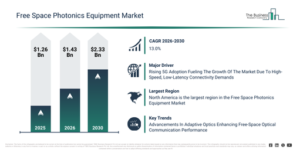
The free space photonics equipment market has seen significant expansion in recent years. This market is forecast to increase from $1.26 billion in 2025 to $1.43 billion in 2026, driven by a compound annual growth rate (CAGR) of 13.3%. The historical expansion of this market is attributable to several factors, including the rising demand for high-speed data transmission, the challenges of deploying physical fiber in urban settings, increasing communication requirements within the defense and aerospace industries, initial implementation in secure enterprise networks, and ongoing improvements in laser and photonic component manufacturing.
The free space photonics equipment market is projected to experience substantial expansion in the coming years, with its valuation anticipated to reach $2.33 billion by 2030, driven by a compound annual growth rate (CAGR) of 13.0%. This projected growth can be ascribed to several factors, including the expanding requirements for 5G and future backhaul, increased investments in space-based communication systems, the need for highly secure optical communication links, the development of smart cities and interconnected infrastructure, and ongoing advancements in atmospheric compensation technologies. Key trends anticipated during this period encompass the integration of free-space optical links for last-mile connections, a rise in hybrid free-space and fiber communication setups, progress in adaptive optics to lessen atmospheric interference, the miniaturization of free-space photonics components, and the wider implementation of high-capacity point-to-point optical wireless links.
Download A Free Sample Report For Comprehensive Market Insights:
#Free Space Photonics Equipment Market Growth Drivers And Industry Catalysts
The expanding integration of 5G networks is anticipated to stimulate the growth of the free space photonics equipment market moving forward. These 5G networks represent the latest generation of wireless technology, engineered to offer faster data speeds, minimal communication latency, and the ability to connect numerous devices simultaneously. The proliferation of 5G networks stems from the escalating demand for high-speed and low-latency connectivity, which is crucial for the efficient operation of advanced technologies such as autonomous vehicles, smart cities, and real-time remote healthcare. The need for ultra-fast, high-capacity data transmission and dense small-cell connections within 5G networks drives the demand for free space photonics equipment, as they require efficient, high-bandwidth optical wireless links for backhaul. For example, in March 2024, 5G Americas, a US-based industry trade association dedicated to promoting 5G and future technologies in the Americas, stated that North America achieved 197 million 5G connections by the end of 2023. This accounted for 29% of all wireless connections in the region and represented a 64% year-over-year increase from 2022. Consequently, the increasing adoption of 5G networks is fueling the expansion of the free space photonics equipment market.
Free Space Photonics Equipment Market Segment Breakdown: Which Categories Generate The Most Revenue?
The free space photonics equipment market covered in this report is segmented –
1) By Type of Equipment: Transmitters, Receivers, Optical Amplifiers, Modulators, Filters, Switches
2) By Technology: Free-Space Laser Communication, Fiber Optic Solutions, Optical Wireless Technology, Advanced Modulation Techniques, Quantum Key Distribution Technologies
3) By Application: Corporate Networks, Education, Energy, Utilities, Industrial, Other Applications
4) By End-User: Telecommunications Operators, Aerospace And Defense Contractors, Healthcare Providers, Automotive Manufacturers, Other End Users
Subsegments:
1) By Transmitters: Laser Diode Transmitters, Light Emitting Diode Transmitters, Vertical Cavity Surface Emitting Laser Transmitters, Quantum Cascade Laser Transmitters
2) By Receivers: Photodiode Receivers, Avalanche Photodiode Receivers, PIN Photodiode Receivers, Coherent Detection Receivers
3) By Optical Amplifiers: Erbium Doped Fiber Optical Amplifiers, Semiconductor Optical Amplifiers, Raman Optical Amplifiers, Fiber Bragg Grating Optical Amplifiers
4) By Modulators: Electro Absorption Modulators, Lithium Niobate Modulators, Electro Optic Modulators, Acousto Optic Modulators
5) By Filters: Thin Film Optical Filters, Fiber Bragg Grating Optical Filters, Acousto Optic Tunable Filters, Liquid Crystal Tunable Filters
6) By Switches: Optical Cross Connect Switches, Micro Electro Mechanical System Optical Switches, Liquid Crystal Optical Switches, Thermo Optic Optical Switches
Free Space Photonics Equipment Market Innovation Trends: Which Developments Are Transforming The Industry?
Leading companies in the free space photonics equipment market are concentrating on developing advanced solutions, such as adaptive optics systems, to enhance the performance and reliability of free-space optical communication links through dynamic correction of atmospheric distortion. Adaptive optics systems are defined as technologies that utilize sensors and deformable optics to detect and correct atmospheric turbulence in real time, thereby improving beam quality, data throughput, and link stability over long distances. For instance, in April 2023, Viasat Inc., a US-based communications company, launched the Mercury Expeditionary Free Space Optical Communications (FSOC) Terminal. This Mercury terminal integrates an automated pointing, acquisition, and tracking (PAT) gimbal system, enabling rapid setup and precise beam alignment. It delivers ultra-high throughput of up to 40 Gbps across line-of-sight ranges up to 70 km while maintaining a low electromagnetic footprint. It offers strong resilience against jamming, spoofing, and atmospheric interference, ensuring connectivity in contested environments. The system is designed for expeditionary and tactical missions, providing fiber-like secure performance in ground-to-ground, ground-to-air, ship-to-ship, and ship-to-shore communications.
Free Space Photonics Equipment Market Key Players And Strategic Industry Positioning
Major companies operating in the free space photonics equipment market are Broadcom Inc., Fujitsu Limited, L3Harris Technologies Inc., Corning Incorporated, Mynaric AG, Acuity Brands Inc., Trimble Inc., Lumentum Holdings Inc., Applied Optoelectronics Inc., EC SYSTEM, pureLiFi Limited, AOptix Technologies Inc., Mostcom Inc., BridgeComm Inc., Oledcomm, Finisar Corporation, KORUZA, LightPointe Communications Inc., FSONA Networks Corporation, Wireless Excellence Limited.
Access The Complete Free Space Photonics Equipment Market Report:
Free Space Photonics Equipment Market Geographic Analysis: Where Is Demand Growing The Fastest?
North America was the largest region in the free space photonics equipment market in 2025. Asia-Pacific is expected to be the fastest-growing region in the forecast period. The regions covered in the free space photonics equipment market report are Asia-Pacific, South East Asia, Western Europe, Eastern Europe, North America, South America, Middle East, Africa.
Get in touch with us:
The Business Research Company: https://www.thebusinessresearchcompany.com/
Americas: +1 310-496-7795
Asia: +44 7882 955267 & +91 8897263534
Europe: +44 7882 955267
Email us at: marketing@tbrc.info
Follow us on:
LinkedIn: https://in.linkedin.com/company/the-business-research-company
YouTube: https://www.youtube.com/channel/UC24_fI0rV8cR5DxlCpgmyFQ
Global Market Model: https://www.thebusinessresearchcompany.com/global-market-model

Wasay has over a decade of experience in market research, data modelling, and analytics, with prior experience at GlobalData and Decision Tree Consulting Services. At The Business Research Company , he leads research operations across syndicated studies, customized consulting engagements, and the Global Market Model platform. His professional experience includes supporting organizations such as Boston Consulting Group, KPMG, and Ernst & Young. Wasay holds a degree in Electronics and Communications Engineering, postgraduate management qualifications from International Management Institute Belgium and Indian School of Business and Entrepreneurship, and completed the Integrated Program in Business Analytics from Indian Institute of Management Indore.