Designed to make market research more actionable and strategically valuable, The Business Research Company’s 2026 market reports feature market attractiveness scoring, total addressable market sizing, company benchmarking matrices, interactive Excel dashboards, deeper supply chain intelligence, emerging startup tracking, and granular product-level insights.
How Fast Is The Gesture Recognition For Desktop And Portable Personal Computers (PCs) Market Growing? Market Size, CAGR And Forecast Insights
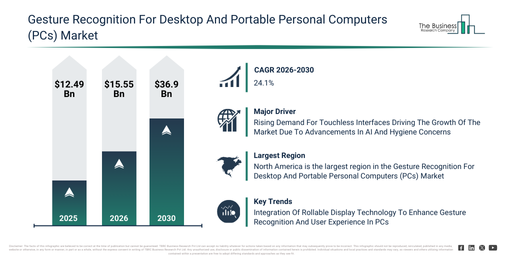
The market size for gesture recognition in desktop and portable personal computers (pcs) has expanded significantly in recent years. This market is projected to increase from $12.49 billion in 2025 to $15.55 billion in 2026, reflecting a compound annual growth rate (CAGR) of 24.5%. Historically, this expansion has been driven by the emergence of touchless technology, the rising uptake of PCs and laptops, the development of the gaming industry, the demand for accessibility aids, and progress in camera and sensor technologies.
The market for gesture recognition in desktop and portable personal computers (PCs) is projected to experience substantial expansion over the coming years. This sector is anticipated to reach a valuation of $36.9 billion by 2030, exhibiting a compound annual growth rate (CAGR) of 24.1%. This projected growth is driven by factors such as the integration with AR/VR systems, the increasing proliferation of smart home devices, its uptake in enterprise and industrial settings, the advancements in AI-driven gesture recognition, and improved software-hardware compatibility. Key developments expected during this period encompass touchless human-computer interaction, innovative gesture-based gaming interfaces, computing solutions enhanced for accessibility, advanced virtual collaboration tools, and more precise gesture recognition capabilities.
Unlock Gesture Recognition For Desktop And Portable Personal Computers (PCs) Market Insights With A Free Sample Report:
Gesture Recognition For Desktop And Portable Personal Computers (PCs) Market Momentum: Key Driver Expected To Boost Growth Through 2030
The expanding need for touchless interfaces is anticipated to fuel the expansion of the gesture recognition for desktop and portable personal computers (PCs) market moving ahead. These interfaces are defined as human-machine interaction systems that enable users to manage and interact with devices without physical touch, commonly employing methods such as gestures, voice commands, facial recognition, and eye tracking. The uptake of touchless interfaces is escalating, driven by progress in artificial intelligence (AI) and sensor technologies, heightened awareness regarding hygiene and non-contact interactions, and the desire for more intuitive and convenient user experiences. Enhanced sensors and AI-driven gesture recognition facilitate accurate hand movement tracking, thereby making touchless control more dependable and widely available across numerous devices. Specifically, gesture recognition for desktop and portable personal computers (PCs) improves touchless interfaces by providing intuitive, hands-free interaction through motion sensing and AI-driven recognition, thereby boosting user convenience, accessibility, and hygiene. As an illustration, in November 2024, data from the House of Commons Library, a UK-based research and information source, indicated that the metropolitan police deployed live facial recognition (LFR) technology 117 times from January to August 2024. Consequently, the rising need for touchless interfaces is propelling the expansion of the gesture recognition for desktop and portable personal computers (PCs) market.
Gesture Recognition For Desktop And Portable Personal Computers (PCs) Market Segments: A Category-By-Category Overview
The gesture recognition for desktop and portable personal computers (pcs) market covered in this report is segmented –
1) By Type: Two-Dimensional (2D) Gesture Recognition, Three-Dimensional (3D) Gesture Recognition
2) By Technology: Touch-Based Gesture Recognition, Touchless Gesture Recognition
3) By Application: Desktop Personal Computers (PCs), Laptops Or Notebooks, Gaming Systems, Tablets Or Convertible Personal Computers (PCs), Virtual Reality (VR) Devices, Smart Home Systems, Other Applications
4) By End-User: Residential, Commercial, Industrial
Subsegments:
1) By Two-Dimensional (2D) Gesture Recognition: Touch-Based Gesture Recognition, Capacitive Gesture Recognition, Resistive Gesture Recognition, Optical Gesture Recognition, Infrared Gesture Recognition
2) By Three-Dimensional (3D) Gesture Recognition: Vision-Based 3D Gesture Recognition, Sensor-Based 3D Gesture Recognition, Ultrasonic Gesture Recognition, Magnetic Field-Based Gesture Recognition, Multi-Sensor Fusion Gesture Recognition
Which Emerging Trends Are Gaining Traction In The Gesture Recognition For Desktop And Portable Personal Computers (PCs) Market?
Leading companies in the gesture recognition for desktop and portable personal computers (PCs) market are concentrating on creating advanced technologies, such as rollable display technology, to enhance screen adaptability, boost portability, and deliver a more engaging and flexible user experience. Rollable display technology is an advanced screen innovation that utilizes pliable organic light-emitting diode (OLED) or similar materials, enabling displays to expand, retract, or fold while preserving high resolution and sturdiness. For instance, in January 2025, Lenovo Group Limited, a China-based technology firm, introduced the Lenovo ThinkBook Plus Gen 6 rollable AI personal computer (PC). This device is designed to redefine productivity and multitasking through its distinctive rollable display technology, expanding vertically from a compact 14-inch display to a generous 16.7 inches with a simple press of a dedicated key or via hand gestures directed at the camera.
Gesture Recognition For Desktop And Portable Personal Computers (PCs) Market Key Participants: Prominent Companies At A Glance
Major companies operating in the gesture recognition for desktop and portable personal computers (pcs) market are Apple Inc., Google LLC, Microsoft Corporation, Intel Corporation, Qualcomm Technologies Inc., pmdtechnologies ag, Infineon Technologies AG, Synaptics Incorporated, OmniVision Technologies Inc., Ultraleap, Cognitec Systems GmbH, GestureTek, Sony Depthsensing Solutions, ManoMotion, Elliptic Laboratories AS, LM3LABS Corporation, Pointgrab Ltd., eSight Technologies Ltd., Blumind Inc., Motion Gestures Inc.
Get Detailed Gesture Recognition For Desktop And Portable Personal Computers (PCs) Market Forecasts In The Complete Report:
Top Region In The Gesture Recognition For Desktop And Portable Personal Computers (PCs) Market: A Global Perspective
North America was the largest region in the gesture recognition for desktop and portable personal computers (PCs) market in 2025. The regions covered in the gesture recognition for desktop and portable personal computers (pcs) market report are Asia-Pacific, South East Asia, Western Europe, Eastern Europe, North America, South America, Middle East, Africa.
Reach Out To Our Team:
The Business Research Company: https://www.thebusinessresearchcompany.com/
Americas: +1 310-496-7795
Asia: +44 7882 955267 & +91 8897263534
Europe: +44 7882 955267
Email us at: marketing@tbrc.info
Follow us on:
LinkedIn: https://in.linkedin.com/company/the-business-research-company
YouTube: https://www.youtube.com/channel/UC24_fI0rV8cR5DxlCpgmyFQ
Global Market Model: https://www.thebusinessresearchcompany.com/global-market-model

Wasay has over a decade of experience in market research, data modelling, and analytics, with prior experience at GlobalData and Decision Tree Consulting Services. At The Business Research Company , he leads research operations across syndicated studies, customized consulting engagements, and the Global Market Model platform. His professional experience includes supporting organizations such as Boston Consulting Group, KPMG, and Ernst & Young. Wasay holds a degree in Electronics and Communications Engineering, postgraduate management qualifications from International Management Institute Belgium and Indian School of Business and Entrepreneurship, and completed the Integrated Program in Business Analytics from Indian Institute of Management Indore.