The Business Research Company’s 2026 market reports combine market attractiveness scoring, total addressable market sizing, company benchmarking matrices, interactive Excel dashboards, deeper supply chain intelligence, emerging startup tracking, and granular product-level insights to deliver research that is more actionable and strategically valuable.
Is The Ethanol Car Market Expanding? Latest Size Estimates And 2030 Projections
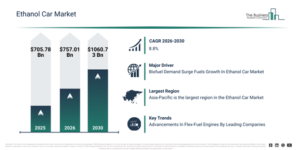
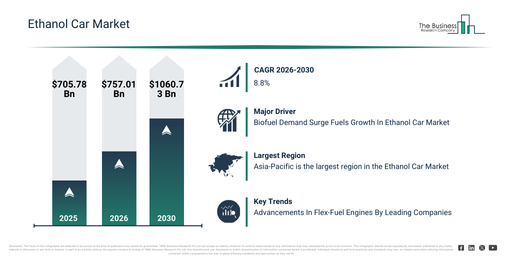
The ethanol car market has demonstrated robust growth over recent years. It is anticipated to expand from $705.78 billion in 2025 to $757.01 billion in 2026, achieving a compound annual growth rate (CAGR) of 7.3%. This past growth can be attributed to several factors including the early implementation of ethanol blending mandates, the volatility of crude oil prices, the expansion of domestic biofuel production, initial government incentives for ethanol vehicles, and increasing consumer acceptance of renewable fuels.
The ethanol car market is anticipated to experience robust growth in the upcoming years. It is projected to expand to $1060.73 billion by 2030, exhibiting a compound annual growth rate (CAGR) of 8.8%. This projected growth is driven by factors such as the increasing demand for low-carbon transportation, rising investments in biofuel infrastructure, enhanced government support for high ethanol blends, the expansion of sustainable agriculture feedstocks, and technological advancements in ethanol engine optimization. Significant trends during this period include the growing adoption of flex fuel vehicle technologies, a rising interest in renewable fuel alternatives, the continued development of high ethanol blend engines, an increase in domestic ethanol production capacity, and the expanding use of ethanol cars in emerging markets.
Free Ethanol Car Market Sample: Market Size, Growth Drivers And Competitive Landscape:
Ethanol Car Market Drivers Explained: What Is Supporting A 8.8% CAGR?
The escalating demand for biofuels is poised to boost the expansion of the ethanol car market in the coming years. Biofuels are renewable energy sources obtained from organic matter such as plants and animal waste, serving as an alternative to conventional fossil fuels. Vehicles powered by ethanol, utilizing bioethanol, promote the use of these fuels by offering a cleaner and more sustainable choice over gasoline, thereby lowering greenhouse gas emissions. For example, in January 2024, the International Energy Agency, an autonomous intergovernmental organization based in France, forecasted a growth in biofuel demand of 38 billion liters from 2023 to 2028, representing an almost 30% increase when compared to the previous five-year period. Consequently, the heightened demand for biofuels is a key driver for the growth of the ethanol car market.
Ethanol Car Market Segment Guide: Main Divisions And Subsegments
The ethanol car market covered in this report is segmented –
1) By Product: Starch-Based, Sugar-Based, Cellulosic
2) By Drive Type: Front Wheel Drive, Rear Wheel Drive, All Wheel Drive
3) By Blend Type: E10 To E26, E25 To E86, Above E86
4) By Vehicle Class: Hatchback, Sedan, SUV, Other Vehicle Class
5) By Application: Conventional Fuel Vehicles, Flexible Fuel Vehicles, Other Applications
Subsegments:
1) By Starch-Based: Corn Ethanol, Wheat Ethanol
2) By Sugar-Based: Cane Ethanol, Beet Ethanol
3) By Cellulosic: Agricultural Residues, Wood-Based Ethanol
Ethanol Car Market Trends And Opportunities For 2026–2030
Leading companies in the ethanol car market are developing innovative products, such as flex-fuel engines, to enhance their market profitability. A flex-fuel engine, frequently referred to as a flexible-fuel engine or FFV (Flexible Fuel Vehicle), is an internal combustion engine engineered to operate on a variety of fuels, typically a blend of gasoline and ethanol, such as E85 (a blend of 85% ethanol and 15% gasoline). For instance, in August 2023, Toyota Motor Corporation, a Japan-based automotive manufacturer, launched the electrified flex-fuel Innova HyCross car in India, which is the world’s first fully ethanol-powered car equipped with a flex-fuel engine. The flex-fuel electric vehicle Innova HyCross has the capability to operate in an electric-only mode and use alternative fuels. It is designed to run exclusively on ethanol, an E100 plant-generated fuel. Additionally, it will feature a lithium-ion battery pack that can provide ample power for the car to function in electric mode.
Which Major Players Are Active In The Ethanol Car Market?
Major companies operating in the ethanol car market are Volkswagen AG, Toyota Motor Corporation, Fiat Chrysler Automobiles, Peugeot Citroën Automobiles S.A., Stellantis NV, Ford Motor Company, Mercedes-Benz Group AG, General Motors Corp., Bayerische Motoren Werke AG, Honda Motor Co. Ltd., Nissan Motor Co. Ltd., Kia Motors Corporation, Volvo Group, Tata Engineering and Locomotive Company Limited, Jaguar Land Rover Automotive plc, Cummins Inc., Mitsubishi Motors Corporation, Delphi Technologies, Parker Hannifin Corporation, Isuzu Motors Ltd., Mahindra And Mahindra Limited, Maruti Suzuki India Ltd., Dongfeng Motor Corporation
Unlock The Complete Ethanol Car Market Report With Company Benchmarking:
Ethanol Car Market World Regions Compared: Which Leads In Revenue?
Asia-Pacific was the largest region in the ethanol car market in 2025. The regions covered in the ethanol car market report are Asia-Pacific, South East Asia, Western Europe, Eastern Europe, North America, South America, Middle East, Africa.
Reach Out To Our Team:
The Business Research Company: https://www.thebusinessresearchcompany.com/
Americas: +1 310-496-7795
Asia: +44 7882 955267 & +91 8897263534
Europe: +44 7882 955267
Email us at: marketing@tbrc.info
Follow us on:
LinkedIn: https://in.linkedin.com/company/the-business-research-company
YouTube: https://www.youtube.com/channel/UC24_fI0rV8cR5DxlCpgmyFQ
Global Market Model: https://www.thebusinessresearchcompany.com/global-market-model

Wasay has over a decade of experience in market research, data modelling, and analytics, with prior experience at GlobalData and Decision Tree Consulting Services. At The Business Research Company , he leads research operations across syndicated studies, customized consulting engagements, and the Global Market Model platform. His professional experience includes supporting organizations such as Boston Consulting Group, KPMG, and Ernst & Young. Wasay holds a degree in Electronics and Communications Engineering, postgraduate management qualifications from International Management Institute Belgium and Indian School of Business and Entrepreneurship, and completed the Integrated Program in Business Analytics from Indian Institute of Management Indore.