Built to provide research that’s more actionable and strategically valuable, The Business Research Company’s 2026 market reports include market attractiveness analysis, total addressable market sizing, company benchmarking matrices, interactive Excel dashboards, broader supply chain intelligence, emerging startup tracking, and in-depth product insights.
Glass Flexible Display Market Forecast: Value Set To Climb From $25.25 Billion To $34.55 Billion
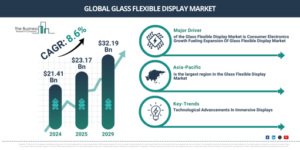
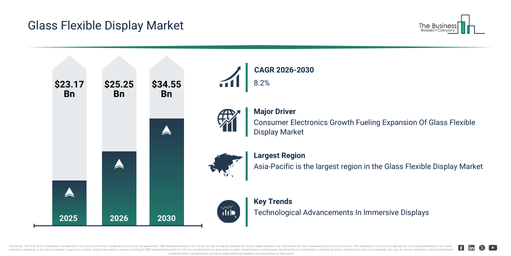
The glass flexible display market has shown significant growth in recent years. Its size is expected to expand from $23.17 billion in 2025 to $25.25 billion in 2026, exhibiting a compound annual growth rate (CAGR) of 9.0%. This historical expansion can be linked to factors such as increased smartphone and tablet adoption, the demand for lighter and thinner electronic devices, advancements in oled display technologies, rising investments in display manufacturing, and the initial use of flexible screens in consumer electronics.
The glass flexible display market is anticipated to experience robust expansion in the coming years. It is projected to reach $34.55 billion by 2030, demonstrating a compound annual growth rate (CAGR) of 8.2%. This growth over the forecast period is primarily driven by the escalating demand for foldable smartphones, the expanding market for wearable electronics, increased integration of flexible displays in automotive interiors, continuous advancements in flexible glass durability, and the rising adoption of smart home display devices. Furthermore, significant trends expected during this period include the growing popularity of foldable and rollable display designs, broader application of flexible glass in premium consumer electronics, ongoing advancements in ultra-thin glass manufacturing, heightened integration of flexible displays into wearables, and the expansion of flexible displays across automotive and smart home applications.
Get A Free Sample Report With In-Depth Market Insights:
Glass Flexible Display Market Demand Drivers: What’s Powering Industry Growth?
The increasing demand for consumer electronics is anticipated to fuel the expansion of the glass flexible display market moving forward. Consumer electronics are defined as electronic devices specifically created for purchase and use by end-users or consumers for personal, non-commercial, or professional purposes in their daily lives. The consumer electronics market is propelled by factors such as rising disposable income levels, shifts in consumer lifestyles, rapid urbanization, and the proliferation of e-commerce platforms. Glass flexible displays are utilized in the development of cutting-edge products like foldable smartphones, rollable tablets, and curved televisions. For instance, in May 2023, data from the Japan Electronics and Information Technology Industries Association, a Japan-based trade association, indicated that the total electronic equipment production in Japan reached $4919 million ( ¥771,457 million). Furthermore, consumer electronics production climbed to $204.67 million (¥32,099 million) in May 2023, marking an increase from $161.12 million (¥25,268 million) in May 2022. Therefore, the growing demand for consumer electronics is driving the growth of the glass flexible display market.
Glass Flexible Display Market Segment Analysis: What Are The Core Market Categories?
The glass flexible display market covered in this report is segmented –
1) By Component: Organic Material, Substrate, Conductive Layer, Backlight Panel, Other Components
2) By Display Type: Bendable, Rollable, Foldable
3) By Manufacturing Technology: Flexible Flat Panel Display, Flexible Plasma Display, Photographic Technology
4) By Application: Smartphone And Tablet, Smartwatches And Wearables, Television And Digital Signage Systems, Personal Computer (PC) Monitors And Laptops, E-Reader, Electronic Shelf Labels (ESLs), Vehicles And Public Transports, Smart Home Appliances
5) By End User: Automotive, Aerospace, Retail, Transportation, Government, Utilities, Other End Users
Subsegments:
1) By Organic Material: Organic Light-Emitting Diodes (OLEDs), Organic Semiconductors, Polymer Light-Emitting Diodes (PLEDs), Organic Photovoltaic (OPV) Materials
2) By Substrate: Glass Substrate, Plastic Substrate, Metal Foil Substrate, Polyimide Substrate
3) By Conductive Layer: Indium Tin Oxide (ITO), Silver Nanowires, Graphene, Carbon Nanotubes
4) By Backlight Panel: Edge-lit Backlight Panel, Direct-lit Backlight Panel, Quantum Dot Backlight Panel, MicroLED Backlight Panel
5) By Other Components: Encapsulation Layer, Adhesive Layer, Protective Layer, Thin Film Transistors (TFTs)
Glass Flexible Display Market Innovation Trends: What Developments Are Reshaping The Industry?
Leading companies in the Glass Flexible Display market are prioritizing the development of advanced technological solutions, such as spatial displays, to enhance user experience and expand applications across sectors like entertainment, healthcare, and automotive. Spatial displays are sophisticated visual technologies that generate 3D images or holograms, enabling users to interact with content in a more immersive and realistic way. These displays do not necessitate special glasses, providing a genuine three-dimensional viewing experience. For instance, in May 2024, Looking Glass Factory Inc., a China-based company specializing in holographic displays, unveiled two spatial display models: a 16-inch and a 32-inch version, to facilitate 3D visualization without requiring headsets, making them suitable for group viewing experiences. These displays support communal viewing by broadcasting between 45 and 100 views, allowing multiple users to experience 3D content simultaneously without headsets, while also offering compatibility with popular software platforms like Unity and Unreal Engine.
Glass Flexible Display Market Top Companies Driving Competitive Growth
Major companies operating in the glass flexible display market are Samsung Electronics Co. Ltd., Sony Corporation, BOE Technology Group Co. Ltd, Koninklijke Philips N.V. (Royal Philips), LG Display Co. Ltd., Sharp Corporation, Delta Electronics Inc., Corning Incorporated, DuPont de Nemours Inc., Innolux Corporation, AU Optronics Corp., Materion Corporation, Japan Display Inc., E Ink Holdings Inc., Kateeva Inc., Royole Corporation, Novaled GmbH, NanoLumens Inc., FlexEnable Limited, Plastic Logic Limited, Visionox Company Ltd., Microtips Technology LLC
View The Full Glass Flexible Display Market Report:
Glass Flexible Display Market Regional Split: Which Areas Are Fueling Growth?
Asia-Pacific was the largest region in the glass flexible display market in 2025. North America is expected to be the fastest-growing region in the forecast period. The regions covered in the glass flexible display market report are Asia-Pacific, South East Asia, Western Europe, Eastern Europe, North America, South America, Middle East, Africa.
Reach Out To Our Team:
The Business Research Company: https://www.thebusinessresearchcompany.com/
Americas: +1 310-496-7795
Asia: +44 7882 955267 & +91 8897263534
Europe: +44 7882 955267
Email us at: marketing@tbrc.info
Follow us on:
LinkedIn: https://in.linkedin.com/company/the-business-research-company
YouTube: https://www.youtube.com/channel/UC24_fI0rV8cR5DxlCpgmyFQ
Global Market Model: https://www.thebusinessresearchcompany.com/global-market-model

Wasay has over a decade of experience in market research, data modelling, and analytics, with prior experience at GlobalData and Decision Tree Consulting Services. At The Business Research Company , he leads research operations across syndicated studies, customized consulting engagements, and the Global Market Model platform. His professional experience includes supporting organizations such as Boston Consulting Group, KPMG, and Ernst & Young. Wasay holds a degree in Electronics and Communications Engineering, postgraduate management qualifications from International Management Institute Belgium and Indian School of Business and Entrepreneurship, and completed the Integrated Program in Business Analytics from Indian Institute of Management Indore.