Featuring market attractiveness scoring, total addressable market sizing, company benchmarking matrices, interactive Excel dashboards, deeper supply chain intelligence, emerging startup tracking, and granular product-level insights, The Business Research Company’s 2026 market reports are built to deliver research that is both more actionable and more strategically valuable.
Nanophotonics Market Size And Revenue Outlook Through 2030
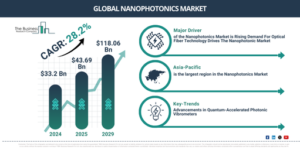
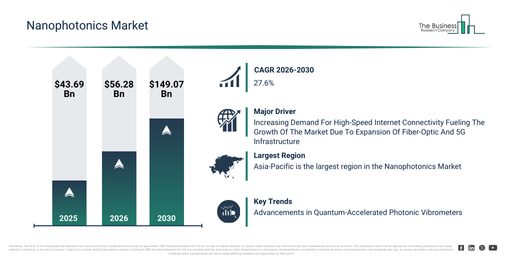
The nanophotonics market has experienced rapid expansion over the past few years. Projections indicate that it is set to expand from $43.69 billion in 2025 to $56.28 billion in 2026, demonstrating a compound annual growth rate (CAGR) of 28.8%. Historically, this expansion has been driven by factors such as initial uses in telecommunications, advancements in research and development within consumer electronics, its uptake in medical imaging, its incorporation into indicator and signage systems, and trials in high-performance computing.
The nanophotonics market is projected to experience rapid expansion in the coming years. Its valuation is anticipated to reach $149.07 billion by 2030, demonstrating a compound annual growth rate (CAGR) of 27.6%. This growth during the forecast period stems from factors such as advancements in high-efficiency photonic device research, progress in solar photovoltaic applications, expansion of display technologies, the widespread use of optical switches and amplifiers, and the integration of holographic storage systems. Key trends for the forecast duration involve the creation of nano-optical devices, the incorporation of photonic crystals and quantum dots, the implementation of nanophotonic LEDs and OLEDs, the refinement of plasmonic and nanotube materials, and breakthroughs in holographic data storage.
Get A Free Sample Report With In-Depth Market Insights:
Nanophotonics Market Growth Factors Behind Sustained Expansion
The nanophotonic market is anticipated to expand, driven by the rising need for high-speed internet connectivity. High-speed internet connectivity is defined as swift and dependable data transfer, facilitating uninterrupted access to online services, cloud applications, and digital communication via cutting-edge technologies like fiber optics, 5G, and broadband networks. This surge in high-speed internet connectivity stems from the swift global expansion of fiber-optic and 5G network infrastructure, which allows for quicker and more consistent data transmission across diverse geographical areas. Nanophotonics contributes to high-speed internet connectivity by facilitating quicker and more energy-efficient data transmission. It achieves this using light-based components in place of conventional electronic ones, thereby decreasing latency and enhancing bandwidth capacity to meet the world’s increasing data requirements. For example, data released in November 2024 by the UK Parliament’s House of Commons Library, a UK-based government body, showed that as of January 2024, 78% of UK premises could access gigabit broadband. This represents substantial advancement towards the UK government’s goal of 85% coverage by 2025 and full national availability by 2030. Consequently, the rising need for high-speed internet connectivity is propelling the expansion of the nanophotonic market.
Nanophotonics Market Segment Analysis And Revenue Potential
The nanophotonics market covered in this report is segmented –
1) By Product: LED, OLED, NFO, Optical Amplifier, Optical Switches, Holographic Data Storage System
2) By Material: Quantum Dots, Photonic Crystals, Plasmonic, Nanotubes, Nanoribbons
3) By Application: Telecommunications, Entertainment, Consumer Electronics, Indicator And Signs, Lighting, Non-Visual Applications, Other Applications
Subsegments:
1) By Light Emitting Diode (LED): Surface-Mounted Device (SMD) LEDs, Chip On Board (COB) LEDs, Miniature LEDs, High-Power LEDs
2) By Organic Light Emitting Diode (OLED): Active-Matrix OLED (AMOLED), Passive-Matrix OLED (PMOLED), Transparent OLEDs, Flexible OLEDs
3) By Nano-Photonic Film (NFO): Thin-Film NFOs, Metamaterial NFOs, Plasmonic NFOs45) By Optical Amplifier: Erbium-Doped Fiber Amplifier (EDFA), Raman Fiber Amplifier (RFA), Semiconductor Optical Amplifiers (SOA)
5) By Optical Switches: Electro-Optic Switches, Optomechanical Switches, Micro-Electro-Mechanical Systems (MEMS) Switches
6) By Holographic Data Storage System: Volume Holographic Storage, Surface Holographic Storage, Hybrid Holographic Storage Systems
Nanophotonics Market Industry Trends Fueling Future Revenue Growth
Leading entities within the nanophotonics market are prioritizing the development of sophisticated products, such as the innovative photonic vibrometer, to facilitate accurate and comprehensive vibration analysis. A photonic vibrometer represents an advanced optical apparatus that leverages laser technology to precisely measure and examine vibrations and displacements in various materials or structures, frequently employed across disciplines like engineering, materials science, and structural health monitoring. For example, in July 2023, Quantum Computing Inc., a US-based photonics company, introduced the Quantum Photonic Vibrometer (QPV). This potent instrument is crafted for distant vibration detection, sensing, and inspection. As the initial quantum-accelerated photonic vibrometer released to the market, it provides considerable advancements in sensitivity, speed, and resolution, enabling the identification of greatly obscured and non-line-of-sight objects for the first time. Its military and commercial applications are extensive, covering material recognition, elevated surveillance capabilities, monitoring of infrastructure integrity, and proactive industrial maintenance, all executable from secure distances with minimal energy and optical power consumption.
Nanophotonics Market Key Players Shaping Industry Direction
Major companies operating in the nanophotonics market are Cambrios Technologies Corporation, Cnano Technology, Cree Inc., LG Display Co. Ltd., Nanocs Inc., Nanocyl S.A., Nanoco Technologies Ltd., Nanosys Inc., Nanostructured & Amorphous Materials Inc., OSRAM Opto Semiconductors GmbH, Philips Lumileds Lighting Company LLC, QD Vision Inc., Quantum Materials Corp., TCL Display Technology Holdings Limited, Sharp Corporation, Novaled GmbH, Nano Magic LLC, eSpin Technologies, Advanced Nano Products Co. Ltd (ANP), Hamamatsu Photonics K.K., Agiltron Inc., Seoul Semiconductor Co. Ltd., Jenoptik AG, Tech-X Corporation, Nanophase Technologies Corporation
View The Full Nanophotonics Market Report:
Nanophotonics Market Regional Split: Which Areas Are Fueling Growth?
Asia-Pacific was the largest region in the nanophotonic market in 2025. North America is expected to be the fastest-growing region in the forecast period. The regions covered in the nanophotonics market report are Asia-Pacific, South East Asia, Western Europe, Eastern Europe, North America, South America, Middle East, Africa.
Reach Out To Our Team:
The Business Research Company: https://www.thebusinessresearchcompany.com/
Americas: +1 310-496-7795
Asia: +44 7882 955267 & +91 8897263534
Europe: +44 7882 955267
Email us at: marketing@tbrc.info
Follow us on:
LinkedIn: https://in.linkedin.com/company/the-business-research-company
YouTube: https://www.youtube.com/channel/UC24_fI0rV8cR5DxlCpgmyFQ
Global Market Model: https://www.thebusinessresearchcompany.com/global-market-model

Wasay has over a decade of experience in market research, data modelling, and analytics, with prior experience at GlobalData and Decision Tree Consulting Services. At The Business Research Company , he leads research operations across syndicated studies, customized consulting engagements, and the Global Market Model platform. His professional experience includes supporting organizations such as Boston Consulting Group, KPMG, and Ernst & Young. Wasay holds a degree in Electronics and Communications Engineering, postgraduate management qualifications from International Management Institute Belgium and Indian School of Business and Entrepreneurship, and completed the Integrated Program in Business Analytics from Indian Institute of Management Indore.