
Delivering more actionable and strategically valuable research, The Business Research Company’s 2026 market reports feature market attractiveness analysis, total addressable market evaluation, company benchmarking matrices, interactive Excel dashboards, expanded supply chain intelligence, emerging startup coverage, and detailed product insights.
Graphics Synchronization (G-Sync) Compatible Display Market Growth Analysis: How Will Revenue Expand During The Forecast Period?
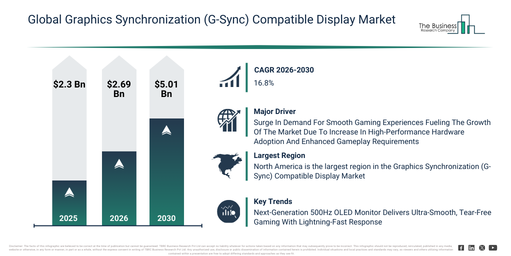
The market for graphics synchronization (g-sync) compatible displays has seen rapid expansion in recent years. This segment is expected to rise from $2.3 billion in 2025 to $2.69 billion in 2026, achieving a compound annual growth rate (CAGR) of 16.6%. The historical surge in this market can be attributed to several factors including the expansion of the PC gaming ecosystem, improved GPU performance capabilities, a growing consumer appetite for high-end displays, the burgeoning esports industry, and the increasing availability of high-refresh-rate panels.
The graphics synchronization (g-sync) compatible display market is anticipated to experience substantial growth over the next few years, projected to reach $5.01 billion by 2030, demonstrating a compound annual growth rate (CAGR) of 16.8%. This expansion during the forecast period can be attributed to the increasing uptake of immersive gaming technologies, a surging demand for professional-grade monitors, the widening reach of cloud gaming platforms, a growing preference for large-format displays, and continuous progress in display synchronization technologies. Significant trends for the forecast period include the increasing incorporation of high refresh rate displays, a rising need for seamless, tear-free gaming experiences, the expanding integration of advanced display controllers, the proliferation of large screen and ultra-wide displays, and a heightened emphasis on color accuracy and calibration.
Download A Free Sample Report For Comprehensive Market Insights:
Graphics Synchronization (G-Sync) Compatible Display Market Demand Drivers: What Is Fueling Industry Growth?
The future expansion of the graphics synchronization (g-sync) compatible display market is anticipated, driven by an increasing need for fluid gaming experiences. A smooth gaming experience means visually seamless and highly responsive gameplay, which significantly reduces issues like screen tearing, stuttering, and input delay for both casual and competitive players. This surge in demand stems from consumers increasingly preferring high-performance hardware capable of supporting refresh rates superior to standard displays. G-sync compatible displays address this requirement by aligning the display’s refresh rate with the graphics card’s output, thereby improving motion clarity and delivering an uninterrupted gaming experience. For example, data from August 2023, provided by the Australia-based Interactive Games and Entertainment Association, shows that in Australia, 94% of homes possess a device capable of gaming, and 81% of the population engages in video games, indicating significant growth in gaming participation. A diverse and mature gaming audience is evident, with almost half of all players (48%) being female, and the average player age being 35, with 79% being 18 years old or older. Consequently, the heightened need for smooth gaming experiences is propelling the growth of the graphics synchronization (g-sync) compatible display market.
Graphics Synchronization (G-Sync) Compatible Display Market Segment Landscape: Which Areas Lead Market Development?
The graphics synchronization (g-sync) compatible display market covered in this report is segmented –
1) By Component: Hardware; Software; Services
2) By Product Type: Monitors; Laptops; Televisions; Other Product Types
3) By Screen Size: Below 24 Inches; 24–27 Inches; Above 27 Inches
4) By Application: Gaming; Professional; Commercial; Other Applications
5) By Distribution Channel: Online; Offline
Subsegments:
1) By Hardware: Graphics Processing Units; Display Panels; Cables And Connectors; Refresh Rate Controllers
2) By Software: G-Sync Drivers And Utilities; Calibration And Optimization Software; Display Management Applications
3) By Services: Installation And Setup Services; Maintenance And Repair Services; Firmware Updates And Support Services
Graphics Synchronization (G-Sync) Compatible Display Market Innovation Trends: Which Developments Are Transforming The Industry?
Leading companies in the graphics synchronization (g-sync) compatible display market are prioritizing the development of innovative solutions, such as a 500 Hz OLED gaming monitor, to deliver ultra-smooth, tear-free, and highly responsive gaming experiences. A 500 Hz OLED gaming monitor is a high-speed display capable of refreshing its screen 500 times per second, thereby providing extremely smooth motion, minimal blur, and ultra-responsive visuals specifically for gaming. For instance, in May 2025, Samsung Electronics Co. Ltd., a consumer electronics and technology company based in South Korea, unveiled the Odyssey OLED G6, which stands as the world’s first 500 Hz OLED gaming monitor. This advanced monitor features a 27-inch QHD display built on QD-OLED technology with an ultra-fast 0.03 ms gray-to-gray response time, enabling exceptionally smooth gameplay during rapid gaming scenarios. The Odyssey OLED G6 incorporates support for NVIDIA G-SYNC Compatible technology to ensure tear-free and low-latency visuals, alongside AMD FreeSync Premium Pro, and offers enhanced visual performance through VESA DisplayHDR True Black 500 certification and Pantone-validated color accuracy. By integrating extreme refresh rates, OLED pixel responsiveness, and adaptive synchronization technologies, Samsung’s Odyssey OLED G6 represents a next-generation, high-precision approach to immersive and competitive gaming displays.
Graphics Synchronization (G-Sync) Compatible Display Market Industry Leaders And Market Competition
Major companies operating in the graphics synchronization (g-sync) compatible display market are Lenovo Group Ltd., Micro-Star International Co. Ltd., Samsung Electronics Co. Ltd., Sony Group Corporation, Dell Technologies Inc., LG Electronics Inc., HP Inc., Xiaomi Corporation, NVIDIA Corporation, TCL Technology Group Corporation, ASUSTeK Computer Inc., Acer Inc., Hisense Co. Ltd., Gigabyte Technology Co. Ltd., Razer Inc., Corsair Gaming Inc., Cooler Master Technology Inc., ViewSonic Corporation, BenQ Corporation, and YEYIAN International Co. Ltd.
Access The Complete Graphics Synchronization (G-Sync) Compatible Display Market Report:
Graphics Synchronization (G-Sync) Compatible Display Market Regional Analysis: Which Region Leads By Revenue?
North America was the largest region in the graphics synchronization (g-sync) compatible display market in 2025. Asia-Pacific is expected to be the fastest-growing region in the forecast period. The regions covered in the graphics synchronization (g-sync) compatible display market report are Asia-Pacific, South East Asia, Western Europe, Eastern Europe, North America, South America, Middle East, Africa.
Get in touch with us:
The Business Research Company: https://www.thebusinessresearchcompany.com/
Americas: +1 310-496-7795
Asia: +44 7882 955267 & +91 8897263534
Europe: +44 7882 955267
Email us at: marketing@tbrc.info
Follow us on:
LinkedIn: https://in.linkedin.com/company/the-business-research-company
YouTube: https://www.youtube.com/channel/UC24_fI0rV8cR5DxlCpgmyFQ
Global Market Model: https://www.thebusinessresearchcompany.com/global-market-model

Wasay has over a decade of experience in market research, data modelling, and analytics, with prior experience at GlobalData and Decision Tree Consulting Services. At The Business Research Company , he leads research operations across syndicated studies, customized consulting engagements, and the Global Market Model platform. His professional experience includes supporting organizations such as Boston Consulting Group, KPMG, and Ernst & Young. Wasay holds a degree in Electronics and Communications Engineering, postgraduate management qualifications from International Management Institute Belgium and Indian School of Business and Entrepreneurship, and completed the Integrated Program in Business Analytics from Indian Institute of Management Indore.