
Featuring market attractiveness scoring, total addressable market sizing, company benchmarking matrices, interactive Excel dashboards, deeper supply chain intelligence, emerging startup tracking, and granular product-level insights, The Business Research Company’s 2026 market reports are built to deliver research that is both more actionable and more strategically valuable.
Health Sensors Market Forecast: What Value Will The Market Reach By 2030?
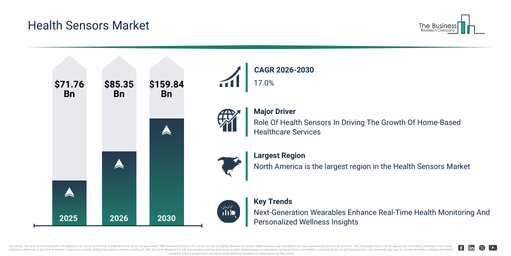
The health sensors market has seen considerable growth in recent times. Its value is anticipated to rise from $71.76 billion in 2025 to $85.35 billion in 2026, achieving a compound annual growth rate (CAGR) of 18.9%. The market’s past expansion is a result of several factors, including an increase in chronic disease prevalence, greater adoption of basic diagnostic sensors, the expansion of hospital monitoring equipment, growing awareness of preventive healthcare, and advancements in biosensor technologies.
The health sensors market is poised for significant expansion over the coming years, with projections indicating it will reach $159.84 billion by 2030, demonstrating a compound annual growth rate (CAGR) of 17.0%. This anticipated growth during the forecast period is fueled by factors such as the broadening scope of remote and home-based healthcare, the increasing adoption of AI-driven health analytics, a global rise in the aging population, the expansion of telemedicine platforms, and the escalating demand for continuous and real-time health monitoring. Prominent trends expected within this period include the wider acceptance of wearable and continuous health monitoring sensors, a growing integration of multi-parameter sensors into single devices, a surge in demand for remote patient monitoring solutions, the advancement of miniaturized and non-invasive sensor technologies, and an intensifying focus on data accuracy and clinical-grade sensor performance.
Get A Free Sample Report With In-Depth Market Insights:
Health Sensors Market Growth Factors Behind Sustained Expansion
The evolving trend towards home-based healthcare provisions is set to stimulate the expansion of the health sensors market moving forward. Home-based healthcare involves a spectrum of medical and non-medical assistance provided to individuals within their residences to facilitate recuperation, manage chronic illnesses, or help with everyday tasks. The increasing prevalence of home-based healthcare is attributed to an aging global population, its cost-effectiveness, continuous technological progress, and individuals’ preference for self-sufficiency. Health sensors contribute to home-based healthcare by enabling remote tracking of vital signs and various health indicators, thereby enhancing the caliber of care and patient outcomes. As an illustration, in June 2025, the Australian Institute of Health and Welfare (AIHW), an Australia-based government agency, reported that in 2024, spending on residential care reached $21.5B, nearly double the $11.5B allocated for home care and support, a rise from 2023, when both categories recorded lower figures. Consequently, the transition to home-based healthcare services is a key driver for the growth of the health sensors market.
Health Sensors Market Segment Analysis Spotlighting Growth Areas
The health sensors market covered in this report is segmented –
1) By Product: Hand Held Diagnostic Sensors, Wearable Sensors, Ingestible Or Implantable Sensors
2) By Application: Chronic Illness And At Risk-Monitoring, Wellness Monitoring, Patient Admission Triage, Logistical Tracking, In Hospital Clinical Monitoring, Sensor Therapeutics, Post-Acute Care Monitoring, Other Applications
3) By End User: Hospitals And Clinics, Long-Term Care Centers And Nursing homes, Home Care Settings, Other End Users
Subsegments:
1) By Hand Held Diagnostic Sensors: Glucose Monitoring Sensors, Blood Pressure Sensors, Thermometers, Pulse Oximeters, ECG Sensors
2) By Wearable Sensors: Fitness Trackers, Smartwatches, Wearable ECG Monitors, Sleep Monitoring Sensors, Activity Monitors
3) By Ingestible Or Implantable Sensors: Ingestible Pill Sensors, Implantable Glucose Sensors, Biometric Implantable Sensors, Ingestible Medication Adherence Sensors
Health Sensors Market Industry Trends Fueling Future Revenue Growth
Prominent companies in the health sensors market are intensifying their efforts to develop next-generation wearables, aiming to enhance real-time health monitoring, provide individualized wellness insights, and aid in proactive disease management by tracking sophisticated biometric and physiological data. These advanced devices integrate cutting-edge technology, moving beyond conventional functionalities such as basic heart-rate monitoring or step counting. For instance, in May 2025, WHOOP Inc., a U.S.-based human performance company, unveiled WHOOP 5.0 and WHOOP MG, which are next-generation wearables designed to enhance health and longevity tracking. These units boast a sleek aesthetic coupled with a 14-day battery lifespan, housing precision sensors capable of capturing data 26 times per second, alongside medical-grade ECG functionalities, blood pressure insights, and a novel Healthspan feature for assessing physiological age and the rate of aging. Moreover, WHOOP 5.0 and MG provide extensive fitness tracking, offer specific hormonal insights for women, and integrate seamlessly with WHOOP Body and AnyWear technology for uninterrupted 24/7 monitoring, thereby enabling users to make knowledgeable, data-backed decisions leading to improved health and performance results.
Health Sensors Market Leading Companies: Who Holds The Strongest Market Presence?
Major companies operating in the health sensors market are Apple Inc., Samsung Electronics Co. Ltd., Johnson & Johnson, Abbott Laboratories, Medtronic plc, Nokia Corporation, Texas Instruments Incorporated, Koninklijke Philips N.V., Strykar Healthcare, GE HealthCare Technologies Inc., STMicroelectronics, Boston Scientific Corporation, Analog Devices Inc., OMRON Healthcare Inc., Garmin Ltd., Smiths Group plc, Dexcom Inc., Masimo Corporation, Nihon Kohden Corporation, Google Fitbit, Nonin, Sotera Inc., Empatica Inc., AliveCor Inc., Shimmer Sensing
View The Full Health Sensors Market Report:
Health Sensors Market Regional Split: Which Areas Are Fueling Growth?
North America was the largest region in the dominated market in 2025. Asia-Pacific is expected to be the fastest-growing region in the forecast period. The regions covered in the health sensors market report are Asia-Pacific, South East Asia, Western Europe, Eastern Europe, North America, South America, Middle East, Africa.
Reach Out To Our Team:
The Business Research Company: https://www.thebusinessresearchcompany.com/
Americas: +1 310-496-7795
Asia: +44 7882 955267 & +91 8897263534
Europe: +44 7882 955267
Email us at: marketing@tbrc.info
Follow us on:
LinkedIn: https://in.linkedin.com/company/the-business-research-company
YouTube: https://www.youtube.com/channel/UC24_fI0rV8cR5DxlCpgmyFQ
Global Market Model: https://www.thebusinessresearchcompany.com/global-market-model

Wasay has over a decade of experience in market research, data modelling, and analytics, with prior experience at GlobalData and Decision Tree Consulting Services. At The Business Research Company , he leads research operations across syndicated studies, customized consulting engagements, and the Global Market Model platform. His professional experience includes supporting organizations such as Boston Consulting Group, KPMG, and Ernst & Young. Wasay holds a degree in Electronics and Communications Engineering, postgraduate management qualifications from International Management Institute Belgium and Indian School of Business and Entrepreneurship, and completed the Integrated Program in Business Analytics from Indian Institute of Management Indore.