Delivering more actionable and strategically valuable research, The Business Research Company’s 2026 market reports feature market attractiveness analysis, total addressable market evaluation, company benchmarking matrices, interactive Excel dashboards, expanded supply chain intelligence, emerging startup coverage, and detailed product insights.
Heterogeneous Integration Market Size Forecast: How Large Could The Market Become By 2030?
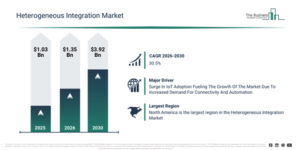
The heterogeneous integration market has experienced substantial expansion in its size over recent years. It is anticipated to increase from $1.03 billion in 2025 to $1.35 billion in 2026, registering a compound annual growth rate (CAGR) of 30.8%. Historically, this growth can be ascribed to the rise of semiconductor miniaturization, demand for high-performance computing, adoption of advanced packaging, growth in consumer electronics, and initial integration of sensors and actuators.
The market size for heterogeneous integration is expected to demonstrate significant growth in the coming years. It is projected to expand to $3.92 billion by 2030, achieving a compound annual growth rate (CAGR) of 30.5%. This anticipated growth is driven by factors such as the expansion of ai-driven applications, the widespread adoption of 5g and iot devices, increasing demand for automotive electronics, advancements in healthcare and life sciences applications, and a rise in aerospace and defense electronics. Noteworthy trends for the forecast period include heterogeneous system optimization, multi-material chip integration, advanced packaging techniques, thermal management solutions, and high-density electronics integration.
Download A Free Sample Report For Comprehensive Market Insights:
Heterogeneous Integration Market Growth Momentum: Which Factors Are Influencing Demand?
The increasing use of IoT devices is anticipated to fuel the expansion of the heterogeneous integration market in the coming years. These devices are internet-connected objects fitted with sensors and software, facilitating data exchange and automation in various sectors such as residential, industrial, and medical applications. The heightened adoption of IoT devices stems mainly from a rising need for connectivity, automation, and insights from data across numerous industries. Heterogeneous integration improves IoT devices by allowing the smooth merging of various parts like sensors, processors, and communication modules into small, power-efficient systems. This ensures better performance and multiple functions to satisfy the needs of connected systems. For example, in 2024, Ericsson, a Sweden-based network and telecommunications company, stated that cellular IoT connections reached nearly 4 billion and are forecasted to increase at a CAGR of around 11%, exceeding 7 billion by 2030. Consequently, the growing adoption of IoT devices is propelling the growth of the heterogeneous integration market.
Heterogeneous Integration Market Categorization By Product Type And Application
The heterogeneous integration market covered in this report is segmented –
1) By Component: Advanced Manufacturing And Multi-Chip Integration, Integrated Photonics, Integrated Power Electronics, Microelectromechanical Systems (MEMS) And Sensor Integration, 5G, Radio Frequency (RF) And Analog Mixed Signal
2) By Design: Co-Design, Modeling And Simulation
3) By End-User: Semiconductor And Electronics, Information Technology (IT) And Telecommunications, Automotive And Transportation, Healthcare And Life Sciences, Manufacturing And Industrial, Aerospace And Defense, Other End Users
Subsegments:
1) By Advanced Manufacturing And Multi-Chip Integration: 2.5D And 3D Packaging, Fan-Out Wafer-Level Packaging (FOWLP), System-In-Package (SiP)
2) By Integrated Photonics: Silicon Photonics, Optical Interconnects, Photonic Integrated Circuits (PICs)
3) By Integrated Power Electronics: Wide Bandgap Semiconductors (SiC, GaN), Power Modules, Smart Power ICs
4) By Microelectromechanical Systems (MEMS) And Sensor Integration: Inertial Sensors, Pressure And Environmental Sensors, BioMEMS And Microfluidic Devices
5) By 5G: mmWave Antennas, Beamforming Technologies, 5G Baseband And RF Integration
6) By Radio Frequency (RF) And Analog Mixed Signal: RF Front-End Modules, Mixed-Signal ASICs, High-Frequency Amplifiers And Filters
Heterogeneous Integration Market Company Landscape And Strategic Competition
Major companies operating in the heterogeneous integration market are Samsung Electronics Co. Ltd., Taiwan Semiconductor Manufacturing Company Limited (TSMC), Intel Corporation, International Business Machines Corporation, Qualcomm Incorporated, Broadcom Inc., Micron Technology Inc., Hewlett Packard Enterprise Company, NVIDIA Corporation, Applied Materials Inc., Advanced Micro Devices Inc., ASE Technology Holding Co. Ltd., STMicroelectronics NV, Analog Devices Inc., GlobalFoundries Inc., EV Group, SkyWater Technology Inc., Micross Components Inc., Etron Technology, Silicon Austria Labs GmbH
Access The Complete Heterogeneous Integration Market Report:
Heterogeneous Integration Market Geographic Distribution And Regional Opportunities
North America was the largest region in the heterogeneous integration market in 2025. Asia-Pacific is expected to be the fastest-growing region in the forecast period. The regions covered in the heterogeneous integration market report are Asia-Pacific, South East Asia, Western Europe, Eastern Europe, North America, South America, Middle East, Africa.
Get in touch with us:
The Business Research Company: https://www.thebusinessresearchcompany.com/
Americas: +1 310-496-7795
Asia: +44 7882 955267 & +91 8897263534
Europe: +44 7882 955267
Email us at: marketing@tbrc.info
Follow us on:
LinkedIn: https://in.linkedin.com/company/the-business-research-company
YouTube: https://www.youtube.com/channel/UC24_fI0rV8cR5DxlCpgmyFQ
Global Market Model: https://www.thebusinessresearchcompany.com/global-market-model

Wasay has over a decade of experience in market research, data modelling, and analytics, with prior experience at GlobalData and Decision Tree Consulting Services. At The Business Research Company , he leads research operations across syndicated studies, customized consulting engagements, and the Global Market Model platform. His professional experience includes supporting organizations such as Boston Consulting Group, KPMG, and Ernst & Young. Wasay holds a degree in Electronics and Communications Engineering, postgraduate management qualifications from International Management Institute Belgium and Indian School of Business and Entrepreneurship, and completed the Integrated Program in Business Analytics from Indian Institute of Management Indore.