Designed to make market research more actionable and strategically valuable, The Business Research Company’s 2026 market reports feature market attractiveness scoring, total addressable market sizing, company benchmarking matrices, interactive Excel dashboards, deeper supply chain intelligence, emerging startup tracking, and granular product-level insights.
How Big Is The Human-Machine Interface (HMI) Sensors In Wearables Market In 2026, And How Fast Will It Grow?
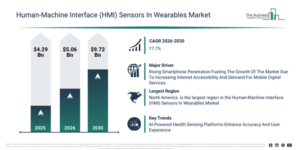
The market size for human-machine interface (hmi) sensors in wearables has seen swift expansion in recent years. It is anticipated to increase from $4.29 billion in 2025 to $5.06 billion in 2026, achieving a compound annual growth rate (CAGR) of 17.9%. The historical growth of this market can be attributed to factors such as the rising adoption of wearable devices, ongoing advancements in sensor technologies, increasing consumer focus on health monitoring, the early integration of hmi in smart devices, and the surge in fitness and sports applications.
The market for human-machine interface (HMI) sensors in wearables is expected to undergo rapid expansion in the coming years. It is projected to achieve a value of $9.72 billion in 2030, demonstrating a compound annual growth rate (CAGR) of 17.7%. This anticipated growth during the forecast period can be attributed to the emergence of personalized healthcare solutions, the integration of AI and machine learning into wearables, the expansion of smart enterprise applications, the development of next-generation immersive experiences, and a rising demand for remote patient monitoring. Significant trends for this period encompass wearable sensor miniaturization, real-time biometric analytics, context-aware interaction, advanced haptic feedback, and edge computing for wearables.
Download A Free Human-Machine Interface (HMI) Sensors In Wearables Market Sample Report With Size And Forecast Data:
Human-Machine Interface (HMI) Sensors In Wearables Market Growth Driver: The Key Factor Behind Rising Demand
The increasing adoption of smartphones is anticipated to drive the expansion of the human-machine interface (HMI) sensors in wearables market in the future. Smartphone penetration refers to the percentage of a population within a specific region or market that owns or regularly uses a smartphone. The surge in smartphone penetration rates is attributed to improved internet accessibility, more affordable devices, and an escalating demand for mobile digital services. Human-Machine Interface (HMI) sensors in wearables enhance smartphones by enabling intuitive and seamless user interactions, such as gesture control, touchless commands, and real-time physiological monitoring. They improve the user experience by offering faster response times, personalized feedback, and smarter device control, making smartphone usage more convenient and engaging. For instance, in October 2023, data from the GSM Association, a UK-based non-profit organization, indicated that nearly 4.3 billion people (53% of the global population) were utilizing their own smartphones for internet access, with approximately 80% of mobile internet users now employing 4G or 5G smartphones, signifying an increase of 330 million people from 2022 to 2023. Thus, the escalating smartphone penetration is a key driver for the growth of the human-machine interface (HMI) sensors in wearables market.
Human-Machine Interface (HMI) Sensors In Wearables Market Segmentation: Key Segments And Subsegments Covered
The human-machine interface (hmi) sensors in wearables market covered in this report is segmented –
1) By Sensor Type: Touch Sensors, Motion Sensors, Biometric Sensors, Voice And Audio Sensors, Environmental Sensors, Other Sensor Types
2) By Device Type: Smartwatches And Fitness Bands, Smart Glasses Or Augmented Reality (AR) Glasses, Smart Clothing, Smart Rings Or Wristbands, Hearables Or Earbuds, Head-Mounted Displays (HMDs), Other Device Types
3) By Application: Health And Fitness Monitoring, Gesture And Motion Control, Communication And Voice Interaction, Ambient Sensing And Personalization, Gaming And Immersive Experience, Other Applications
4) By End Use: Consumer Electronics, Healthcare, Enterprise And Industrial Applications, Other End Uses
Subsegments:
1) By Touch Sensors: Capacitive Touch Sensors, Resistive Touch Sensors, Infrared Touch Sensors, Optical Touch Sensors, Surface Acoustic Wave Touch Sensors
2) By Motion Sensors: Accelerometers, Gyroscopes, Magnetometers, Inertial Measurement Units, Proximity Sensors
3) By Biometric Sensors: Fingerprint Sensors, Heart Rate Sensors, Electrocardiogram Sensors, Blood Oxygen Sensors, Facial Recognition Sensors, Skin Temperature Sensors
4) By Voice And Audio Sensors: Microphones, Voice Recognition Sensors, Acoustic Sensors, Bone Conduction Sensors
5) By Environmental Sensors: Temperature Sensors, Humidity Sensors, Pressure Sensors, Gas Sensors, Light Sensors, Ultraviolet Sensors
6) By Other Sensor Types: Haptic Feedback Sensors, Electromyography Sensors, Electroencephalography Sensors, Galvanic Skin Response Sensors, Force Sensors, Flex Sensors
Human-Machine Interface (HMI) Sensors In Wearables Market Trends: Key Developments Shaping 2026 And Beyond
Leading companies in the human-machine interface (HMI) sensors in wearables market are concentrating on developing advanced systems, such as AI-powered health sensing platforms, to enhance accuracy, improve user experience, and provide comprehensive health monitoring. An artificial intelligence (AI)-powered health sensing platform refers to an integrated hardware and software system in wearables that utilizes artificial intelligence to process multiple health signals simultaneously, converting raw sensor data into actionable health insights. For instance, in August 2024, Huawei Technologies Co., Ltd., a China-based provider of consumer electronics and information and communications technology solutions, launched the HUAWEI TruSense System. This system incorporates a multi-sensor architecture capable of monitoring over sixty health and fitness indicators across several body systems, including assessments of emotional well-being derived from heart rate and nervous system data. It is characterized by its certified accuracy, adaptability to varying user conditions, and openness to ecosystem collaboration, positioning it as a significant advancement in digital health and wearable technology.
Leading Companies Operating In The Human-Machine Interface (HMI) Sensors In Wearables Market
Major companies operating in the human-machine interface (hmi) sensors in wearables market are Apple Inc., Samsung Electronics Co. Ltd., Qualcomm Technologies Inc., Broadcom Inc., Texas Instruments Incorporated, TDK Corporation, STMicroelectronics N.V., Infineon Technologies AG, NXP Semiconductors NV, Analog Devices Inc., Microchip Technology Inc., Omron Corporation, Ams-OSRAM AG, Garmin Ltd., Qorvo Inc., ROHM Co. Ltd., Synaptics Incorporated, Goodix Technology Co. Ltd., Sensirion AG, Bosch Sensortec GmbH, Valencell Inc., Interlink Electronics Inc., Ultrasense Systems Inc.
Access The Full Human-Machine Interface (HMI) Sensors In Wearables Market Research Report:
Human-Machine Interface (HMI) Sensors In Wearables Market Regional Analysis: Largest Region And Key Geographies Covered
North America was the largest region in the human-machine interface (HMI) sensors in wearables market in 2025. Asia-Pacific is expected to be the fastest-growing region in the forecast period. The regions covered in the human-machine interface (hmi) sensors in wearables market report are Asia-Pacific, South East Asia, Western Europe, Eastern Europe, North America, South America, Middle East, Africa.
Reach Out To Our Team:
The Business Research Company: https://www.thebusinessresearchcompany.com/
Americas: +1 310-496-7795
Asia: +44 7882 955267 & +91 8897263534
Europe: +44 7882 955267
Email us at: marketing@tbrc.info
Follow us on:
LinkedIn: https://in.linkedin.com/company/the-business-research-company
YouTube: https://www.youtube.com/channel/UC24_fI0rV8cR5DxlCpgmyFQ
Global Market Model: https://www.thebusinessresearchcompany.com/global-market-model

Wasay has over a decade of experience in market research, data modelling, and analytics, with prior experience at GlobalData and Decision Tree Consulting Services. At The Business Research Company , he leads research operations across syndicated studies, customized consulting engagements, and the Global Market Model platform. His professional experience includes supporting organizations such as Boston Consulting Group, KPMG, and Ernst & Young. Wasay holds a degree in Electronics and Communications Engineering, postgraduate management qualifications from International Management Institute Belgium and Indian School of Business and Entrepreneurship, and completed the Integrated Program in Business Analytics from Indian Institute of Management Indore.