Backed by market attractiveness analysis, total addressable market sizing, company benchmarking matrices, interactive Excel dashboards, wider supply chain intelligence, emerging startup coverage, and detailed product-level insights, The Business Research Company’s 2026 market reports are designed to offer research that is more actionable and strategically valuable than ever.
Home Solar Equipment Market Value Analysis: What Growth Lies Ahead Over The Forecast Period?
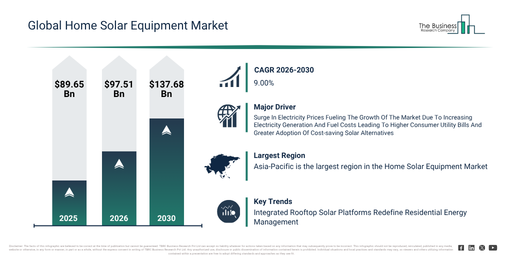
The home solar equipment market size has experienced significant expansion over recent years. It is forecast to grow from $89.65 billion in 2025 to $97.51 billion in 2026, achieving a compound annual growth rate (CAGR) of 8.8%. This historical growth can be attributed to several factors, including rising electricity costs driving solar adoption, government subsidies and incentive programs for residential solar installations, an increasing awareness of renewable energy benefits, the expansion of urban housing electrification, and the early adoption of solar photovoltaic technology in the residential sector.
The home solar equipment market size is projected to experience substantial expansion in the coming years. This market is anticipated to reach a valuation of $137.68 billion by 2030, demonstrating a compound annual growth rate (CAGR) of 9.0%. This expected growth during the forecast period is driven by several factors, including the rising adoption of smart home energy management systems, a decrease in the cost of solar panels and battery storage solutions, a growing interest in net-zero residential constructions, the broadening of decentralized energy generation models, and the increasing integration of AI-powered energy optimization systems. Key trends identified for the forecast period encompass a greater uptake of rooftop solar setups in urban homes, an elevated demand for hybrid solar systems featuring integrated battery storage, the increasing appeal of modular and scalable home solar packages, the proliferation of subscription-based solar energy services for residences, and an intensified emphasis on achieving energy independence and robust solutions for grid resilience.
Get A Free Sample Report With In-Depth Market Insights:
Home Solar Equipment Market Growth Momentum: What Factors Are Shaping Demand?
Increasing electricity costs are anticipated to boost the expansion of the home solar equipment market in the future. These prices represent the amount consumers pay for every unit of electricity they use, usually quantified per kilowatt-hour (kWh). The escalation in electricity costs stems from rising expenses associated with generation and fuel, where elevated input costs for producing and distributing power are transferred to end-users, resulting in increased overall electricity charges. Home solar equipment aids in mitigating electricity expenses by producing power locally from solar energy, consequently lessening reliance on grid power and decreasing consumers’ monthly utility expenditures. For instance, a report from the International Energy Agency, a France-based intergovernmental organization, indicated that in July 2025, wholesale electricity prices across the European Union averaged approximately USD 90/MWh during the first half of 2025. This reflected an increase of about 30% when compared to the same timeframe in 2024, a rise primarily driven by higher fuel and carbon costs. Consequently, the increasing cost of electricity is stimulating the expansion of the home solar equipment market for the foreseeable future.
Home Solar Equipment Market Segment Landscape And Growth Outlook
The home solar equipment market covered in this report is segmented –
1) By Product Type: Solar Panels, Solar Inverters, Solar Batteries, Mounting And Racking Systems, Solar Charge Controllers, Monitoring And Control Systems, Balance Of System Components
2) By Connectivity: Grid-Connected Systems, Standalone Systems
3) By Application: Electricity Generation, Water Heating, Lighting Solutions, Backup Power Systems
4) By End User: Residential Homeowners, Housing Societies Or Apartments
Subsegments:
1) By Solar Panels: Monocrystalline Solar Panels, Polycrystalline Solar Panels, Thin Film Solar Panels, Bifacial Solar Panels, Building Integrated Photovoltaic Panels
2) By Solar Inverters: String Inverters, Micro Inverters, Central Inverters, Hybrid Inverters, Off Grid Inverters
3) By Solar Batteries: Lithium Ion Batteries, Lead Acid Batteries, Flow Batteries, Nickel Cadmium Batteries
4) By Mounting And Racking Systems: Roof Mount Systems, Ground Mount Systems, Pole Mount Systems, Tracking Mount Systems, Ballasted Mount Systems
5) By Solar Charge Controllers: Pulse Width Modulation Charge Controllers, Maximum Power Point Tracking Charge Controllers
6) By Monitoring And Control Systems: Energy Monitoring Systems, Remote Monitoring Systems, Smart Energy Management Systems, Performance Analytics Systems
7) By Balance Of System Components: Junction Boxes, Wiring And Cabling, Combiner Boxes, Fuses And Circuit Breakers, Disconnect Switches, Conduits And Mounting Hardware
Home Solar Equipment Market Trends Redefining Industry Growth
Leading companies in the home solar equipment market are directing their efforts towards creating advanced solutions, including integrated rooftop solar management systems. This focus is aimed at improving energy efficiency, simplifying installation, and enhancing the real-time monitoring and optimization of household solar power generation. Integrated rooftop solar management systems are defined as intelligent solar solutions that merge solar panels, inverters, and digital platforms, enabling homeowners to track energy production, manage consumption, and maximize savings through smart energy control. For instance, in April 2026, AB Energia, an India-based renewable energy company, introduced Arkannect, an integrated rooftop solar solution engineered to transform residential solar adoption in India. This platform facilitates continuous solar energy generation, monitoring, and optimization, thereby assisting homeowners in improving energy efficiency, lowering electricity costs, and boosting overall system performance through intelligent digital control and connected solar infrastructure.
Home Solar Equipment Market Competitive Overview And Top Companies
Major companies operating in the home solar equipment market are Siemens AG, LG Electronics Inc., Panasonic Holdings Corporation, Schneider Electric SE, ABB Ltd., LONGi Green Energy Technology Co. Ltd., JinkoSolar Holding Co. Ltd., Trina Solar Co. Ltd., Hanwha Q CELLS Co. Ltd., Canadian Solar Inc., SolarEdge Technologies Inc., Enphase Energy Inc., SMA Solar Technology AG, Suntech Power Holdings Co. Ltd., Fronius International GmbH, GoodWe Technologies Co. Ltd., SunPower Corporation, Growatt New Energy Technology Co. Ltd., Tesla Energy Operations Inc., JA Solar Technology Co. Ltd.
View The Full Home Solar Equipment Market Report:
Home Solar Equipment Market Leading Geography: Which Region Contributes The Most Revenue?
Asia-Pacific was the largest region in the home solar equipment market in 2025 and is expected to be the fastest-growing region in the forecast period. The regions covered in the home solar equipment market report are Asia-Pacific, South East Asia, Western Europe, Eastern Europe, North America, South America, Middle East and Africa.
Reach Out To Our Team:
The Business Research Company: https://www.thebusinessresearchcompany.com/
Americas: +1 310-496-7795
Asia: +44 7882 955267 & +91 8897263534
Europe: +44 7882 955267
Email us at: marketing@tbrc.info
Follow us on:
LinkedIn: https://in.linkedin.com/company/the-business-research-company
YouTube: https://www.youtube.com/channel/UC24_fI0rV8cR5DxlCpgmyFQ
Global Market Model: https://www.thebusinessresearchcompany.com/global-market-model

Wasay has over a decade of experience in market research, data modelling, and analytics, with prior experience at GlobalData and Decision Tree Consulting Services. At The Business Research Company , he leads research operations across syndicated studies, customized consulting engagements, and the Global Market Model platform. His professional experience includes supporting organizations such as Boston Consulting Group, KPMG, and Ernst & Young. Wasay holds a degree in Electronics and Communications Engineering, postgraduate management qualifications from International Management Institute Belgium and Indian School of Business and Entrepreneurship, and completed the Integrated Program in Business Analytics from Indian Institute of Management Indore.