The Business Research Company’s 2026 market reports combine market attractiveness scoring, total addressable market sizing, company benchmarking matrices, interactive Excel dashboards, deeper supply chain intelligence, emerging startup tracking, and granular product-level insights to deliver research that is more actionable and strategically valuable.
Is The Industrial Automation And Control Systems Market Expanding? Latest Size Estimates And 2030 Projections
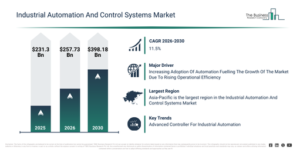
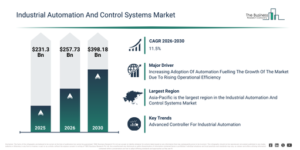
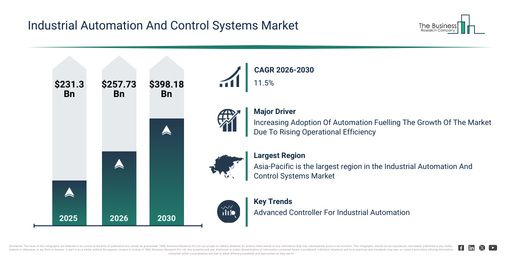
The market size for industrial automation and control systems has experienced substantial growth in recent years. This market is forecast to expand from $231.3 billion in 2025 to $257.73 billion in 2026, achieving a compound annual growth rate (CAGR) of 11.4%. The growth observed in the historical period can be attributed to increased programmable logic controller usage, reliance on early SCADA systems, wider adoption of industrial robotics, a heightened need for process consistency, and the development of basic machine automation technologies.
The industrial automation and control systems market is projected to experience substantial expansion over the upcoming years, with its size reaching $398.18 billion in 2030, demonstrating a compound annual growth rate (CAGR) of 11.5%. This anticipated growth is driven by factors such as increased spending on smart manufacturing, a greater need for real-time production oversight, the proliferation of autonomous industrial operations, the creation of energy-saving automation products, and the wider acceptance of predictive maintenance strategies. Key developments expected during this period involve the implementation of AI for optimizing industrial processes, the incorporation of autonomous robotic automation, the spread of IoT-enabled control frameworks, enhancements in digital manufacturing technologies, and the creation of cybersecure industrial automation platforms.
Free Industrial Automation And Control Systems Market Sample: Market Size, Growth Drivers And Competitive Landscape:
Industrial Automation And Control Systems Market Drivers Explained: What Is Supporting A 11.5% CAGR?
The growing embrace of automation is projected to fuel the expansion of the industrial automation and control systems market. Automation pertains to employing control systems and technologies to execute industrial processes with minimal human input. The increasing adoption of automation primarily stems from its capacity to substantially enhance operational efficiency through reduced labor costs and error minimization. Industrial automation and control systems contribute to this progress by enabling real-time process oversight, predictive maintenance, and seamless machine connectivity, thereby boosting overall productivity and product quality. A relevant illustration is the report from September 2024 by the International Federation of Robotics (IFR), a Germany-based non-profit organization, which indicated that industrial robot installations in the UK increased by 51%, reaching 3,830 units. Concurrently, in the Americas, more than 50,000 units were installed for the third consecutive year, amounting to 55,389 units in 2023. Thus, the increasing integration of automation is anticipated to drive considerable growth in the industrial automation and control systems market, notwithstanding potential substantial initial capital outlays.
Industrial Automation And Control Systems Market Segment Guide: Main Divisions And Subsegments
The industrial automation and control systems market covered in this report is segmented –
1) By Component: HMI (Human-Machine Interface), Industrial Robots, Control Valves, Sensors, Other Component
2) By Control System: DCS (Distributed Control System), PLC (Programmable Logic Controller), SCADA (Supervisory Control And Data Acquisition)
3) By End-User Industry: Aerospace And Defense, Automotive, Chemical, Energy And Utilities, Food And Beverage, Healthcare, Manufacturing, Mining And Metal, Oil And Gas, Transportation
Subsegments:
1) By HMI (Human-Machine Interface): Touchscreen HMIs, Software-based HMIs, Embedded HMIs
2) By Industrial Robots: Articulated Robots, SCARA Robots, Collaborative Robots (Cobots), Cartesian Robots
3) By Control Valves: Manual Control Valves, Automatic Control Valves, Pressure Relief Valves, Flow Control Valves
4) By Sensors: Proximity Sensors, Temperature Sensors, Pressure Sensors, Flow Sensors, Level Sensors
5) By Other Components: PLCs (Programmable Logic Controllers), Drives And Motors, Networking Equipment, Safety Systems
Industrial Automation And Control Systems Market Trends And Opportunities For 2026–2030
Leading firms in the industrial automation and control systems market are concentrating on creating sophisticated controllers, including integrated controllers, for industrial automation purposes. An integrated controller is defined as a device or system that merges various control functionalities into one unit. As an illustration, in April 2023, OMRON, an electronics company headquartered in Japan, introduced the NX502 CPU Unit, the newest product in its NX series, alongside the NX-EIP201 EtherNet/IP Unit. These units offer exceptional precision in data collection and high-capacity transfer abilities, thereby minimizing resource waste and facilitating real-time analytical processes. The NX502 stands as the inaugural integrated controller within the OMRON NX-Series, facilitating extensive and rapid safety operations and shortening the time required for modifying production lines.
Which Major Players Are Active In The Industrial Automation And Control Systems Market?
Major companies operating in the industrial automation and control systems market are ABB Ltd., Emerson Electric Co., Honeywell International Inc., Kawasaki Heavy Industries Ltd., Mitsubishi Electric Corporation, Omron Corporation, Rockwell Automation Inc., Schneider Electric SE, Siemens AG, Yokogawa Electric Corporation, Texas Instruments Inc., Robert Bosch GmbH, Fortive, Ametek EIG, Phoenix Contact GmbH & Co. KG, General Electric Company, Johnson Controls International plc, Fanuc Corporation, Advantech Co. Ltd., Bosch Rexroth AG, Beckhoff Automation GmbH & Co. KG, Eaton Corporation plc, National Instruments Corporation, Keyence Corporation, Delta Electronics Inc., Pilz GmbH & Co. KG, Danaher Corporation, Endress+Hauser Group, Pepperl+Fuchs AG, WAGO Kontakttechnik GmbH & Co. KG
Unlock The Complete Industrial Automation And Control Systems Market Report With Company Benchmarking:
Industrial Automation And Control Systems Market World Regions Compared: Which Leads In Revenue?
Asia-Pacific was the largest region in the industrial automation and control systems market in 2025 and is expected to be the fastest-growing region in the industrial automation and control systems market during the forecast period. The regions covered in the industrial automation and control systems market report are Asia-Pacific, South East Asia, Western Europe, Eastern Europe, North America, South America, Middle East, Africa.
Reach Out To Our Team:
The Business Research Company: https://www.thebusinessresearchcompany.com/
Americas: +1 310-496-7795
Asia: +44 7882 955267 & +91 8897263534
Europe: +44 7882 955267
Email us at: marketing@tbrc.info
Follow us on:
LinkedIn: https://in.linkedin.com/company/the-business-research-company
YouTube: https://www.youtube.com/channel/UC24_fI0rV8cR5DxlCpgmyFQ
Global Market Model: https://www.thebusinessresearchcompany.com/global-market-model

Wasay has over a decade of experience in market research, data modelling, and analytics, with prior experience at GlobalData and Decision Tree Consulting Services. At The Business Research Company , he leads research operations across syndicated studies, customized consulting engagements, and the Global Market Model platform. His professional experience includes supporting organizations such as Boston Consulting Group, KPMG, and Ernst & Young. Wasay holds a degree in Electronics and Communications Engineering, postgraduate management qualifications from International Management Institute Belgium and Indian School of Business and Entrepreneurship, and completed the Integrated Program in Business Analytics from Indian Institute of Management Indore.