Enhanced with market attractiveness analysis, total addressable market evaluation, company benchmarking matrices, interactive Excel dashboards, expanded supply chain intelligence, emerging startup coverage, and detailed product insights, The Business Research Company’s 2026 market reports deliver more actionable and strategically valuable research.
Instrument Cluster Market Growth Potential: How Will Market Size Change Through 2030?
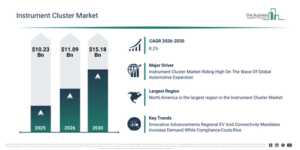
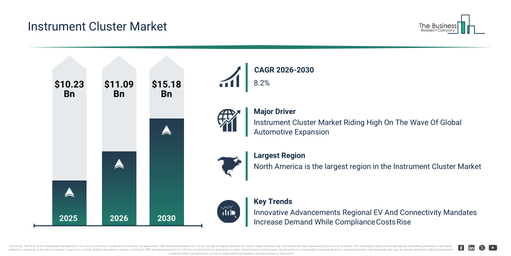
The instrument cluster market size has seen significant growth over recent years. It is anticipated to increase from $10.23 billion in 2025 to $11.09 billion in 2026, at a compound annual growth rate (CAGR) of 8.4%. This historical expansion can be linked to the greater adoption of digital displays, a rise in vehicle manufacturing, the demand for driver safety features, enhancements in display technology, and regulatory demands for vehicle instrumentation.
The instrument cluster market is projected to undergo substantial expansion in the coming years, with its valuation expected to reach $15.18 billion by 2030, demonstrating a compound annual growth rate (CAGR) of 8.2%. This growth over the forecast period is primarily driven by the increasing prevalence of electric vehicles, the integration of AI-based driver assistance systems, a rising demand for connected vehicles, advancements in touchscreen and OLED technologies, and the expansion of autonomous vehicle programs. Significant trends anticipated during this period include advanced driver information systems, connected vehicle dashboards, heads-up display integration, customizable digital interfaces, and real-time vehicle diagnostics.
Download A Free Sample Report For Comprehensive Market Insights:
Instrument Cluster Market Opportunity Drivers: What Is Creating New Revenue Potential?
The expansion in automotive vehicle manufacturing is anticipated to drive the advancement of the instrument cluster market in the future. Automotive vehicle production encompasses the entire process of making and putting together vehicles such as cars, trucks, motorcycles, and other motorized transport. Within these vehicles, the instrument cluster is a vital dashboard element, supplying drivers with critical operational data like speed, temperature, engine RPM monitoring, fuel level indication, and odometer readings. As an illustration, in March 2023, the European Automobile Manufacturers Association (ACEA), a Belgium-based trade group, reported that worldwide car production achieved approximately 76 million units, marking a 10.2 % rise compared to 2022. Consequently, the increasing volume of automotive vehicle production is fueling the expansion of the instrument cluster market.
Instrument Cluster Market Segment Analysis: What Are The Major Market Categories?
The instrument cluster market covered in this report is segmented –
1) By Type: Analog, Digital
2) By Vehicle Type: Passenger Cars, Two-Wheelers, Buses And Coaches, Light Commercial Vehicles, Heavy Trucks
3) By Application: Speedometer, Odometer, Tachometer, Other Applications
Subsegments:
1) By Analog: Mechanical Analog Cluster, Electromechanical Analog Cluster
2) By Digital: LCD Digital Cluster, TFT Digital Cluster, OLED Digital Cluster
Instrument Cluster Market Industry Trends: What Changes Are Reshaping Demand?
Leading firms within the instrument cluster sector are prioritizing the introduction of comprehensive digital cockpit platforms, like integrated infotainment and telematics cluster systems, with the goal of improving the driver’s experience, streamlining vehicle electronic components, and ensuring uninterrupted connectivity for infotainment, navigation, and telematics capabilities. The term compliance cost pressures denotes the extra expenses and intricacy arising from statutory or regulatory mandates concerning connectivity, operational safety, and cybersecurity within automotive cockpit systems. As an illustration, in April 2024, Marelli, an automotive technology enterprise based in Japan, unveiled ProConnect, an innovative platform highlighting 5G telematics (Release 15) and accommodating multiple cameras and displays within contemporary cockpit designs. While the necessity to incorporate these connectivity features boosts the instrument cluster market through elevated specification standards, it simultaneously introduces additional costs and complications, potentially impeding deployment in markets sensitive to pricing.
Instrument Cluster Market Leading Companies Driving Competitive Growth
Major companies operating in the instrument cluster market are Continental AG, Visteon Corporation, Denso Corporation, Nippon Seiki Co. Ltd., Robert Bosch GmbH, Magneti Marelli S.p.A., Yazaki Corporation, Panasonic Automotive Systems Co., Ltd., Mitsubishi Electric Corporation, Stoneridge Inc., JNS Instruments Limited, Pricol Limited, UNO Minda Group (Minda Industries Limited), Marelli Corporation, Valeo SA, Aptiv plc, Kyocera Display Corporation, LG Electronics Inc. (Vehicle Components Division), HyundAI Mobis Co., Ltd., Renesas Electronics Corporation.
Access The Complete Instrument Cluster Market Report:
Instrument Cluster Market Global Footprint: Which Region Holds Market Leadership?
North America was the largest region in the Instrument Cluster market in 2025. The regions covered in the instrument cluster market report are Asia-Pacific, South East Asia, Western Europe, Eastern Europe, North America, South America, Middle East, Africa.
Get in touch with us:
The Business Research Company: https://www.thebusinessresearchcompany.com/
Americas: +1 310-496-7795
Asia: +44 7882 955267 & +91 8897263534
Europe: +44 7882 955267
Email us at: marketing@tbrc.info
Follow us on:
LinkedIn: https://in.linkedin.com/company/the-business-research-company
YouTube: https://www.youtube.com/channel/UC24_fI0rV8cR5DxlCpgmyFQ
Global Market Model: https://www.thebusinessresearchcompany.com/global-market-model

Wasay has over a decade of experience in market research, data modelling, and analytics, with prior experience at GlobalData and Decision Tree Consulting Services. At The Business Research Company , he leads research operations across syndicated studies, customized consulting engagements, and the Global Market Model platform. His professional experience includes supporting organizations such as Boston Consulting Group, KPMG, and Ernst & Young. Wasay holds a degree in Electronics and Communications Engineering, postgraduate management qualifications from International Management Institute Belgium and Indian School of Business and Entrepreneurship, and completed the Integrated Program in Business Analytics from Indian Institute of Management Indore.