Delivering more actionable and strategically valuable research, The Business Research Company’s 2026 market reports feature market attractiveness analysis, total addressable market evaluation, company benchmarking matrices, interactive Excel dashboards, expanded supply chain intelligence, emerging startup coverage, and detailed product insights.
Intelligent Sensors Market Forecast: What Market Value Is Expected By 2030?
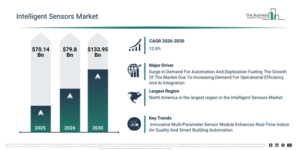
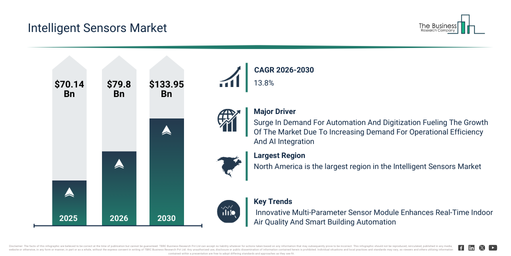
The intelligent sensors market has experienced significant growth in its size over recent years. It is forecast to increase from $70.14 billion in 2025 to $79.8 billion in 2026, achieving a compound annual growth rate (CAGR) of 13.8%. This historical growth can be attributed to several factors such as increased industrial automation, the expansion of consumer electronics, the widespread adoption of embedded systems, a rising demand for smart automotive components, and the broadening of aerospace and defense applications.
The market for intelligent sensors is projected to experience substantial expansion over the coming years, with its size anticipated to reach $133.95 billion by 2030, demonstrating a compound annual growth rate (CAGR) of 13.8%. This growth during the forecast period is primarily driven by advancements in AI-powered sensing, improved integration with IoT ecosystems, increasing demand for energy-efficient sensors, broader adoption in smart city infrastructure, and the development of multi-sensor platforms. Additionally, significant trends expected to shape this period include miniaturization and integration, wider adoption of edge computing, the use of real-time data analytics, a focus on predictive maintenance, and advancements in wireless connectivity.
Download A Free Sample Report For Comprehensive Market Insights:
Intelligent Sensors Market Opportunity Drivers: What Is Creating New Revenue Potential?
The escalating demand for automation is projected to drive the growth of the intelligent sensors market moving forward. Automation refers to the application of technology to tasks or operations with very little human involvement. The rising need for automation stems from the desire for increased operational efficiency as businesses aim to lower costs and boost productivity by minimizing manual labor and errors. Intelligent sensors enable real-time data collection and decision-making, allowing automation systems to respond accurately and autonomously to changing conditions without human input. For instance, in April 2024, according to the International Federation of Robotics, a Germany-based international organization, manufacturing companies in the United States have significantly intensified their automation efforts, with total industrial robot installations increasing 12% to 44,303 units in 2023. Thus, the increasing requirement for automation is propelling the expansion of the intelligent sensors market.
Intelligent Sensors Market Segment Breakdown: Which Categories Generate The Most Revenue?
The intelligent sensors market covered in this report is segmented –
1) By Type: Humidity, Pressure, Motion, Other Types
2) By Technology: Micro-Electro-Mechanical Systems (MEMS), Complementary Metal-Oxide-Semiconductor (CMOS), Other Technologies
3) By Application: Aerospace And Defense, Automotive, Other Applications
Subsegments:
1) By Humidity: Capacitive Humidity Sensors, Resistive Humidity Sensors, Thermal Conductivity Humidity Sensors
2) By Pressure: Absolute Pressure Sensors, Gauge Pressure Sensors, Differential Pressure Sensors, Sealed Pressure Sensors
3) By Motion: Accelerometers, Gyroscopes, Magnetometers, Inertial Measurement Units (IMUs)
4) By Other Types: Temperature Sensors, Proximity Sensors, Image Sensors, Touch Sensors, Gas Sensors, Flow Sensors
Intelligent Sensors Market Innovation Trends: Which Developments Are Transforming The Industry?
Companies that are key players in the intelligent sensors market are concentrating their efforts on creating advanced solutions, such as multi parameter indoor air quality sensor modules. These innovations aim to improve real-time tracking, foster healthier conditions, and facilitate smart building automation. A multi parameter indoor air quality sensor module is defined as a device designed to concurrently assess several air quality elements, including temperature, humidity, carbon dioxide (CO₂), volatile organic compounds (VOCs), and particulate matter (PM), thereby ensuring the maintenance of healthy indoor spaces. As an illustration, in August 2024, Renesas Electronics Corporation, a semiconductor firm based in Japan, introduced the RRH62000. This is an extremely compact, integrated sensor module intended for intelligent indoor air quality surveillance in residential buildings, educational institutions, and public facilities. The module provides as many as seven concurrent sensor readings, encompassing laser-based detection of particulate matter (PM1, PM2.5, PM10), total volatile organic compounds (TVOC), estimated carbon dioxide (eCO2), temperature, and humidity. It is equipped with an integrated Renesas RA microcontroller unit (MCU) featuring AI-enhanced firmware, which enables continuous air quality monitoring and adherence to international guidelines such as WELL and RESET. Furthermore, the module supports AI-powered demand-controlled ventilation for HVAC systems, leading to optimized airflow, forecasted filter replacements, anomaly detection, enhanced energy efficiency, and lower maintenance expenditures.
Intelligent Sensors Market Key Players And Strategic Industry Positioning
Major companies operating in the intelligent sensors market are Qualcomm Incorporated, Honeywell International Inc., ABB Ltd, Eaton Corporation plc, Texas Instruments Incorporated, TDK Corporation, STMicroelectronics N.V., Infineon Technologies AG, NXP Semiconductors N.V., Analog Devices Inc., Renesas Electronics Corporation, Rockwell Automation Inc., Omron Corporation, Vishay Intertechnology Inc., Sick AG, ifm electronic gmbh, Balluff GmbH, Sensirion AG, CEVA Inc., Bosch Sensortec GmbH
Access The Complete Intelligent Sensors Market Report:
Intelligent Sensors Market Geographic Analysis: Where Is Demand Growing The Fastest?
North America was the largest region in the intelligent sensors market in 2025. Asia-Pacific is expected to be the fastest-growing region in the forecast period. The regions covered in the intelligent sensors market report are Asia-Pacific, South East Asia, Western Europe, Eastern Europe, North America, South America, Middle East, Africa.
Get in touch with us:
The Business Research Company: https://www.thebusinessresearchcompany.com/
Americas: +1 310-496-7795
Asia: +44 7882 955267 & +91 8897263534
Europe: +44 7882 955267
Email us at: marketing@tbrc.info
Follow us on:
LinkedIn: https://in.linkedin.com/company/the-business-research-company
YouTube: https://www.youtube.com/channel/UC24_fI0rV8cR5DxlCpgmyFQ
Global Market Model: https://www.thebusinessresearchcompany.com/global-market-model

Wasay has over a decade of experience in market research, data modelling, and analytics, with prior experience at GlobalData and Decision Tree Consulting Services. At The Business Research Company , he leads research operations across syndicated studies, customized consulting engagements, and the Global Market Model platform. His professional experience includes supporting organizations such as Boston Consulting Group, KPMG, and Ernst & Young. Wasay holds a degree in Electronics and Communications Engineering, postgraduate management qualifications from International Management Institute Belgium and Indian School of Business and Entrepreneurship, and completed the Integrated Program in Business Analytics from Indian Institute of Management Indore.