Featuring market attractiveness scoring, total addressable market sizing, company benchmarking matrices, interactive Excel dashboards, deeper supply chain intelligence, emerging startup tracking, and granular product-level insights, The Business Research Company’s 2026 market reports are built to deliver research that is both more actionable and more strategically valuable.
Interior Lighting Market Growth Analysis: How Will Revenue Trend Over The Forecast Period?
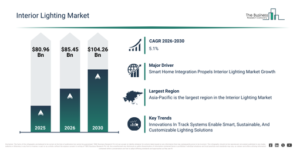
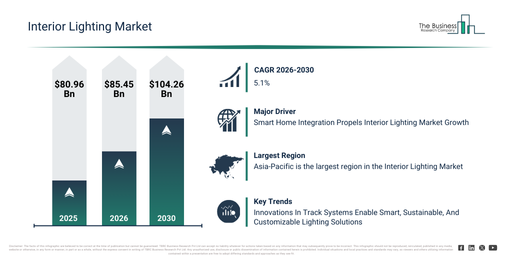
The interior lighting market size has demonstrated robust expansion in recent years. It is projected to grow from $80.96 billion in 2025 to $85.45 billion in 2026, at a compound annual growth rate (CAGR) of 5.5%. This growth observed in the historic period is largely due to factors such as urbanization and the increase in residential construction, the replacement of incandescent and fluorescent lighting, rising commercial building development, declining LED costs, and an increasing focus on indoor aesthetics.
The interior lighting market is projected to experience substantial expansion over the upcoming years. This market is anticipated to reach a valuation of $104.26 billion by 2030, demonstrating a compound annual growth rate (CAGR) of 5.1%. This projected growth can be ascribed to several factors, including the increasing integration of smart homes, a heightened need for energy optimization, the expansion of commercial interior refurbishment projects, a rise in consumer expenditure on high-end interior designs, and the integration of IoT-enabled lighting solutions. Key developments expected during this period involve the increasing embrace of smart and interconnected interior lighting, a growing inclination towards energy-efficient LED interior options, a greater demand for human-centric and adaptive lighting, the proliferation of modular and customizable lighting aesthetics, and an increasing incorporation of architecturally focused aesthetic lighting.
Get A Free Sample Report With In-Depth Market Insights:
Interior Lighting Market Growth Factors: What’s Supporting Expansion?
The interior lighting market is anticipated to expand due to the rising prevalence of smart homes in developing nations. Smart homes are defined as residences featuring internet-connected devices that facilitate automated and remote management of systems such as lighting, heating, security, and entertainment. This increase in smart homes in developing countries stems from higher disposable incomes, improved technological access, and a growing desire for convenience and energy efficiency. The necessity for interior lighting is crucial for influencing the ambiance, utility, and visual appeal of indoor environments, which in turn encourages the adoption of smart technologies to enhance energy efficiency, user convenience, and personalization in contemporary homes. For example, in May 2024, Netguru S.A., a software development firm located in Poland, reported that in 2023, the count of U.S. households utilizing smart home devices reached 63.43 million, showing a 10.2% rise from the previous year. Consequently, the increasing adoption of smart homes in developing countries will fuel the interior lighting market.
Interior Lighting Market Segment Trends And Revenue Contributors
The interior lighting market covered in this report is segmented –
1) By Type: General Lighting, Ambient Lighting, Task Lighting, Mood Lighting, Accent Lighting
2) By Lighting Effect: Downlighting, Uplighting, Wall Washing, Wall Grazing, Spotlighting, Perimeter Lighting, Other Lighting Effects
3) By End Use: Residential, Commercial, Other End-Uses
Subsegments:
1) By General Lighting: Ceiling Lights, Downlights, LED Panels, Fluorescent Lights
2) By Ambient Lighting: Recessed Lighting, Chandeliers, Pendant Lights, Cove Lighting
3) By Task Lighting: Desk Lamps, Reading Lights, Under-Cabinet Lighting, Workbench Lighting
4) By Mood Lighting: LED Strips, Smart Lights, Floor Lamps, Dimmable Lights
5) By Accent Lighting: Wall Sconces, Spotlights, Track Lighting, Picture Lights
Interior Lighting Market Industry Trends: What’s Reshaping Demand?
Leading businesses within the interior lighting sector are increasingly prioritizing novel approaches, including track systems, to enhance versatility in lighting, personalize designs, and boost energy conservation, simultaneously offering engaging and tailored environments across residential, commercial, and hospitality settings. These track systems are mechanisms enabling light fixtures to traverse a predetermined path, ensuring both stability and precise directional guidance. An illustrative instance occurred in January 2024 when Signify, a Netherlands-based traded multinational corporation, unveiled the Philips Hue Dymera wall light, distinguished by its independently adjustable up and down beams suitable for both indoor and outdoor applications. The Dymera integrates a spectrum from warm-to-cool white to full color lighting, with each beam possessing individual dimming capabilities, and facilitates the crafting of scenes through the Philips Hue app. Furthermore, Philips Hue also rolled out Perifo track lighting connectors, allowing for diverse track configurations, alongside a pendant cord crafted from 55% bio-circular material, underscoring a commitment to sustainable aesthetics. Such advancements elevate visual appeal, energy performance, and user-specific adaptability, serving as a testament to the expanding movement of incorporating smart technology and environmental responsibility into high-end lighting offerings.
Interior Lighting Market Competitive Landscape: Which Companies Lead The Industry?
Major companies operating in the interior lighting market are Samsung Electronics Co. Ltd., Panasonic Corporation, Eaton Corporation Plc, Koninklijke Philips N.V., Stanley Black & Decker Inc., Signify Holding B.V., Osram Licht AG, Hubbell Inc., Acuity Brands Inc., Hafele Gmbh & Co., Havells India Ltd., Zumtobel Group AG, Cree Lighting USA LLC, Lutron Electronics Co. Inc., Thorn Lighting Ltd., GE Lighting, Kichler Lighting LLC, Tech Lighting LLC, Craftmade International Inc., WAC Lighting, Quoizel Inc., Hinkley Lighting Inc., Sea Gull Lighting, Maxim Lighting International Inc., Lighting New York, Csl Lighting Inc., Murray Feiss Light
View The Full Interior Lighting Market Report:
Interior Lighting Market Top Region: Where Does Most Revenue Come From?
Asia-Pacific was the largest region in the interior lighting market in 2025. The regions covered in the interior lighting market report are Asia-Pacific, South East Asia, Western Europe, Eastern Europe, North America, South America, Middle East, Africa.
Reach Out To Our Team:
The Business Research Company: https://www.thebusinessresearchcompany.com/
Americas: +1 310-496-7795
Asia: +44 7882 955267 & +91 8897263534
Europe: +44 7882 955267
Email us at: marketing@tbrc.info
Follow us on:
LinkedIn: https://in.linkedin.com/company/the-business-research-company
YouTube: https://www.youtube.com/channel/UC24_fI0rV8cR5DxlCpgmyFQ
Global Market Model: https://www.thebusinessresearchcompany.com/global-market-model

Wasay has over a decade of experience in market research, data modelling, and analytics, with prior experience at GlobalData and Decision Tree Consulting Services. At The Business Research Company , he leads research operations across syndicated studies, customized consulting engagements, and the Global Market Model platform. His professional experience includes supporting organizations such as Boston Consulting Group, KPMG, and Ernst & Young. Wasay holds a degree in Electronics and Communications Engineering, postgraduate management qualifications from International Management Institute Belgium and Indian School of Business and Entrepreneurship, and completed the Integrated Program in Business Analytics from Indian Institute of Management Indore.