Featuring market attractiveness scoring, total addressable market sizing, company benchmarking matrices, interactive Excel dashboards, deeper supply chain intelligence, emerging startup tracking, and granular product-level insights, The Business Research Company’s 2026 market reports are built to deliver research that is both more actionable and more strategically valuable.
IOT Sensors Market Value Growth And Long-Term Outlook
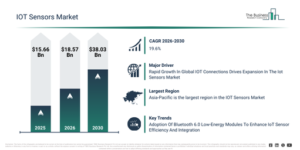
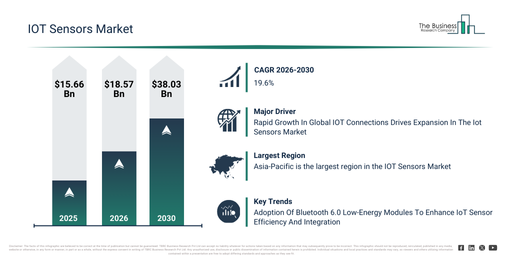
The iot sensors market size has experienced rapid growth in recent years. It is projected to expand from $15.66 billion in 2025 to $18.57 billion in 2026, demonstrating a compound annual growth rate (CAGR) of 18.6%. The historical expansion of this market can be linked to advancements in MEMS technology, the early adoption of industrial automation, the increasing deployment of sensors in consumer electronics, the rise of basic environmental monitoring solutions, and the development of low-power wireless communication standards.
The iot sensors market is anticipated to experience significant expansion in the coming years, with its size projected to reach $38.03 billion by 2030, demonstrating a compound annual growth rate (CAGR) of 19.6%. This projected growth is driven by several factors, including the expanding smart city infrastructure, the rapid proliferation of connected and autonomous systems, a surging demand for predictive maintenance, the widespread adoption of edge iot platforms, and the increasing incorporation of sensors into healthcare diagnostics. Key trends anticipated during this period encompass IOT-driven multi-parameter sensing integration, real-time cloud-connected sensor analytics, AI-powered predictive sensing solutions, the development of energy-efficient and sustainable sensor designs, and the growing deployment of sensors within autonomous and robotic systems.
Get A Free Sample Report With In-Depth Market Insights:
IOT Sensors Market Growth Factors Behind Sustained Expansion
The escalating deployment of Internet of Things (IoT) devices is anticipated to fuel expansion within the Internet of Things (IoT) sensors market. Internet of Things (IoT) devices, which encompass non-standard computing hardware like sensors, actuators, appliances, or machines, establish wireless connections to networks, facilitating data transmission over the internet or other networks. Crucially, Internet of Things (IoT) sensors serve as a vital element within Internet of Things (IoT) devices, allowing them to capture data through the detection of environmental changes. For instance, in April 2025, according to Ericsson, a Sweden-based telecommunications company, global IoT connections reached 18.8 billion connections in 2024 and are expected to increase to 43.0 billion connections by 2030. Therefore, the rising adoption of Internet of Things (IoT) devices is set to propel the growth of the Internet of Things (IoT) sensors market moving forward.
IOT Sensors Market Breakdown By Product Type And Application
The iot sensors market covered in this report is segmented –
1) By Product Type: Temperature sensors, Pressure sensors, Humidity sensors, Flow sensors, Accelerometers, Magnetometers, Gyroscopes, Inertial sensors, Image sensors, Other Product Types
2) By Application: Building Automation, Industrial Application, Automotive Application, Healthcare Application, Retailing And Logistics Application, Security Application, Agriculture Application, Other Applications
3) By End-user Industry: Healthcare, Automotive and Transportation, Manufacturing / Industrial, Other End-Users
Subsegments:
1) By Temperature Sensors: Thermocouples, RTDs (Resistance Temperature Detectors), Thermistors, Infrared Sensors, Bimetallic Sensors
2) By Pressure Sensors: Piezoresistive Pressure Sensors, Capacitive Pressure Sensors, Strain Gauge Pressure Sensors, Optical Pressure Sensors, Resonant Pressure Sensors
3) By Humidity Sensors: Capacitive Humidity Sensors, Resistive Humidity Sensors, Thermal Conductivity Humidity Sensors, Gravimetric Humidity Sensors
4) By Flow Sensors: Electromagnetic Flow Meters, Ultrasonic Flow Meters, Thermal Mass Flow Meters, Coriolis Flow Meters, Differential Pressure Flow Meters
5) By Accelerometers: MEMS Accelerometers, Piezoelectric Accelerometers, Capacitive Accelerometers
6) By Magnetometers: Hall Effect Magnetometers, Anisotropic Magnetoresistive (AMR) Magnetometers, Giant Magnetoresistive (GMR) Magnetometers
7) By Gyroscopes: MEMS Gyroscopes, Fiber Optic Gyroscopes, Ring Laser Gyroscopes, Mechanical Gyroscopes
8) By Inertial Sensors: Inertial Measurement Units (IMUs), Microelectromechanical Systems (MEMS) Sensors, Fiber Optic Gyroscopes
9) By Image Sensors: CMOS Image Sensors, CCD Image Sensors, Infrared Image Sensors
10) By Other Product Types: Gas Sensors, Proximity Sensors, Light Sensors, pH Sensors, Soil Moisture Sensors
IOT Sensors Market Industry Trends Fueling Future Revenue Growth
Leading companies within the IoT sensors market are adopting Bluetooth 6.0 low-energy system-level modules, which incorporate advanced SoCs, to boost performance, decrease power consumption, and streamline sensor integration. These modules integrate radio and MCU functions, allowing for ultra-compact, multi-protocol operations compatible with Bluetooth 6.0, Thread, Matter, and Zigbee, thereby aiding the creation of smaller, more energy-efficient IoT devices that offer longer battery life. For instance, in September 2025, MinewSemi, a China-based wireless modules company, introduced the ME54BS61 and ME54BS12 Bluetooth 6.0 low-energy modules. Both modules are built on Nordic Semiconductor’s nRF54L15 SoC and are specifically designed for space-constrained and ultra-low-power IoT endpoints. They feature compact package options, with the ME54BS61 targeting 6×6 mm designs, multi-protocol 2.4 GHz connectivity, and enhanced on-module processing driven by an Arm Cortex-M33 core with advanced memory support. This configuration enables local edge processing, reduces power draw, and improves device integration for next-generation IoT sensor applications.
IOT Sensors Market Company Landscape And Competitive Strategy
Major companies operating in the iot sensors market are Texas Instruments, TE Connectivity, NXP Semiconductors, STMicroelectronics, TDK Corporation, Honeywell International, Sensata Technologies, Broadcom Inc., Bosch, Analog Devices, Siemens AG, General Electric Company, Monnit Corporation, Murata Manufacturing Co., Ltd., Sensirion AG, Silicon Laboratories Inc., ABB Ltd., Schneider Electric SE, Qualcomm Incorporated, Canon Inc., Skyworks Solutions, Inc., Infineon Technologies AG, Omron Corporation, Intel Corporation
View The Full IOT Sensors Market Report:
IOT Sensors Market Geographic Landscape: Which Region Leads Industry Growth?
Asia-Pacific was the largest region in the IoT sensors market in 2025. North America was the second-largest region in the IoT sensors market. The regions covered in the iot sensors market report are Asia-Pacific, South East Asia, Western Europe, Eastern Europe, North America, South America, Middle East, Africa.
Reach Out To Our Team:
The Business Research Company: https://www.thebusinessresearchcompany.com/
Americas: +1 310-496-7795
Asia: +44 7882 955267 & +91 8897263534
Europe: +44 7882 955267
Email us at: marketing@tbrc.info
Follow us on:
LinkedIn: https://in.linkedin.com/company/the-business-research-company
YouTube: https://www.youtube.com/channel/UC24_fI0rV8cR5DxlCpgmyFQ
Global Market Model: https://www.thebusinessresearchcompany.com/global-market-model

Wasay has over a decade of experience in market research, data modelling, and analytics, with prior experience at GlobalData and Decision Tree Consulting Services. At The Business Research Company , he leads research operations across syndicated studies, customized consulting engagements, and the Global Market Model platform. His professional experience includes supporting organizations such as Boston Consulting Group, KPMG, and Ernst & Young. Wasay holds a degree in Electronics and Communications Engineering, postgraduate management qualifications from International Management Institute Belgium and Indian School of Business and Entrepreneurship, and completed the Integrated Program in Business Analytics from Indian Institute of Management Indore.