Through market attractiveness analysis, total addressable market evaluation, company benchmarking matrices, interactive Excel dashboards, expanded supply chain intelligence, emerging startup coverage, and detailed product insights, The Business Research Company’s 2026 market reports provide more actionable and strategically valuable research.
Low Light Imaging Market Growth Analysis: How Will Revenue Expand During The Forecast Period?
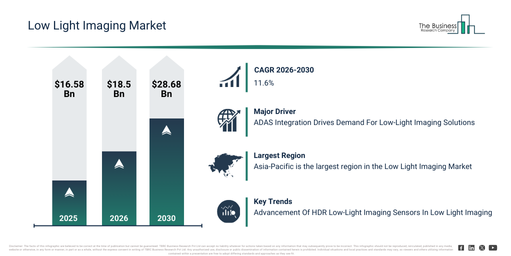
The low light imaging market has experienced significant growth recently. It is forecast to rise from $16.58 billion in 2025 to $18.5 billion in 2026, driven by a compound annual growth rate (CAGR) of 11.6%. The historical expansion can be credited to various factors, including an increase in surveillance and security applications, early adoption in scientific imaging, broader utilization in astronomy and fluorescence studies, reliance on ccd and early cmos sensors, and the expansion in industrial and automotive night vision technologies.
The low light imaging market is anticipated to experience substantial expansion in the coming years. This sector is projected to reach a valuation of $28.68 billion by 2030, exhibiting a compound annual growth rate (CAGR) of 11.6%. The impetus for this growth during the forecast period stems from factors such as increasing demand for sophisticated CMOS and BSI sensors, their growing application in autonomous vehicles and intelligent infrastructure, the enlargement of medical and life sciences imaging, advancements in defense-related night vision technologies, and the creation of highly sensitive imaging platforms. Key developments foreseen for this period encompass the emergence of intelligent low-light imaging systems, progress in AI-powered night vision solutions, the proliferation of digitally interconnected imaging setups, the incorporation of smart autonomous detection capabilities, and the widespread adoption of high-performance image processing systems.
Download A Free Sample Report For Comprehensive Market Insights:
#Low Light Imaging Market Growth Factors: Which Forces Are Supporting Market Expansion?
The rapid integration of advanced driver assistance systems (ADAS) into automobiles is anticipated to propel the growth of the low-light imaging market in the coming period. Advanced driver-assistance systems (ADAS) are vehicular electronic components that offer support to drivers through the application of sophisticated technologies. The uptake of advanced driver assistance systems (ADAS) for vehicles is increasing, driven by a greater emphasis on improving vehicle safety and preventing accidents. Low-light imaging is instrumental in advanced driver assistance systems (ADAS) for enhancing vehicle visibility and detecting objects under dark or low-light conditions. For instance, in February 2023, data from Compass IoT, an Australia-based startup focused on leveraging connected vehicle data for road safety and urban planning, revealed that Australia currently has more than 1 million connected vehicles, a number projected to expand tenfold by 2030. Therefore, the swift adoption of advanced driver assistance systems (ADAS) in automobiles is a key factor driving the expansion of the low-light imaging market.
Low Light Imaging Market Segment Landscape: Which Areas Lead Market Development?
The low light imaging market covered in this report is segmented –
1) By Technology: Complementary Metal-Oxide Semiconductor (CMOS), Charge-Coupled Device (CCD)
2) By Application: Photography, Monitoring, Inspection And Detection, Security And Surveillance
3) By Vertical: Consumer Electronics, Automotive, Medical And Life Sciences, Military And Defense, Industrial, Commercial And Residential Infrastructure
Subsegments:
1) By Complementary Metal-Oxide Semiconductor (CMOS): Standard CMOS Sensors, Backside-Illuminated (BSI) CMOS Sensors, Global Shutter CMOS Sensors
2) By Charge-Coupled Device (CCD): Full-Frame CCD Sensors, Interline Transfer CCD Sensors, Scientific CCD Sensors
Low Light Imaging Market Transformation Trends: Which Innovations Are Driving Change?
Major companies in the Low Light Imaging market are dedicated to creating innovative products, such as HDR low-light USB cameras—high-dynamic-range imaging devices designed to capture clear visuals in minimal lighting by combining advanced sensor technology and flicker mitigation—to gain a competitive edge. For instance, in July 2024, e con Systems, an India-based embedded vision company, introduced the See3CAM_CU31, a 3 MP HDR low-light USB camera featuring up to 120 dB HDR, LED flicker mitigation, and industrial-temperature operation from –40 °C to 85 °C. This trend highlights the increasing demand for imaging solutions capable of reliable performance in dark or variable lighting conditions across sectors like surveillance, transportation, and robotics; however, adoption may be limited by higher costs and integration complexity with legacy systems.
Low Light Imaging Market Industry Leaders And Market Competition
Major companies operating in the low light imaging market are Sony Group, Samsung Electronics, Omnivision Technologies, STMicroelectronics Inc, Teledyne FLIR LLC, on Semiconductor, Panasonic Holdings Corporation, Hamamatsu Photonics, ROHM CO. Ltd., Photonis Technologies Sas, Pixart Imaging, Pixelplus, Ruixin Microelectronics Co. Ltd., Canon Inc., Fairchild Imaging Systems, BAE System, Cobham Limited, Honeywell International Inc., L3Harris Technologies Inc., Raytheon Technologies Corporation, Thales Group, Appareo, Himax Technologies Inc., Sharp Corporation
Access The Complete Low Light Imaging Market Report:
Low Light Imaging Market Regional Analysis And Leading Geography
Asia-Pacific was the largest region in the low-light imaging market in 2025. Asia-Pacific is expected to be the fastest-growing region in the low light imaging market during the forecast period. The regions covered in the low light imaging market report are Asia-Pacific, South East Asia, Western Europe, Eastern Europe, North America, South America, Middle East, Africa.
Get in touch with us:
The Business Research Company: https://www.thebusinessresearchcompany.com/
Americas: +1 310-496-7795
Asia: +44 7882 955267 & +91 8897263534
Europe: +44 7882 955267
Email us at: marketing@tbrc.info
Follow us on:
LinkedIn: https://in.linkedin.com/company/the-business-research-company
YouTube: https://www.youtube.com/channel/UC24_fI0rV8cR5DxlCpgmyFQ
Global Market Model: https://www.thebusinessresearchcompany.com/global-market-model

Wasay has over a decade of experience in market research, data modelling, and analytics, with prior experience at GlobalData and Decision Tree Consulting Services. At The Business Research Company , he leads research operations across syndicated studies, customized consulting engagements, and the Global Market Model platform. His professional experience includes supporting organizations such as Boston Consulting Group, KPMG, and Ernst & Young. Wasay holds a degree in Electronics and Communications Engineering, postgraduate management qualifications from International Management Institute Belgium and Indian School of Business and Entrepreneurship, and completed the Integrated Program in Business Analytics from Indian Institute of Management Indore.