Built to provide research that’s more actionable and strategically valuable, The Business Research Company’s 2026 market reports include market attractiveness analysis, total addressable market sizing, company benchmarking matrices, interactive Excel dashboards, broader supply chain intelligence, emerging startup tracking, and in-depth product insights.
Maritime Safety System Market Size Outlook: How Quickly Will Revenue Expand Through 2030?
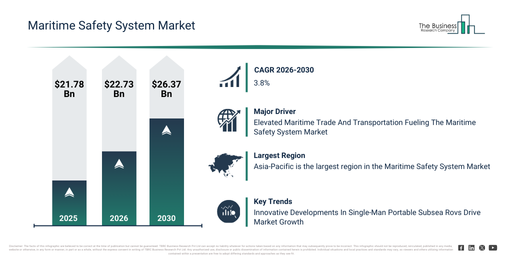
The maritime safety system market has experienced consistent expansion in its size over the past few years. This market is projected to expand from $21.78 billion in 2025 to $22.73 billion by 2026, demonstrating a compound annual growth rate (CAGR) of 4.4%. Key factors contributing to this historical growth include the early adoption in commercial shipping, the dependence on traditional monitoring systems, the initial rollout in oil & gas shipping, the advancements in vessel tracking technologies, and the implementation of cargo management solutions.
The maritime safety system market is projected to experience consistent expansion over the upcoming years, with its size forecast to reach $26.37 billion by 2030, demonstrating a compound annual growth rate (CAGR) of 3.8%. This growth during the forecast period can be attributed to the increasing adoption of AIS and GMDSS, integration with automated incident reporting, expansion in coastal and offshore safety systems, rising demand for anti-piracy technologies, and the development of smart vessel monitoring solutions. Major trends anticipated in this period include the deployment of real-time maritime tracking systems, the integration of advanced navigation solutions, the adoption of satellite-based monitoring, the implementation of automated security protocols, and the expansion of smart maritime safety systems.
Get A Free Sample Report With In-Depth Market Insights:
Maritime Safety System Market Demand Drivers: What’s Powering Industry Growth?
The maritime safety system market is anticipated to be driven forward by the expansion of maritime trade and transportation. This is supported by an increase in consumer well-being, which leads to higher production, and the ability of maritime trade and transportation to ensure lower emissions on long voyages, helping producers maintain competitiveness. Sea transport is recognized for moving a greater volume of products per trip, rendering it more cost-effective and environmentally sound compared to other methods for long-distance shipping. For illustration, in July 2023, the United Nations Conference on Trade and Development (UNCTAD), a Switzerland-based UN agency, projected that the overall maritime trade volume would grow by 2.4 per cent in 2023. While containerized trade, measured in metric tons, experienced a 3.7 per cent decline in 2022, UNCTAD forecasts it will increase by 1.2 per cent in 2023 and expand by over 3 per cent during the 2024–2028 period. Additionally, in 2022, oil and gas trade volumes exhibited robust annual growth rates of 6 per cent and 4.6 per cent, respectively. Therefore, the increasing maritime trade and transportation will propel the growth of the maritime safety system market.
Maritime Safety System Market Segment Landscape: Which Areas Lead Development?
The maritime safety system market covered in this report is segmented –
1) By System: Ship Security Reporting System, Automatic Identification System (AIS), Global Maritime Distress Safety System (GMDSS), Long Range Tracking and Identification (LRIT) System, Vessel Monitoring and Management System, Other Systems
2) By Application: Loss prevention and detection, Security management, Counter piracy, Coastal monitoring, Safety of ship, Pollution Prevention and Response (PPR) management
3) By End User: Government Institutions, Oil & Gas, Marine & construction, Shipping & Transportation, Cargos & containers, Other End-Users
Subsegments:
1) By Ship Security Reporting System: Real-time Ship Reporting, Incident Reporting
2) By Automatic Identification System (AIS): Class A (AIS), Class B AIS
3) By Global Maritime Distress Safety System (GMDSS): Search and Rescue Equipment, Emergency Position Indicating Radio Beacons (EPIRB), Maritime Safety Information (MSI)
4) By Long Range Tracking and Identification (LRIT) System: Satellite-based Tracking, Coastal Tracking
5) By Vessel Monitoring and Management System: Fleet Management, Navigation Systems
6) By Other Systems: Radar Systems, Surveillance Systems, Communication Systems
Maritime Safety System Market Innovation Trends: What Developments Are Reshaping The Industry?
Leading companies within the marine safety system market are introducing novel products, such as single-man portable subsea ROVs, aiming to broaden their customer reach, elevate sales, and grow their revenue. These compact, remotely operated underwater vehicles are designed for conducting inspections, performing maintenance, and executing tasks in underwater settings challenging for human access. For example, in June 2023, SeaDrone Inc., a US-based provider of sub-sea inspection solutions, unveiled the SeaDrone MINI. This latest addition to their lineup of compact, one-person-operable subsea remotely operated vehicles (ROVs) stands out as a professional-grade solution suitable for users across all experience levels. The MINI ROV comes with four 96-Wh batteries and is approved for airline transport. Additionally, users can opt for a 400-W hybrid surface power system to infinitely extend the robot’s operational time. The base MINI robot incorporates a wide-angle video camera capable of capturing 12-megapixel still images and recording video in 1080/30p H.264 format. It also includes depth and AHRS sensors, enabling automatic regulation of depth, heading, roll, and pitch across all control modes. Furthermore, its integrated GPS functionality supports the geotagging of photos and videos, along with the marking of saved landmarks.
Maritime Safety System Market Industry Leaders And Competitive Landscape
Major companies operating in the maritime safety system market are Anschutz GmbH, Honeywell International Inc., Elbit Systems Ltd., Saab AB, OSI Maritime Systems Ltd., BAE Systems plc, Thales Group, Smiths Group plc, Northrop Grumman Corporation, Westminster Group Plc, L3Harris Technologies Inc., Kongsberg Gruppen ASA, Leonardo S.p.a., Atlas Elektronik GmbH, Airbus SE, Terma Group AS, Nuctech Company Ltd., ARES Security Corporation, Rolta India Ltd., HALO Maritime Defense Systems Inc., Lockheed Martin Corporation, General Dynamics Corporation, Harris Corporation, Safran S.A., FLIR Systems Inc., Garmin Ltd., Furuno Electric Co. Ltd., Japan Radio Co. Ltd., Wärtsilä Corporation, Signalis SA, SRT Marine Systems PLC, Consilium Strategic Communications Ltd., MarineGuard Systems Ltd., Martek Marine Ltd., HENSOLDT UK
View The Full Maritime Safety System Market Report:
Maritime Safety System Market Geographic Spread And Regional Opportunities
Asia-Pacific was the largest region in the maritime safety system market in 2025 and is also expected to be the fastest-growing region in the forecast period. The regions covered in the maritime safety system market report are Asia-Pacific, South East Asia, Western Europe, Eastern Europe, North America, South America, Middle East, Africa.
Reach Out To Our Team:
The Business Research Company: https://www.thebusinessresearchcompany.com/
Americas: +1 310-496-7795
Asia: +44 7882 955267 & +91 8897263534
Europe: +44 7882 955267
Email us at: marketing@tbrc.info
Follow us on:
LinkedIn: https://in.linkedin.com/company/the-business-research-company
YouTube: https://www.youtube.com/channel/UC24_fI0rV8cR5DxlCpgmyFQ
Global Market Model: https://www.thebusinessresearchcompany.com/global-market-model

Wasay has over a decade of experience in market research, data modelling, and analytics, with prior experience at GlobalData and Decision Tree Consulting Services. At The Business Research Company , he leads research operations across syndicated studies, customized consulting engagements, and the Global Market Model platform. His professional experience includes supporting organizations such as Boston Consulting Group, KPMG, and Ernst & Young. Wasay holds a degree in Electronics and Communications Engineering, postgraduate management qualifications from International Management Institute Belgium and Indian School of Business and Entrepreneurship, and completed the Integrated Program in Business Analytics from Indian Institute of Management Indore.