Backed by market attractiveness analysis, total addressable market sizing, company benchmarking matrices, interactive Excel dashboards, wider supply chain intelligence, emerging startup coverage, and detailed product-level insights, The Business Research Company’s 2026 market reports are designed to offer research that is more actionable and strategically valuable than ever.
#Memristive Devices For Computing Market Size Forecast: How Big Could The Market Get By 2030?#_x000D_
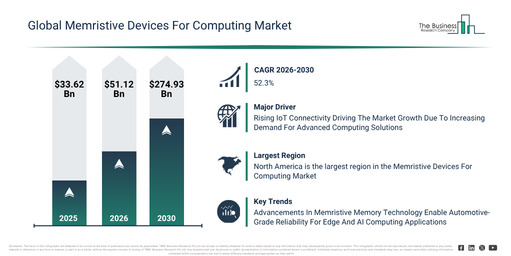
The memristive devices for computing market size has experienced exponential expansion in recent years. This market is set to grow from $33.62 billion in 2025 to $51.12 billion in 2026, demonstrating a compound annual growth rate (CAGR) of 52.0%. The expansion observed in the historic period can be attributed to the increase in AI and machine learning workloads, the escalating limitations of traditional transistor scaling, a rising demand for high-speed data processing, the broader expansion of semiconductor R&D investments, and the growing requirement for low-power computing solutions._x000D_
_x000D_
The memristive devices for computing market size is projected to experience substantial growth in the upcoming years. It is anticipated to reach $274.93 billion in 2030 at a compound annual growth rate (CAGR) of 52.3%. This expansion during the forecast period is largely due to the increasing deployment of edge AI devices, a growing demand for energy-efficient data centers, the rising adoption of autonomous systems computing platforms, the expansion of neuromorphic research initiatives, and the increasing integration of advanced memory technologies in consumer electronics. Prominent trends for this period involve the increasing development of in-memory computing architectures, the rising adoption of neuromorphic computing systems, the growing integration of crossbar array modules in AI hardware, the expansion of high-density non-volatile memory solutions, and a rising focus on energy-efficient semiconductor design._x000D_
_x000D_
#Get A Free Sample Report With In-Depth Market Insights:#_x000D_
_x000D_
#Memristive Devices For Computing Market Industry Drivers: What’s Behind The Revenue Growth?#_x000D_
The increasing Internet of Things (IoT) connectivity is anticipated to drive the expansion of the memristive devices for the computing market in the future. IoT connectivity describes the underlying network infrastructure and communication standards that allow IoT devices to link, interact, and transfer data among themselves and with cloud platforms. This growth in IoT connectivity is primarily fueled by the proliferation of 5G networks and edge computing infrastructure, which deliver the fast, low-delay connections required to support vast numbers of interconnected devices in domains like smart cities, industrial automation, and consumer use cases. The surge in IoT connectivity increases the need for memristive devices because they provide energy-efficient, high-density memory and neuromorphic computing abilities crucial for handling the immense data volumes produced by edge-connected devices. For example, Ericsson, a telecommunications firm based in Sweden, reported in April 2025 that worldwide IoT connections hit 18.8 billion connections in 2024 and are projected to rise to 43.0 billion connections by 2030. Consequently, the expanding IoT connectivity is fostering the development of the memristive devices for the computing market._x000D_
_x000D_
#Memristive Devices For Computing Market Segments: Where Is Growth Concentrated?#_x000D_
The memristive devices for computing market covered in this report is segmented –_x000D_
_x000D_
1) By Component: Hardware, Software, Services_x000D_
2) By Device Type: Resistive Random-Access Memory, Spin-Transfer Torque Magnetic Random-Access Memory, Spin-Orbit Torque Magnetic Random-Access Memory, Phase-Change Memory, Ferroelectric Random-Access Memory, Conductive Bridging Random-Access Memory_x000D_
3) By Material Type: Metal Oxide Based Materials, Two Dimensional Materials, Chalcogenide Materials, Organic Materials_x000D_
4) By Application: Spiking Neural Networks, Non-Volatile Memory Systems, Programmable Logic And Signal Processing Systems, Artificial Neural Networks, Machine Learning, Neuromorphic Computing Systems_x000D_
5) By End-User: Consumer Electronics, Information Technology And Telecommunications, Data Centers And Cloud Computing, Automotive And Autonomous Vehicles, Healthcare And Medical Devices, Aerospace And Defense, Industrial Automation And Robotics, Research And Academia_x000D_
_x000D_
Subsegments:_x000D_
1) By Hardware: Memristor Chips, Crossbar Array Modules, Compute In Memory Processors, Analog Memory Devices, Hybrid Memory Logic Circuits, Neuromorphic Computing Boards_x000D_
2) By Software: Device Modeling And Simulation Software, Programming And Development Platforms, Data Mapping And Optimization Software, Memory Management Software, Artificial Intelligence Training Software, System Control And Integration Software_x000D_
3) By Services: Consulting And Design Services, Fabrication And Prototyping Services, System Integration Services, Testing And Validation Services, Maintenance And Support Services, Research And Development Services_x000D_
_x000D_
#Memristive Devices For Computing Market Growth Trends: What’s Shaping The Future Outlook?_x000D_
Leading firms within the memristive devices for the computing market are increasingly emphasizing the attainment of automotive-grade qualification standards. This focus aims to elevate their products’ reliability, endurance, and performance when subjected to demanding operational settings. This qualification process guarantees that memory technologies fulfill rigorous criteria concerning reliability, temperature tolerance, and stress resistance. Such compliance is crucial for their integration into applications like advanced driver assistance systems (ADAS), edge AI processors, and in-vehicle computing platforms. A notable example is Weebit Nano Ltd., an Israel-based semiconductor memory technology company, which declared in March 2025 the complete qualification of its embedded Resistive Random-Access Memory (ReRAM) module. This achievement aligns with the AEC-Q100 standard, making it suitable for automotive applications. The aforementioned qualification validates that Weebit Nano Ltd.’s silicon oxide-based ReRAM technology adheres to stringent automotive reliability benchmarks. Consequently, it can be incorporated into automotive microcontrollers and system-on-chip (SoC) devices, thereby facilitating AI-driven edge computing, neuromorphic architectures, and advanced vehicle electronics._x000D_
_x000D_
#Memristive Devices For Computing Market Competitive Overview And Top Companies#_x000D_
Major companies operating in the memristive devices for computing market are Samsung Electronics Co. Ltd., Sony Group Corporation, Taiwan Semiconductor Manufacturing Company Limited, International Business Machines Corporation, SK hynix Inc., Panasonic Holdings Corporation, Intel Corporation, Fujitsu Limited, Toshiba Corporation, Infineon Technologies AG, Micron Technology Inc., Renesas Electronics Corporation, GlobalFoundries Inc., United Microelectronics Corporation, Tower Semiconductor Ltd., Everspin Technologies Inc., Avalanche Technology Inc., Aspinity Inc., Crossbar Inc., Weebit Nano Ltd., Knowm Inc., and Nantero Inc._x000D_
_x000D_
#View The Full Memristive Devices For Computing Market Report:#_x000D_
_x000D_
#Memristive Devices For Computing Market Top Region: Where Does Most Revenue Come From?#_x000D_
North America was the largest region in the memristive devices for computing market in 2025. Asia-Pacific is expected to be the fastest-growing region in the forecast period. The regions covered in the memristive devices for computing market report are Asia-Pacific, South East Asia, Western Europe, Eastern Europe, North America, South America, Middle East, Africa._x000D_
_x000D_
#Reach Out To Our Team:#_x000D_
_x000D_
The Business Research Company: https://www.thebusinessresearchcompany.com/_x000D_
Americas: +1 310-496-7795_x000D_
Asia: +44 7882 955267 & +91 8897263534_x000D_
Europe: +44 7882 955267_x000D_
Email us at: marketing@tbrc.info_x000D_
_x000D_
#Follow us on:#_x000D_
_x000D_
LinkedIn: https://in.linkedin.com/company/the-business-research-company_x000D_
YouTube: https://www.youtube.com/channel/UC24_fI0rV8cR5DxlCpgmyFQ_x000D_
Global Market Model: https://www.thebusinessresearchcompany.com/global-market-model

Wasay has over a decade of experience in market research, data modelling, and analytics, with prior experience at GlobalData and Decision Tree Consulting Services. At The Business Research Company , he leads research operations across syndicated studies, customized consulting engagements, and the Global Market Model platform. His professional experience includes supporting organizations such as Boston Consulting Group, KPMG, and Ernst & Young. Wasay holds a degree in Electronics and Communications Engineering, postgraduate management qualifications from International Management Institute Belgium and Indian School of Business and Entrepreneurship, and completed the Integrated Program in Business Analytics from Indian Institute of Management Indore.