Delivering more actionable and strategically valuable research, The Business Research Company’s 2026 market reports feature market attractiveness analysis, total addressable market evaluation, company benchmarking matrices, interactive Excel dashboards, expanded supply chain intelligence, emerging startup coverage, and detailed product insights.
Microelectronic Residual Chlorine Sensor Market Forecast: What Market Value Is Expected By 2030?
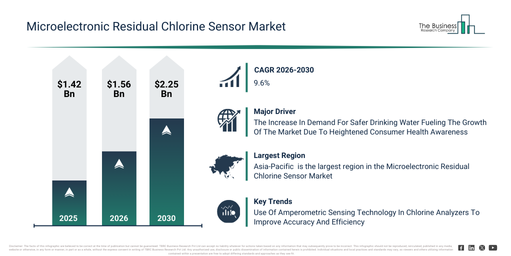
The microelectronic residual chlorine sensor market has observed significant growth in recent years. This market is anticipated to expand from $1.42 billion in 2025 to $1.56 billion by 2026, advancing at a compound annual growth rate (CAGR) of 9.9%. Historically, the expansion of the market can be attributed to factors such as increasing urbanization, a rise in waterborne diseases, the integration of electrochemical sensors, strict regulatory mandates for water quality, and the growth in municipal water treatment operations.
The microelectronic residual chlorine sensor market is anticipated to experience substantial growth in the upcoming years. Its valuation is projected to reach $2.25 billion by 2030, expanding at a compound annual growth rate (CAGR) of 9.6%. This expected expansion during the forecast period is driven by factors such as the increasing demand for smart water monitoring, widespread integration with IoT and cloud platforms, advancements in optical sensing technology, the broader application of industrial water treatment, and heightened focus on water safety in the agriculture and food sectors. Noteworthy trends anticipated for this period include miniaturization combined with high-precision sensing, continuous real-time water quality monitoring, seamless integration with industrial automation systems, sophisticated electrochemical and optical sensing techniques, and advanced remote monitoring alongside data analytics capabilities.
Download A Free Sample Report For Comprehensive Market Insights:
Microelectronic Residual Chlorine Sensor Market Industry Drivers: What Is Driving Revenue Growth?
The future expansion of the microelectronic residual chlorine sensor market is anticipated to be driven by the growing need for safer potable water. This term defines water that is free from detrimental pollutants and adheres to recognized health and safety benchmarks for human intake. The heightened demand for clean drinking water stems from an increased public focus on health and hygiene, spurred by greater understanding of waterborne illnesses and the necessity for dependable, pure water supplies. These sensors improve water safety frameworks through precise, continuous tracking of chlorine concentrations from initial treatment facilities to end distribution networks. As an illustration, the U.S. Environmental Protection Agency (EPA), a US-based government entity, reported in April 2023 that the FY 2023 Drinking Water State Revolving Fund (DWSRF) had disbursed more than US $5.1 billion to states, territories, and tribes by the close of March 2023, under the Bipartisan Infrastructure Law’s water-infrastructure initiative, surpassing allocations from the prior year. Consequently, significant governmental financial commitment to water safety acts as a primary catalyst for the microelectronic residual chlorine sensor market.
Microelectronic Residual Chlorine Sensor Market Segment Breakdown: Which Categories Generate The Most Revenue?
The microelectronic residual chlorine sensor market covered in this report is segmented –
1) By Type: Amperometric Residual Chlorine Sensor, Potentiometric Residual Chlorine Sensor
2) By Technology: Electrochemical Sensors, Optical Sensors, Other Technologies
3) By Application: Smart Home, Food Industry, Medical Industry, Agriculture, Other Applications
4) By End-Use Industry: Municipal Water Treatment, Industrial Sector, Commercial Sector, Residential Sector
Subsegments:
1) By Amperometric Residual Chlorine Sensor, Polarographic Sensors, Membrane-covered Sensors, Differential Sensors
2) By Potentiometric Residual Chlorine Sensor, Ion-selective Electrode (ISE) Sensors, Solid-state Sensors, Glass Electrode Sensors
Microelectronic Residual Chlorine Sensor Market Innovation Trends: Which Developments Are Transforming The Industry?
Leading companies in the microelectronic residual chlorine sensor market are prioritizing technological advancements, such as amperometric sensing, to boost the accuracy and efficiency of chlorine measurement. Amperometric sensing is a technique that determines a chemical substance’s concentration by observing the electric current generated from its oxidation or reduction at an electrode surface when a fixed voltage is applied. For example, in April 2025, ABB Ltd., a Switzerland-based industrial technology company, unveiled the ChloroStar family of analysers, specifically designed for precise and continuous monitoring of residual chlorine in water treatment and various industrial processes. These analysers are equipped with a direct-contact electrode cell that includes continuous sample flow cleaning, making them well-suited for high-fouling environments like wastewater and industrial effluents. Key benefits include better measurement accuracy, reduced maintenance demands, and up to 20% lower consumables costs, which allows for more efficient, reliable, and cost-effective chlorine monitoring in municipal and industrial settings.
Microelectronic Residual Chlorine Sensor Market Key Players And Strategic Industry Positioning
Major companies operating in the microelectronic residual chlorine sensor market are Thermo Fisher Scientific Inc., ABB Ltd., Emerson Electric Co., Endress+Hauser AG, Xylem Inc., ATI Inc., Polestar Technologies Inc., HORIBA Ltd., Hach Company, Swan Analytical Instruments, ProMinent GmbH, Nanjing Wotian Technology Co. Ltd., Myron L Company, Thermochem Corporation Pvt. Ltd., Axis Solutions Private Limited, Hangzhou Supmea International Trading Co. Ltd., ShanghAI Boqu Instrument Co. Ltd., Aquadax South Asia Private Limited (OPC), ShanghAI GL Environmental Technology Co. Ltd., Suzhou Delfino Environmental Technology Co. Ltd.
Access The Complete Microelectronic Residual Chlorine Sensor Market Report:
#Microelectronic Residual Chlorine Sensor Market Largest Region: Which Geography Holds The Highest Market Share?
Asia-Pacific was the largest region in the microelectronic residual chlorine sensor market in 2025. Asia-Pacific is expected to be the fastest-growing region in the forecast period. The regions covered in the microelectronic residual chlorine sensor market report are Asia-Pacific, South East Asia, Western Europe, Eastern Europe, North America, South America, Middle East, Africa.
Get in touch with us:
The Business Research Company: https://www.thebusinessresearchcompany.com/
Americas: +1 310-496-7795
Asia: +44 7882 955267 & +91 8897263534
Europe: +44 7882 955267
Email us at: marketing@tbrc.info
Follow us on:
LinkedIn: https://in.linkedin.com/company/the-business-research-company
YouTube: https://www.youtube.com/channel/UC24_fI0rV8cR5DxlCpgmyFQ
Global Market Model: https://www.thebusinessresearchcompany.com/global-market-model

Wasay has over a decade of experience in market research, data modelling, and analytics, with prior experience at GlobalData and Decision Tree Consulting Services. At The Business Research Company , he leads research operations across syndicated studies, customized consulting engagements, and the Global Market Model platform. His professional experience includes supporting organizations such as Boston Consulting Group, KPMG, and Ernst & Young. Wasay holds a degree in Electronics and Communications Engineering, postgraduate management qualifications from International Management Institute Belgium and Indian School of Business and Entrepreneurship, and completed the Integrated Program in Business Analytics from Indian Institute of Management Indore.