
Through market attractiveness analysis, total addressable market evaluation, company benchmarking matrices, interactive Excel dashboards, expanded supply chain intelligence, emerging startup coverage, and detailed product insights, The Business Research Company’s 2026 market reports provide more actionable and strategically valuable research.
#Nano Smart Blackboard Market Size And Revenue Forecast Through 2030
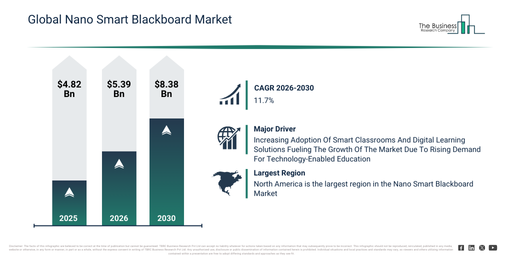
The nano smart blackboard market has observed significant growth over recent years. Its valuation is anticipated to climb from $4.82 billion in 2025 to $5.39 billion in 2026, advancing at a compound annual growth rate (CAGR) of 12.0%. The expansion witnessed in prior periods is attributable to factors like the increasing adoption of digital classrooms, the growing replacement of traditional boards, a rising emphasis on dust-free teaching solutions, the expanding application of interactive learning tools, and increasing demand for durable writing surfaces.
The nano smart blackboard market is projected for substantial expansion over the coming years, with its size expected to reach $8.38 billion by 2030, demonstrating a compound annual growth rate (CAGR) of 11.7%. This anticipated growth is largely attributed to factors such as increasing investment in smart education infrastructure, a rising demand for eco friendly classroom solutions, the growing adoption of AI-enabled teaching tools, expanding deployment in corporate training rooms, and a stronger preference for long lasting nano coated boards. Key trends identified for this forecast period include advancements in nano coating technologies, innovations in smart sensor interaction, the development of cloud connected board systems, increasing research and development in interactive learning tools, and the integration of AI-powered content recognition systems.
Download A Free Sample Report For Comprehensive Market Insights:
Nano Smart Blackboard Market Growth Factors Supporting Long-Term Expansion
The expanding integration of smart classrooms and digital learning tools is projected to fuel the nano smart blackboard market’s expansion. These educational settings are characterized by the use of sophisticated technologies like interactive boards, digital content, and interconnected learning platforms designed to enrich teaching and learning. The uptake of smart classrooms and digital learning solutions is increasing as educational institutions aim for more individualized, data-informed instruction, which enhances student engagement, facilitates remote or hybrid learning, and allows for real-time progress monitoring. The nano smart blackboard aids this transition by providing interactive, robust, and energy-efficient digital blackboards that enable easy multimedia integration, real-time teamwork, and remote educational functionalities. For example, data from November 2025, supplied by the Department for Education, a UK government department, indicated that the use of interactive whiteboards in primary schools rose from 96% in 2023 to 98% in 2025, and in secondary schools, usage climbed from 76% in 2023 to 80% in 2025 for at least one lesson. Consequently, the growing adoption of smart classrooms and digital learning solutions is a significant impetus for the nano smart blackboard market’s development. The heightened emphasis on enhancing student engagement and learning achievements is anticipated to propel the expansion of the nano smart blackboard market. These initiatives involve strategies to boost classroom participation, comprehension, and academic success using interactive and technology-enabled teaching instruments. The growing priority on improving student engagement and learning outcomes stems from the wider adoption of interactive digital learning tools that facilitate personalized teaching, immediate feedback, and active participation during lessons. The nano smart blackboard contributes to improved student engagement and learning outcomes by delivering sophisticated digital blackboards that incorporate multimedia content, interactive functionalities, and live feedback for pupils. As an illustration, in November 2025, information from the Department for Education, a UK-based government agency, indicated that the number of learners with a learning difficulty or disability (LLDD) increased by 0.5% to 261,260 in 2024-25, an rise from 260,040 in 2023-24, accounting for 22.9% of the cohort, up from 21.8% in 2023-2024. Consequently, the intensifying focus on improving student engagement and learning outcomes is stimulating the growth of the nano smart blackboard market.
Nano Smart Blackboard Market Segment Performance And Strategic Opportunities
The nano smart blackboard market covered in this report is segmented –
1) By Product Type: Standalone Nano-Coated Smart Boards, Interactive Flat Panel Displays With Nano Coatings, Connected Smart Whiteboard Systems, Accessories And Consumables
2) By Screen Size: Below 75 Inches, 75–85 Inches, 86 Inches And Above
3) By Technology: Nano-Coated Writing Surface Technology, Smart Sensor–Enabled Boards, Hybrid Digital-Interactive Boards, Anti-Glare And Anti-Reflection Display Technologies, Pressure-Sensitive And Gesture-Recognition Boards
4) By Distribution Channel: Direct Sales (B2B), Integrators And Value-Added Resellers (VARs), Online Retail And E-Commerce
5) By Application: Preschool Education, Primary And Secondary School Education, College Or University, Training Institutions, Corporate Offices Or Meeting Rooms, Other Applications
Subsegments:
1) By Standalone Nano-Coated Smart Boards: Advanced Nano Surface Boards, Basic Digital Capture Boards, Magnetic Nano Surface Boards, Dry Erase Nano Surface Boards
2) By Interactive Flat Panel Displays With Nano Coating: Full Touch Interactive Displays, Multi Touch Panel Displays, Ultra High Definition Nano Displays, Classroom Interactive Display Panels
3) By Connected Smart Whiteboard Systems: Processor Integrated Smart Boards, Camera Enabled Smart Boards, Audio Equipped Smart Boards, Collaboration Ready Smart Boards
4) By Accessories And Consumables: Digital Writing Pens, Smart Erasers, Board Mounting Systems, Display Cleaning Kits
Nano Smart Blackboard Market Key Players: Which Companies Shape Industry Competition?
Major companies operating in the nano smart blackboard market are LG Electronics Inc., Dongguan Ikinor Technology Co. Ltd., Guangzhou Senke Electronics Co. Ltd., Dongguan Riotouch Technology, Hushidaglobal, Shenzhen HDFocus Technology Co. Ltd., Nanjing Odin Technology Co. Ltd., Shenzhen Fangcheng Tech Co. Ltd., MaxHub, Shandong Lanbeisite Group, Guangzhou Yichuang Electronic Co. Ltd., Shenzhen iBoard Technology Co. Ltd., Dongguan Sunvol Information Technology Co. Ltd., Fvasee (Shenzhen) Technology Co. Ltd., Yatal Technology Co. Ltd., INGSCREEN Technology Ltd., Shenzhen Qunmao Display Technology Co. Ltd., JMSX Display Technology Co. Ltd., Edutech
Access The Complete Nano Smart Blackboard Market Report:
Nano Smart Blackboard Market Regional Outlook: Where Are The Largest Opportunities Located?
North America was the largest region in the nano smart blackboard market in 2025. Asia-Pacific is expected to be the fastest-growing region in the forecast period. The regions covered in the nano smart blackboard market report are Asia-Pacific, South East Asia, Western Europe, Eastern Europe, North America, South America, Middle East, Africa.
Get in touch with us:
The Business Research Company: https://www.thebusinessresearchcompany.com/
Americas: +1 310-496-7795
Asia: +44 7882 955267 & +91 8897263534
Europe: +44 7882 955267
Email us at: marketing@tbrc.info
Follow us on:
LinkedIn: https://in.linkedin.com/company/the-business-research-company
YouTube: https://www.youtube.com/channel/UC24_fI0rV8cR5DxlCpgmyFQ
Global Market Model: https://www.thebusinessresearchcompany.com/global-market-model

Wasay has over a decade of experience in market research, data modelling, and analytics, with prior experience at GlobalData and Decision Tree Consulting Services. At The Business Research Company , he leads research operations across syndicated studies, customized consulting engagements, and the Global Market Model platform. His professional experience includes supporting organizations such as Boston Consulting Group, KPMG, and Ernst & Young. Wasay holds a degree in Electronics and Communications Engineering, postgraduate management qualifications from International Management Institute Belgium and Indian School of Business and Entrepreneurship, and completed the Integrated Program in Business Analytics from Indian Institute of Management Indore.