
Built to provide research that’s more actionable and strategically valuable, The Business Research Company’s 2026 market reports include market attractiveness analysis, total addressable market sizing, company benchmarking matrices, interactive Excel dashboards, broader supply chain intelligence, emerging startup tracking, and in-depth product insights.
Optoelectronic Switches Market Growth From $4.38 Billion In 2026 To $6.27 Billion By 2030 At A CAGR Of 9.4%
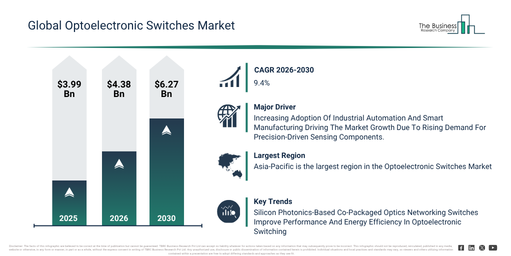
The optoelectronic switches market has witnessed significant growth over recent years. Its valuation is anticipated to rise from $3.99 billion in 2025 to $4.38 billion in 2026, reflecting a compound annual growth rate (CAGR) of 9.8%. The expansion observed historically can be ascribed to factors including the escalating demand for high-speed communication systems, the increasing acceptance of optical signal transmission technologies, the burgeoning requirement for low-power switching solutions, the rising implementation of advanced electronic devices, and the expanding need for dependable signal routing components.
The optoelectronic switches market size is anticipated to experience robust expansion in the coming years. It is projected to reach $6.27 billion by 2030, exhibiting a compound annual growth rate (CAGR) of 9.4%. This expansion during the forecast period is driven by several factors, including the escalating demand for next-generation optical communication networks, the increasing uptake of integrated photonics solutions, a growing requirement for enhanced data transmission capabilities, the wider implementation of advanced switching architectures, and a heightened emphasis on energy-efficient electronic systems. Key developments expected in this period encompass the rising adoption of high-speed optical switching solutions, an expanding need for low-power signal switching devices, the greater integration of photonic switching technologies, the increasing deployment of electromagnetic interference-resistant switching systems, and a growing demand for compact optical signal management devices.
Get A Free Sample Report With In-Depth Market Insights:
Optoelectronic Switches Market Industry Drivers: What’s Behind The Revenue Growth?
The rising integration of industrial automation and smart manufacturing is anticipated to drive the future expansion of the optoelectronic switches market. These advancements utilize intelligent automation, interconnected systems, and digital technologies to boost manufacturing efficiency, productivity, and overall operational performance. The quick transition towards industrial automation and smart manufacturing is significantly fueled by the broad adoption of Industry 4.0 technologies, encouraging manufacturers globally to update their production facilities. The expanding use of industrial automation and smart manufacturing increases the need for optoelectronic switches, given their vital role as sensing and signal-switching components in automated equipment, robotic setups, and precise production lines. An example illustrating this trend is provided by the International Federation of Robotics (IFR), a Germany-based non-profit representing the global robotics industry, which reported in November 2024 that the robot density in the United States grew from 285 units per 10,000 employees in 2022 to 295 units per 10,000 employees in 2023. This indicates a steady increase in industrial automation integration across both manufacturing and logistics sectors. Consequently, the growing acceptance of industrial automation and smart manufacturing is a key factor propelling the expansion of the optoelectronic switches market.
Optoelectronic Switches Market Segment Breakdown: Which Categories Lead On Revenue?
The optoelectronic switches market covered in this report is segmented –
1) By Product Type: Solid State, Liquid Crystal, Electro Optical, Other Product Types
2) By Technology: Mechanical Optical Switching Technology, Non Mechanical Optical Switching Technology, Silicon Photonics Technology, Integrated Photonics Technology, All Optical Switching Technology
3) By Application: Telecommunications, Consumer Electronics, Automotive, Aerospace And Defense, Healthcare, Other Applications
4) By End User: Industrial, Commercial, Residential, Other End Users
Subsegments:
1) By Solid State: Semiconductor Optical Switches, Micro Mechanical Optical Switches, Thermo Optical Switches, Acousto Optical Switches
2) By Liquid Crystal: Twisted Nematic Liquid Crystal Switches, Ferroelectric Liquid Crystal Switches, Polymer Dispersed Liquid Crystal Switches
3) By Electro Optical: Pockels Effect Switches, Kerr Effect Switches, Lithium Niobate Optical Switches, Barium Titanate Optical Switches
4) By Other Product Types: Hybrid Optical Electronic Switches, Photonics Integrated Switches, Plasmonic Optical Switches, Quantum Optical Switches, Nonlinear Optical Switches
#Optoelectronic Switches Market Growth Trends: What’s Shaping The Future Outlook?
Leading companies within the optoelectronic switches market are prioritizing the development of sophisticated silicon photonics-based co-packaged optics (CPO) networking switches to boost bandwidth, enhance energy efficiency, and support large-scale artificial intelligence (AI) infrastructure. These silicon photonics-based CPO networking switches integrate optical components directly with switching chips, enabling ultra-high-speed, energy-efficient data transmission with reduced signal loss for AI data centers and high-performance networks. For example, in March 2025, NVIDIA Corporation, a US-based technology company, announced its Spectrum-X Photonics co-packaged optics networking switches, specifically designed to scale AI factories to millions of graphics processing units (GPUs). This solution delivers up to 1.6 terabits per second per port, providing 3.5 times greater energy efficiency and improved network resilience. It combines silicon photonics with advanced optical technologies to facilitate high-speed, scalable connectivity for next-generation AI data centers.
Optoelectronic Switches Market Competitive Overview And Top Companies
Major companies operating in the optoelectronic switches market are NVIDIA Corporation, Huawei Technologies Co. Ltd., Cisco Systems Inc., Broadcom Inc., Mitsubishi Electric Corporation, Sumitomo Electric Industries Ltd., Fujitsu Limited, Nokia Corporation, NEC Corporation, ZTE Corporation, Onsemi, Marvell Technology Inc., Arista Networks Inc., Omron Corporation, Coherent Corp., FiberHome Telecommunication Technologies Co. Ltd., Ciena Corporation, Vishay Intertechnology Inc., Hamamatsu Photonics K.K., Lumentum Holdings Inc., Accelink Technologies Co. Ltd., Santec Holdings Corporation
View The Full Optoelectronic Switches Market Report:
Optoelectronic Switches Market Top Region: Where Does Most Revenue Come From?
Asia-Pacific was the largest region in the optoelectronic switches market in 2025. Asia-Pacific is expected to be the fastest-growing region in the forecast period. The regions covered in the optoelectronic switches market report are Asia-Pacific, South East Asia, Western Europe, Eastern Europe, North America, South America, Middle East, Africa.
Reach Out To Our Team:
The Business Research Company: https://www.thebusinessresearchcompany.com/
Americas: +1 310-496-7795
Asia: +44 7882 955267 & +91 8897263534
Europe: +44 7882 955267
Email us at: marketing@tbrc.info
Follow us on:
LinkedIn: https://in.linkedin.com/company/the-business-research-company
YouTube: https://www.youtube.com/channel/UC24_fI0rV8cR5DxlCpgmyFQ
Global Market Model: https://www.thebusinessresearchcompany.com/global-market-model

Wasay has over a decade of experience in market research, data modelling, and analytics, with prior experience at GlobalData and Decision Tree Consulting Services. At The Business Research Company , he leads research operations across syndicated studies, customized consulting engagements, and the Global Market Model platform. His professional experience includes supporting organizations such as Boston Consulting Group, KPMG, and Ernst & Young. Wasay holds a degree in Electronics and Communications Engineering, postgraduate management qualifications from International Management Institute Belgium and Indian School of Business and Entrepreneurship, and completed the Integrated Program in Business Analytics from Indian Institute of Management Indore.