
Featuring market attractiveness scoring, total addressable market sizing, company benchmarking matrices, interactive Excel dashboards, deeper supply chain intelligence, emerging startup tracking, and granular product-level insights, The Business Research Company’s 2026 market reports are built to deliver research that is both more actionable and more strategically valuable.
Particulate Soot Sensor Market Revenue Growth On Track For A 9% CAGR Through 2030
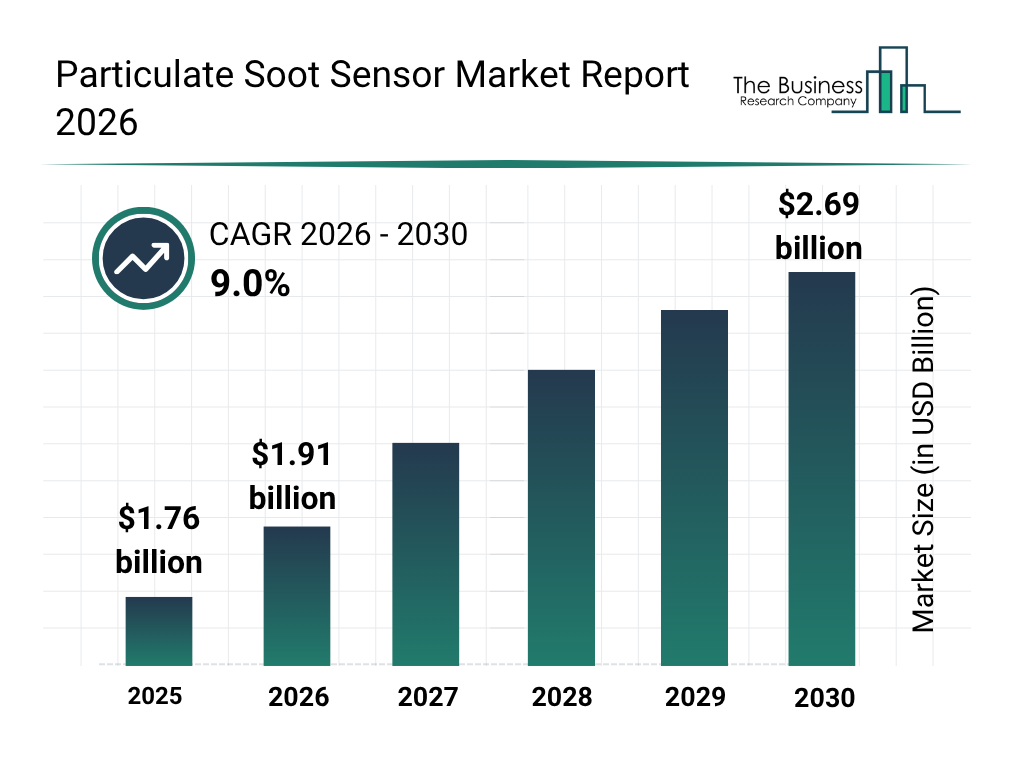
The particulate soot sensor market size has experienced significant expansion in recent years. Projections indicate it will increase from $1.76 billion in 2025 to $1.91 billion in 2026, achieving a compound annual growth rate (CAGR) of 8.7%. Historically, this growth was driven by factors such as stricter environmental regulations concerning diesel emissions, a rise in diesel vehicle manufacturing, the implementation of particulate matter monitoring systems, the enlargement of commercial vehicle fleets, and an enhanced understanding of air pollution’s effects.
The particulate soot sensor market is anticipated to show significant expansion over the next few years. It is expected to grow to $2.69 billion by 2030, demonstrating a compound annual growth rate (CAGR) of 9.0%. This growth during the forecast period is primarily driven by stricter global emission regulations, the increased use of electric and hybrid vehicles featuring diesel engines, continuous advancements in sensor technologies, rising aftermarket adoption of solutions for emission monitoring, and an increased focus on IoT-enabled vehicle diagnostics. Significant trends for this period include an escalating demand for sophisticated diesel engine emission monitoring, a growing uptake of resistive and conductive soot sensors, the integration of these sensors with engine control units, an expansion of soot sensor applications in commercial and off-highway vehicles, and a strong emphasis on meeting stricter environmental compliance requirements.
Get A Free Sample Report With In-Depth Market Insights:
Particulate Soot Sensor Market Growth Drivers: What’s Behind The Acceleration?
The increasing demand for diesel vehicles is anticipated to boost the expansion of the particulate soot sensors market moving forward. Diesel vehicles are internal combustion engine vehicles that run on diesel fuel, providing greater torque efficiency and a longer driving range compared to numerous alternative powertrains. The rising demand for these vehicles is attributed to growing commercial transportation needs, as companies require more fuel-efficient, high-torque vehicles for long-haul and logistics operations. Particulate soot sensors assist diesel vehicles by continuously monitoring and detecting soot levels in the exhaust system, guaranteeing optimal engine performance and adherence to emission standards. They contribute to reducing environmental impact and improving fuel efficiency by enabling the precise regeneration of diesel particulate filters, thus enhancing vehicle reliability and longevity. For instance, in January 2024, according to the Bureau of Infrastructure and Transport Research Economics, an Australia-based government body, diesel-powered motor vehicles represented 29.0 per cent of the total fleet, an increase from 28.3 per cent in 2023. Therefore, the escalating demand for diesel vehicles is expected to fuel the growth of the particulate soot sensors market.
Particulate Soot Sensor Market Segment Outlook: Which Categories Are Growing Fastest?
The particulate soot sensor market covered in this report is segmented –
1) By Product Type: Resistive Soot Sensors, Conductive Soot Sensors, Capacitive Soot Sensors, Other Product Types
2) By Fuel Type: Diesel Engines, Gasoline Direct Injection (GDI) Engines
3) By Technology: Regeneration Type, Non-Regeneration Type
4) By Sales Channel: Original Equipment Manufacturer (OEM), Aftermarket
5) By Application: Passenger Vehicles, Commercial Vehicles, Off-Highway Vehicles, Other Applications
Subsegments:
1) By Resistive Soot Sensors: Planar Resistive Soot Sensors, Interdigital Electrode Resistive Soot Sensors, Ceramic Based Resistive Soot Sensors, Metal Oxide Resistive Soot Sensors
2) By Conductive Soot Sensors: Electrode Bridge Conductive Soot Sensors, Carbon Deposition Conductive Soot Sensors, Multi Electrode Conductive Soot Sensors, High Temperature Conductive Soot Sensors
3) By Capacitive Soot Sensors: Interdigitated Capacitive Soot Sensors, Ceramic Capacitive Soot Sensors, Insulated Electrode Capacitive Soot Sensors, Thin Film Capacitive Soot Sensors
4) By Other Product Types: Optical Particulate Matter Sensors, Photoacoustic Soot Sensors, Radio Frequency Based Soot Sensors, Laser Scattering Particulate Sensors
Particulate Soot Sensor Market Trends: What’s Defining The Industry’s Next Phase?
Leading companies within the particulate soot sensor market are concentrating on integrating innovative offerings, such as high-precision real-time particulate monitoring sensors, to improve emission detection accuracy and meet increasingly rigorous environmental regulations. These advanced high-precision real-time particulate monitoring sensors continuously measure fine particulate matter and soot with high precision, contributing to regulatory compliance, optimized performance, and the reduction of harmful emissions through immediate detection and response. For example, in November 2025, the Massachusetts Department of Environmental Protection, a state environmental regulatory agency in the U.S., initiated two new air monitoring stations to bolster statewide air quality surveillance. These stations incorporate high-precision real-time particulate monitoring sensors, capable of continuously identifying PM2.5 and other soot-related pollutants emitted from transportation corridors and industrial facilities. The systems include automated sampling mechanisms, advanced optical and gravimetric measurement technologies, and digital communication platforms that support real-time data transmission to centralized environmental monitoring networks. Furnished with high-precision real-time particulate monitoring sensors, the recently deployed stations offer improved measurement accuracy, enhanced spatial pollution tracking, and quicker responsiveness to emission spikes when contrasted with conventional periodic sampling and laboratory-based analysis methods.
Particulate Soot Sensor Market Leading Companies And Competitive Benchmarking
Major companies operating in the particulate soot sensor market are Robert Bosch GmbH, Denso Corporation, Continental AG, Weichai Power Co. Ltd., Tenneco Inc., Infineon Technologies AG, STMicroelectronics N.V., TE Connectivity Ltd., Emerson Electric Co., Vitesco Technologies Group AG, Sensata Technologies Holding PLC, NGK Insulators Ltd., PHINIA Inc., HORIBA Ltd, SICK AG, TT Electronics plc, CTS Corporation, Hitachi Astemo Ltd., Amphenol Advanced Sensors.
View The Full Particulate Soot Sensor Market Report:
Particulate Soot Sensor Market Top Region By Revenue And Market Share
Europe was the largest region in the particulate soot sensor market in 2025. Asia-Pacific is expected to be the fastest-growing region in the forecast period. The regions covered in the particulate soot sensor market report are Asia-Pacific, South East Asia, Western Europe, Eastern Europe, North America, South America, Middle East, Africa.
Reach Out To Our Team:
The Business Research Company: https://www.thebusinessresearchcompany.com/
Americas: +1 310-496-7795
Asia: +44 7882 955267 & +91 8897263534
Europe: +44 7882 955267
Email us at: marketing@tbrc.info
Follow us on:
LinkedIn: https://in.linkedin.com/company/the-business-research-company
YouTube: https://www.youtube.com/channel/UC24_fI0rV8cR5DxlCpgmyFQ
Global Market Model: https://www.thebusinessresearchcompany.com/global-market-model

Wasay has over a decade of experience in market research, data modelling, and analytics, with prior experience at GlobalData and Decision Tree Consulting Services. At The Business Research Company , he leads research operations across syndicated studies, customized consulting engagements, and the Global Market Model platform. His professional experience includes supporting organizations such as Boston Consulting Group, KPMG, and Ernst & Young. Wasay holds a degree in Electronics and Communications Engineering, postgraduate management qualifications from International Management Institute Belgium and Indian School of Business and Entrepreneurship, and completed the Integrated Program in Business Analytics from Indian Institute of Management Indore.