
Backed by market attractiveness analysis, total addressable market sizing, company benchmarking matrices, interactive Excel dashboards, wider supply chain intelligence, emerging startup coverage, and detailed product-level insights, The Business Research Company’s 2026 market reports are designed to offer research that is more actionable and strategically valuable than ever.
Passive Ambient Monitoring Sensors Market Size, Value And Growth Trajectory Through 2030
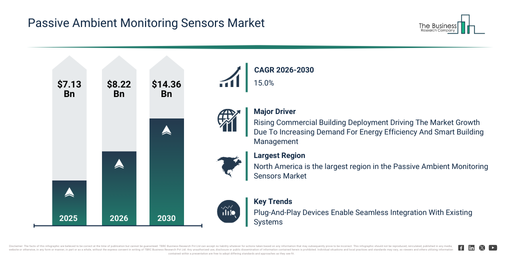
The passive ambient monitoring sensors market has seen rapid expansion in recent years. Its value is predicted to increase from $7.13 billion in 2025 to $8.22 billion in 2026, achieving a compound annual growth rate (CAGR) of 15.3%. This historical development can be linked to factors such as the rising adoption of smart homes, an escalation in industrial automation, increased demands for environmental monitoring, the broadening of healthcare monitoring, and technological progress in sensor materials.
The market for passive ambient monitoring sensors is projected to experience substantial expansion over the coming years. By 2030, its valuation is predicted to reach $14.36 billion, achieving a compound annual growth rate (CAGR) of 15.0%. This projected growth is driven by several factors such as the proliferation of IoT-based monitoring networks, the increasing need for smart cities and connected infrastructure, a heightened focus on developing energy-efficient sensors, more stringent environmental safety regulations, and the uptake of AI-driven data analytics. Significant developments expected during the forecast period involve the widespread use of wireless passive sensing technologies, the integration of monitoring for multiple environmental parameters, the innovation of low-power and battery-free sensors, the deployment of remote and real-time monitoring solutions, and advancements in sensor accuracy and miniaturization.
Get A Free Sample Report With In-Depth Market Insights:
Passive Ambient Monitoring Sensors Market Growth Backed By Core Demand Fundamentals
The projected increase in the adoption of passive ambient monitoring sensors within commercial buildings is anticipated to fuel the market’s expansion. Commercial buildings are structures specifically designed for business operations or service provision, distinct from residential use. The number of these commercial structures is on the rise, primarily due to urbanization, as growing city populations necessitate a greater demand for offices, retail spaces, and service facilities to support economic activities. Passive ambient monitoring sensors offer substantial benefits to commercial buildings by supplying real-time environmental insights, thereby facilitating effective energy management and enhancing indoor air quality. They also minimize the need for manual oversight and foster more intelligent building management, ultimately boosting occupant comfort and operational efficiency. For example, according to the US Census Bureau in July 2025, educational construction reached a seasonally adjusted annual rate of $111.8 billion in May, reflecting a 0.2% increase from the $111.6 billion recorded in April. Consequently, the increasing implementation of these sensors in commercial buildings is a key factor driving the growth of the passive ambient monitoring sensors market.
Passive Ambient Monitoring Sensors Market Segmentation: How Does The Market Break Down By Category?
The passive ambient monitoring sensors market covered in this report is segmented –
1) By Sensor Type: Temperature Sensors, Humidity Sensors, Light Sensors, Air Quality Sensors, Other Sensor Types
2) By Connectivity: Wired, Wireless
3) By Application: Smart Homes, Industrial Automation, Healthcare, Environmental Monitoring, Automotive, Other Applications
4) By End-User: Residential, Commercial, Industrial, Other End-Users
Subsegments:
1) By Temperature Sensors: Thermistors, Resistance Temperature Detectors (RTD), Thermocouples
2) By Humidity Sensors: Capacitive Humidity Sensors, Resistive Humidity Sensors, Thermal Conductivity Humidity Sensors
3) By Light Sensors: Photoresistors (LDR), Photodiodes, Phototransistors
4) By Air Quality Sensors: Gas Sensor, Particulate Matter Sensors, Ozone Sensors
5) By Other Sensor Types: Pressure Sensors, Proximity Sensors, Sound or Noise Level Sensors
Passive Ambient Monitoring Sensors Market Growth Trends Reshaping The Competitive Landscape
Major companies in the passive ambient monitoring sensors market are focusing on developing technologically advanced products, including drop-in compatible sensors, to enable seamless integration into existing building management systems, thereby enhancing real-time environmental monitoring and energy efficiency. A drop-in compatible sensor operates as a plug-and-play device capable of replacing or integrating with current systems without requiring major modifications. For example, in October 2024, DD-Scientific Ltd., a UK-based manufacturing company, introduced a new range of PPB Air Quality Sensors designed to provide highly precise detection of trace pollutants for improved environmental monitoring. These sensors offer high accuracy and sensitivity for identifying trace air pollutants even at extremely low concentrations. These drop-in compatible sensors deliver cost-effective, reliable, and interchangeable solutions for urban, industrial, and indoor air quality monitoring, helping manufacturers reduce instrument costs. This supports enhanced environmental monitoring by enabling precise, affordable, and scalable detection that aids regulatory compliance and promotes healthier indoor and outdoor environments.
Passive Ambient Monitoring Sensors Market Competitive Overview And Top Companies
Major companies operating in the passive ambient monitoring sensors market are Siemens AG., Thermo Fisher Scientific Inc., Schneider Electric SE, Honeywell International Inc., ABB Ltd., Texas Instruments Incorporated, STMicroelectronics N.V., Vaisala Oyj, Sensirion AG, Bosch Sensortec GmbH, Alphasense Limited, Kanomax USA Inc., ENVEA Group, Oizom Instruments Private Limited, LSI Lastem S.r.l., GrayWolf Sensing Solutions, PurpleAir LLC, Aeroqual Limited, Kunak Technologies S.L., Plantower Co. Ltd.
View The Full Passive Ambient Monitoring Sensors Market Report:
Passive Ambient Monitoring Sensors Market Regional Analysis And Top Geography
North America was the largest region in the passive ambient monitoring sensors market in 2025. Asia-Pacific is expected to be the fastest-growing region in the forecast period. The regions covered in the passive ambient monitoring sensors market report are Asia-Pacific, South East Asia, Western Europe, Eastern Europe, North America, South America, Middle East, Africa.
Reach Out To Our Team:
The Business Research Company: https://www.thebusinessresearchcompany.com/
Americas: +1 310-496-7795
Asia: +44 7882 955267 & +91 8897263534
Europe: +44 7882 955267
Email us at: marketing@tbrc.info
Follow us on:
LinkedIn: https://in.linkedin.com/company/the-business-research-company
YouTube: https://www.youtube.com/channel/UC24_fI0rV8cR5DxlCpgmyFQ
Global Market Model: https://www.thebusinessresearchcompany.com/global-market-model

Wasay has over a decade of experience in market research, data modelling, and analytics, with prior experience at GlobalData and Decision Tree Consulting Services. At The Business Research Company , he leads research operations across syndicated studies, customized consulting engagements, and the Global Market Model platform. His professional experience includes supporting organizations such as Boston Consulting Group, KPMG, and Ernst & Young. Wasay holds a degree in Electronics and Communications Engineering, postgraduate management qualifications from International Management Institute Belgium and Indian School of Business and Entrepreneurship, and completed the Integrated Program in Business Analytics from Indian Institute of Management Indore.