Built to provide research that’s more actionable and strategically valuable, The Business Research Company’s 2026 market reports include market attractiveness analysis, total addressable market sizing, company benchmarking matrices, interactive Excel dashboards, broader supply chain intelligence, emerging startup tracking, and in-depth product insights.
Personal Extended Reality Hardware Market Set To Climb From $19.86 Billion In 2026 To $37.56 Billion By 2030
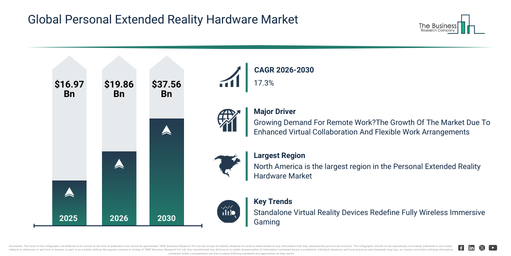
The personal extended reality hardware market size has seen rapid growth in recent years. It is forecast to grow from $16.97 billion in 2025 to $19.86 billion in 2026, exhibiting a compound annual growth rate (CAGR) of 17.0%. The expansion observed in the historical period can be attributed to the proliferation of gaming and immersive entertainment, advancements in display and sensor technologies, the widening consumer electronics market, an increase in digital content consumption, and the early adoption of VR headsets by technology enthusiasts.
The personal extended reality hardware market is poised for significant expansion in the upcoming years. It is forecast to achieve a valuation of $37.56 billion by 2030, demonstrating a compound annual growth rate (CAGR) of 17.3%. This expansion during the projection period stems from factors such as the increasing deployment of XR in educational and training contexts, the proliferation of spatial computing applications, an uptick in demand for mixed reality experiences, continuous progress in compact processing hardware, and the broadening of consumer metaverse platforms. Notable trends foreseen for this period encompass a growing preference for lightweight and ergonomic head-mounted displays, the enhanced integration of motion tracking sensors and spatial computing features, the increasing appeal of standalone XR devices that do not rely on external hardware, the expansion of haptic feedback accessories for more immersive interactions, and a heightened emphasis on high-resolution displays combined with low-latency performance.
Get A Free Sample Report With In-Depth Market Insights:
Personal Extended Reality Hardware Market Growth Factors: What’s Supporting Expansion?
The escalating need for remote work arrangements is anticipated to drive expansion in the personal extended reality hardware market moving ahead. Remote work describes a setup where employees carry out their professional responsibilities away from a conventional office setting, usually from home or any internet-connected place. This increasing demand for remote work largely stems from employees’ desire for improved work-life balance, affording them greater flexibility in handling personal and career obligations. Personal extended reality hardware improves remote working by establishing immersive, interactive virtual environments that facilitate real-time collaboration, spatial visualization, and practical training, independent of physical presence. For example, data from the UK’s Office for National Statistics indicated that in February 2023, approximately 38% of adults in Great Britain worked from home in 2022, with this figure rising to around 40% in 2023. Consequently, the rising need for remote work is a key factor propelling the expansion of the personal extended reality hardware market.
Personal Extended Reality Hardware Market Segment Analysis And Revenue Potential
The personal extended reality hardware market covered in this report is segmented –
1) By Device Type: Virtual Reality Headsets, Augmented Reality Glasses, Mixed Reality Devices, Haptic Feedback Devices
2) By Connectivity: Wired, Wireless, Standalone
3) By Technology: Display Technology, Sensor Technology, Processing Technology, Audio Technology
4) By Distribution Channel: Online Retail, Offline Electronics Stores, Direct-To-Consumer
5) By End Use: Gaming, Training And Education, Healthcare, Entertainment
Subsegments:
1) By Virtual Reality Headsets: Standalone Virtual Reality Headsets, Tethered Virtual Reality Headsets, Mobile Virtual Reality Headsets, Enterprise Virtual Reality Headsets
2) By Augmented Reality Glasses: Monocular Augmented Reality Glasses, Binocular Augmented Reality Glasses, Smart Augmented Reality Glasses, Industrial Augmented Reality Glasses
3) By Mixed Reality Devices: Head-Mounted Mixed Reality Displays, Spatial Computing Devices, Enterprise Mixed Reality Devices, Consumer Mixed Reality Devices
4) By Haptic Feedback Devices: Haptic Gloves, Haptic Vests And Suits, Haptic Controllers, Haptic Footwear And Accessories
Personal Extended Reality Hardware Market Industry Trends: What’s Reshaping Demand?
Leading companies operating in the personal extended reality hardware market are prioritizing the development of innovative solutions, such as standalone virtual reality headsets, to deliver deeply immersive experiences without depending on external PCs or consoles. Standalone virtual reality headsets are self-contained devices capable of running VR experiences independently, without requiring a PC, a console, or external sensors. For instance, in November 2025, Valve Corporation, a US-based video game company, launched Steam Frame. This standalone VR headset is designed to provide users with portable access to and the ability to play their entire Steam library, without the need for a tethered PC. The device operates on SteamOS and supports both native gameplay and low-latency wireless streaming, enabling users to play VR and non-VR titles on a large virtual screen within the headset. Equipped with inside-out tracking, high-resolution displays, and advanced connectivity, Steam Frame delivers a fully wireless, immersive gaming experience. This product launch highlights Valve’s broader strategy to expand the Steam ecosystem beyond PCs by integrating portable computing with next-generation virtual reality.
Personal Extended Reality Hardware Market Key Players Shaping Industry Direction
Major companies operating in the personal extended reality hardware market are Apple Inc., Microsoft Corporation, Samsung Electronics Co. Ltd., Meta Platforms Inc., Sony Group Corporation, Acer Inc., Valve Corporation, Magic Leap Inc., XREAL Inc., Pimax Innovation Inc., Varjo Technologies Oy, LLVision Technology Co. Ltd., Shanghai Deepoon Virtual Reality Technology Co. Ltd., RealWear Inc., NoloVR Co. Ltd., Rayneo Co. Ltd., VRgineers sro, Vuzix Corporation, AjnaLens Inc., Somnium Space Inc.
View The Full Personal Extended Reality Hardware Market Report:
Personal Extended Reality Hardware Market Regional Analysis: Which Geography Leads On Revenue?
North America was the largest region in the personalized genomics market in 2025. Asia-Pacificis expected to be the fastest-growing region in the forecast period. The regions covered in the personal extended reality hardware market report are Asia-Pacific, South East Asia, Western Europe, Eastern Europe, North America, South America, Middle East, Africa.
Reach Out To Our Team:
The Business Research Company: https://www.thebusinessresearchcompany.com/
Americas: +1 310-496-7795
Asia: +44 7882 955267 & +91 8897263534
Europe: +44 7882 955267
Email us at: marketing@tbrc.info
Follow us on:
LinkedIn: https://in.linkedin.com/company/the-business-research-company
YouTube: https://www.youtube.com/channel/UC24_fI0rV8cR5DxlCpgmyFQ
Global Market Model: https://www.thebusinessresearchcompany.com/global-market-model

Wasay has over a decade of experience in market research, data modelling, and analytics, with prior experience at GlobalData and Decision Tree Consulting Services. At The Business Research Company , he leads research operations across syndicated studies, customized consulting engagements, and the Global Market Model platform. His professional experience includes supporting organizations such as Boston Consulting Group, KPMG, and Ernst & Young. Wasay holds a degree in Electronics and Communications Engineering, postgraduate management qualifications from International Management Institute Belgium and Indian School of Business and Entrepreneurship, and completed the Integrated Program in Business Analytics from Indian Institute of Management Indore.