Built to provide research that’s more actionable and strategically valuable, The Business Research Company’s 2026 market reports include market attractiveness analysis, total addressable market sizing, company benchmarking matrices, interactive Excel dashboards, broader supply chain intelligence, emerging startup tracking, and in-depth product insights.
Photonic Integrated Circuits Market Poised To Hit $34.6 Billion By 2030 With A 19.3% CAGR
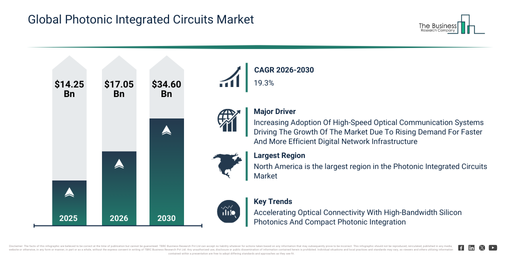
The photonic integrated circuits market size has demonstrated rapid growth in recent years. This market is projected to expand from $14.25 billion in 2025 to $17.05 billion in 2026, achieving a compound annual growth rate (CAGR) of 19.7%. The historical growth observed in this period can be attributed to several factors, including the increasing demand for high-speed data transmission, the rising adoption of optical communication systems, the ongoing expansion of telecommunication infrastructure, the growing use of energy-efficient devices, and the continuous integration of photonics into consumer electronics.
The photonic integrated circuits market is anticipated to experience substantial expansion over the upcoming years. It is projected to reach $34.60 billion in 2030, exhibiting a compound annual growth rate (CAGR) of 19.3%. This projected increase during the forecast period stems from factors such as the increasing adoption of silicon photonics, a rising requirement for compact optical components, amplified investments in data centers, the broadening of cloud computing infrastructure, and heightened demand for 5G and next-generation networks. Key developments expected in this period encompass technological advancements in photonic integration, new approaches in optical chip design, the creation of low-power photonic circuits, ongoing research and development in advanced materials, and significant progress in miniaturized optical components.
Get A Free Sample Report With In-Depth Market Insights:
Photonic Integrated Circuits Market Growth Backed By Core Demand Fundamentals
The rising embrace of high-speed optical communication systems is anticipated to fuel the expansion of the photonic integrated circuits market in the coming years. These systems utilize light for the swift transmission of large data volumes via optical fiber or networks, forming a crucial part of contemporary digital infrastructure. The heightened demand for such systems stems from growing global internet usage and increasing fixed broadband expectations, compelling network operators and service providers to transition from older technologies to fiber-based, high-speed connectivity. Photonic integrated circuits facilitate high-speed optical communication systems by enabling the creation of more compact, energy-efficient, and higher-capacity photonic components, which enhances signal transmission performance and lowers costs for network deployments. For example, the Federal Communications Commission, a US-based government agency, reported in May 2025 that as of June 30, 2024, the United States had 133 million fixed broadband connections, marking a 2.3% increase from June 2023. Of these, 24.5% were optical carrier connections, and 26.0% of fixed connections offered speeds of at least 940 megabits per second, indicating widespread full-fiber gigabit-class services. Consequently, the growing integration of high-speed optical communication systems is a key driver for the growth of the photonic integrated circuits market.
Photonic Integrated Circuits Market Segment Landscape And Growth Outlook
The photonic integrated circuits market covered in this report is segmented –
1) By Component: Lasers, Modulators, Detectors, Multiplexers, Optical Amplifiers, Other Components
2) By Material: Indium Phosphide, Silicon, Lithium Niobate, Gallium Arsenide, Other Materials
3) By Application: Optical Communication, Sensing, Biophotonics, Optical Signal Processing, Other Applications
4) By End-Users: Telecommunications, Healthcare, Data Centres, Defense And Security, Other End Users
Subsegments:
1) By Lasers: Distributed Feedback Laser, Vertical Cavity Surface Emitting Laser, Fabry Perot Laser, Quantum Cascade Laser
2) By Modulators: Electro Optic Modulator, Mach Zehnder Modulator, Microring Modulator, Phase Modulator
3) By Detectors: Photodiode, Avalanche Photodiode, PIN Photodetector, Quantum Dot Photodetector
4) By Multiplexers: Wavelength Division Multiplexer, Arrayed Waveguide Grating, Planar Lightwave Circuit Multiplexer, Optical Add Drop Multiplexer
5) By Optical Amplifiers: Semiconductor Optical Amplifier, Erbium Doped Waveguide Amplifier, Raman Amplifier, Optical Parametric Amplifier
6) By Other Components: Optical Switch, Optical Coupler, Waveguide, Optical Filter
Photonic Integrated Circuits Market Growth Trends Reshaping The Competitive Landscape
Leading companies in the photonic integrated circuits (PICs) market are concentrating on developing advanced optical components, such as high-bandwidth silicon photonics chips, to address the rapidly increasing demands for bandwidth, density, and power efficiency across data centers, AI infrastructure, and hyperscale networking. High-bandwidth silicon photonics chips are photonic integrated circuits that employ silicon-based optical components to facilitate very high data rates (e.g., 800 Gb/s), thereby enabling low-power, compact, and scalable optical interconnects for next-generation communication systems. For instance, in October 2023, DustPhotonics Ltd., an Israel-based developer of silicon photonics solutions, unveiled its Carmel-8 800G silicon photonics chip, marking it as the industry’s first merchant 800 Gb/s silicon photonics PIC suitable for DR8 and DR8+ optical transmit applications up to 2 km. This high-bandwidth silicon photonics chip integrates eight optical channels at 100 Gb/s each in a compact package conforming to industry-standard form factors, supports on-board lasers through low-loss laser coupling, and offers flexible deployment across various transceiver applications.
Photonic Integrated Circuits Market Competitive Analysis Of Leading Industry Participants
Major companies operating in the photonic integrated circuits market are STMicroelectronics N.V., GlobalFoundries Inc., Coherent Inc., MACOM Technology Solutions Holdings Inc., PsiQuantum Corporation, Ayar Labs Inc., Smart Photonics B.V., DustPhotonics Ltd., Lightmatter Inc., Sivers Semiconductors AB, LioniX International B.V., PHIX Photonics Assembly B.V., LIGENTEC SA, QuiX Quantum B.V., Lightelligence Inc., Pilot Photonics Inc., HyperLight Corporation, Scintil Photonics B.V., VLC Photonics S.L., Applied Nanotools Inc.
View The Full Photonic Integrated Circuits Market Report:
Photonic Integrated Circuits Market Geographic Spread And Regional Opportunities
North America was the largest region in the photonic integrated circuits market in 2025. Asia-Pacific is expected to be the fastest-growing region in the forecast period. The regions covered in the photonic integrated circuits market report are Asia-Pacific, South East Asia, Western Europe, Eastern Europe, North America, South America, Middle East, Africa.
Reach Out To Our Team:
The Business Research Company: https://www.thebusinessresearchcompany.com/
Americas: +1 310-496-7795
Asia: +44 7882 955267 & +91 8897263534
Europe: +44 7882 955267
Email us at: marketing@tbrc.info
Follow us on:
LinkedIn: https://in.linkedin.com/company/the-business-research-company
YouTube: https://www.youtube.com/channel/UC24_fI0rV8cR5DxlCpgmyFQ
Global Market Model: https://www.thebusinessresearchcompany.com/global-market-model

Wasay has over a decade of experience in market research, data modelling, and analytics, with prior experience at GlobalData and Decision Tree Consulting Services. At The Business Research Company , he leads research operations across syndicated studies, customized consulting engagements, and the Global Market Model platform. His professional experience includes supporting organizations such as Boston Consulting Group, KPMG, and Ernst & Young. Wasay holds a degree in Electronics and Communications Engineering, postgraduate management qualifications from International Management Institute Belgium and Indian School of Business and Entrepreneurship, and completed the Integrated Program in Business Analytics from Indian Institute of Management Indore.