
Backed by market attractiveness analysis, total addressable market sizing, company benchmarking matrices, interactive Excel dashboards, wider supply chain intelligence, emerging startup coverage, and detailed product-level insights, The Business Research Company’s 2026 market reports are designed to offer research that is more actionable and strategically valuable than ever.
Plastics In Electronics Market Growth Potential: How Will Market Size Shift Through 2030?
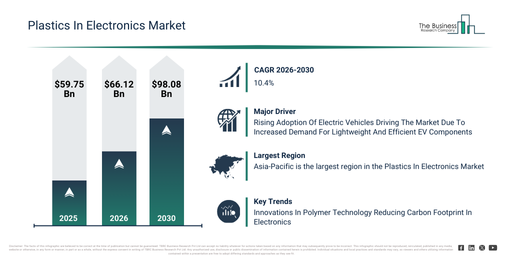
The plastics in electronics market size has experienced rapid expansion in recent years. It is projected to grow from $59.75 billion in 2025 to $66.12 billion in 2026, at a compound annual growth rate (CAGR) of 10.6%. This historical growth can be attributed to various factors such as increasing consumer electronics demand, the adoption of plastic casings in automotive electronics, the necessity for electrical insulation in devices, the expansion of industrial electronics, and the cost benefits of plastics over metals.
The plastics in electronics market size is projected to undergo significant expansion in the coming years, reaching $98.08 billion by 2030, with a compound annual growth rate (CAGR) of 10.4%. This anticipated growth during the forecast period is primarily driven by an increasing demand for sustainable materials, the rise in electric vehicles and transportation electrification, advancements in high-performance polymers, the miniaturization of electronic devices, and the integration of plastics in flexible and wearable electronics. Prominent trends expected in this period include advanced polymer insulation, high-performance plastic casings, flexible circuit materials, thermal management plastics, and eco-friendly electronics plastics.
Get A Free Sample Report With In-Depth Market Insights:
Plastics In Electronics Market Growth Backed By Core Demand Fundamentals
The growing uptake of electric vehicles (EVs) is anticipated to boost the expansion of the plastics in electronics market moving ahead. Electric vehicles (EVs) are defined as automobiles that run entirely or partly on electric motors, drawing power from stored batteries, rather than depending exclusively on internal combustion engines. The growing embrace of electric vehicles (EVs) is largely attributed to heightened environmental worries and governmental initiatives supporting low-emission transport. In electric vehicles (EVs), plastics find application in lightweight structural elements, battery enclosures, insulation, connectors, and interior components, all contributing to enhanced efficiency, safety, and overall vehicle performance. For example, in 2023, the International Energy Agency (IEA), an intergovernmental body based in France, reported that approximately 14 million new electric vehicles (EVs) were registered worldwide, increasing the total EV fleet on roads to 40 million units. This marked a year-on-year rise of 3.5 million vehicles, signifying a 35% growth, with electric cars accounting for roughly 18% of global car sales, an increase from 14% in 2022. Consequently, the expanding adoption of electric vehicles (EVs) is a key factor propelling the growth of the plastics in electronics market.
Plastics In Electronics Market Segment Analysis Spotlighting Growth Areas
The plastics in electronics market covered in this report is segmented –
1) By Product Type: Thermoplastics, Thermosets, Engineering Plastics, Conductive Plastics, Other Product Types
2) By Application: Consumer Electronics, Automotive Electronics, Industrial Electronics, Medical Devices, Other Applications
3) By End-Use Industry: Consumer Goods, Automotive, Healthcare, Industrial, Other End-Use Industries
Subsegments:
1) By Thermoplastics: Polycarbonate (PC), Polyethylene (PE), Polypropylene (PP), Polystyrene (PS), Acrylonitrile Butadiene Styrene (ABS), Polyamide (PA), Polyethylene Terephthalate (PET)
2) By Thermosets: Epoxy Resin, Phenolic Resin, Melamine Formaldehyde (MF), Urea Formaldehyde (UF), Polyurethane (PU)
3) By Engineering Plastics: Polyoxymethylene (POM), Polyetheretherketone (PEEK), Polyphenylene Sulfide (PPS), Polyamide-Imide (PAI), Polybutylene Terephthalate (PBT)
4) By Conductive Plastics: Carbon-Filled Plastics, Metal-Filled Plastics, Polymer Composites, Graphene-Based Plastics
5) By Other Product Types: Liquid Crystal Polymers (LCP), Silicones, Thermoplastic Elastomers (TPE), Acrylics
Plastics In Electronics Market Growth Trends Reshaping The Competitive Landscape
Leading companies in the plastics in electronics market are increasingly concentrating on breakthroughs in polymer technology, including the creation of bio-based and high-performance plastics. This focus aims to bolster sustainability and lessen reliance on fossil fuels. Bio-based plastics, originating entirely or partially from renewable sources like plants or cellulose, present an environmentally sound alternative without compromising structural integrity, thermal stability, or electrical insulation. For instance, in March 2024, Skullcandy Inc., a US-based lifestyle audio brand, unveiled its EcoBuds True Wireless Earbuds, which integrate 65% certified recycled plastics and achieve a 50% lower carbon footprint compared to conventional designs. This exemplifies how electronics manufacturers are implementing advanced polymers to balance performance, durability, and sustainability. Such advancements in polymer engineering are projected to drive the expanded adoption of plastics in electronics, particularly in consumer devices, automotive electronics, and other demanding applications.
Plastics In Electronics Market Leading Companies: Who Holds The Strongest Market Presence?
Major companies operating in the plastics in electronics market are Sinopec Group, BASF SE, Dow Inc., LG Chem, LyondellBasell Industries N.V., SABIC, Mitsubishi Chemical Corporation, Asahi Kasei Corporation, Sumitomo Chemical Co., Ltd., Toray Industries, Inc., Covestro AG, DuPont de Nemours, Inc., Celanese Corporation, Eastman Chemical Company, Teijin Limited, Formosa Plastics Corporation, PolyOne Corporation (now Avient Corporation), INEOS Group, Evonik Industries AG, Chi Mei Corporation
View The Full Plastics In Electronics Market Report:
Plastics In Electronics Market Geographic Spread And Regional Opportunities
Asia-Pacific was the largest region in the plastics in electronics market in 2025. The regions covered in the plastics in electronics market report are Asia-Pacific, South East Asia, Western Europe, Eastern Europe, North America, South America, Middle East, Africa.
Reach Out To Our Team:
The Business Research Company: https://www.thebusinessresearchcompany.com/
Americas: +1 310-496-7795
Asia: +44 7882 955267 & +91 8897263534
Europe: +44 7882 955267
Email us at: marketing@tbrc.info
Follow us on:
LinkedIn: https://in.linkedin.com/company/the-business-research-company
YouTube: https://www.youtube.com/channel/UC24_fI0rV8cR5DxlCpgmyFQ
Global Market Model: https://www.thebusinessresearchcompany.com/global-market-model

Wasay has over a decade of experience in market research, data modelling, and analytics, with prior experience at GlobalData and Decision Tree Consulting Services. At The Business Research Company , he leads research operations across syndicated studies, customized consulting engagements, and the Global Market Model platform. His professional experience includes supporting organizations such as Boston Consulting Group, KPMG, and Ernst & Young. Wasay holds a degree in Electronics and Communications Engineering, postgraduate management qualifications from International Management Institute Belgium and Indian School of Business and Entrepreneurship, and completed the Integrated Program in Business Analytics from Indian Institute of Management Indore.