
Backed by market attractiveness analysis, total addressable market sizing, company benchmarking matrices, interactive Excel dashboards, wider supply chain intelligence, emerging startup coverage, and detailed product-level insights, The Business Research Company’s 2026 market reports are designed to offer research that is more actionable and strategically valuable than ever.
Positive Temperature Coefficient (PTC) Resettable Device Market Expansion Outlook: What Revenue Opportunities Are Ahead?
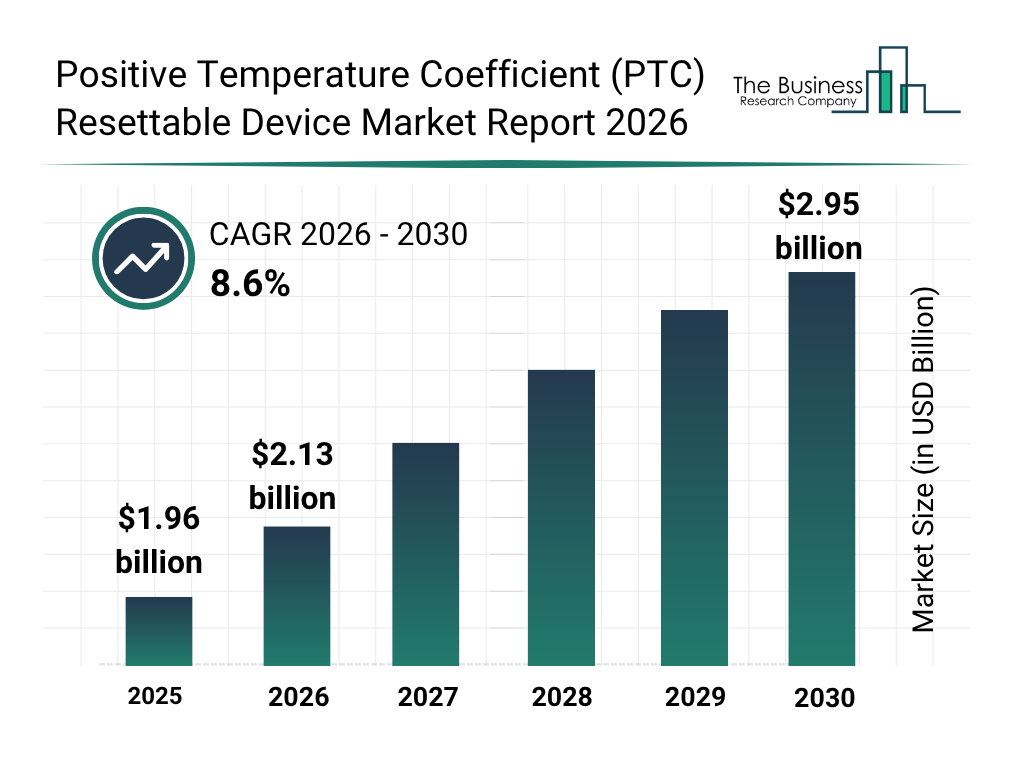
The positive temperature coefficient (PTC) resettable device market has demonstrated robust expansion recently. This market is expected to increase from $1.96 billion in 2025 to $2.13 billion in 2026, achieving a compound annual growth rate (CAGR) of 8.3%. Historically, this growth can be attributed to several factors including the rising use of overcurrent protection in electronics, the uptake of polymer and ceramic PTC devices, expanding electronics manufacturing, increased demand for automotive electronics, and the growing implementation of industrial control systems.
The positive temperature coefficient (PTC) resettable device market is anticipated to experience robust expansion over the next few years. It is projected to achieve a size of $2.95 billion by 2030, demonstrating a compound annual growth rate (CAGR) of 8.6%. The anticipated growth during this period stems from increased deployment in electric vehicles, deeper integration with renewable energy systems, a surge in industrial automation applications, wider adoption for high-density circuit protection, and expanded use in telecommunications equipment protection. Noteworthy trends during the forecast will include the rising embrace of surface mount PTC devices, heightened demand for automotive circuit protection, the growing incorporation of resettable overcurrent protection within consumer electronics, the broadening of high-current and specialized industrial applications, and an increasing emphasis on compact and board-level protection solutions.
Get A Free Sample Report With In-Depth Market Insights:
Positive Temperature Coefficient (PTC) Resettable Device Market Growth Drivers: What’s Behind The Acceleration?
The increasing adoption of consumer electronics is anticipated to fuel the expansion of the positive temperature coefficient (PTC) resettable device market in the coming years. Consumer electronics encompass electronic gadgets intended for everyday personal use, covering areas such as communication, entertainment, and home applications. Their growing integration is driven by elements like increasing disposable incomes, continuous technological progress, and a rising desire for smart and interconnected devices. PTC resettable devices are widely integrated into consumer electronics to offer automatic overcurrent protection that resets automatically after a fault condition, thereby enhancing device safety, reliability, and lifespan without needing fuse replacement. For example, in May 2023, according to the Japan Electronics and Information Technology Industries Association, a Japan-based trade association, consumer electronics output increased from $183 million in May 2022 to $233 million in May 2023. Therefore, the expanding use of consumer electronics is a key factor driving the growth of the positive temperature coefficient (PTC) resettable device market. The rising prevalence of electric vehicles (EVs) is set to propel the growth of the positive temperature coefficient (PTC) resettable device market going forward. Electric vehicles operate using one or more electric motors, drawing energy from rechargeable batteries, as opposed to conventional internal combustion engines. Their growing acceptance is attributed to factors such as rising environmental concerns, supportive government policies, advancements in battery technology, and the development of charging infrastructure. PTC resettable devices are extensively used in electric vehicles to provide self-resetting overcurrent protection, thereby improving battery safety, preventing electrical damage, and boosting the reliability of high-voltage and charging systems. For instance, in January 2025, according to Cox Automotive, a US-based system software company, electric vehicle (EV) sales grew from 2022 levels to 1,212,758 units in 2023, marking a 49% rise, and further increased by 7.3% in 2024 to reach 1,301,411 units. Consequently, the increasing penetration of electric vehicles is a significant driver for the positive temperature coefficient (PTC) resettable device market.
Positive Temperature Coefficient (PTC) Resettable Device Market Segment Landscape: Which Areas Lead Development?
The positive temperature coefficient (PTC) resettable device market covered in this report is segmented –
1) By Type: Polymer, Ceramic, Radial Leaded, Surface Mount, Axial Leaded, Strap Or Custom
2) By Current Rating: Below 5A, 5A-10A, 10A-20A, Above 20A
3) By Sales Channel: Original Equipment Manufacturer, Distributors, Online Retail
4) By Application: Automotive, Electronics, Telecommunications, Industrial, Other Applications
5) By End-Use Industry: Consumer Electronics, Automotive, Telecommunications, Industrial, Healthcare
Subsegments:
1) By Polymer: Overcurrent Protection, Short Circuit Protection, Resettable Circuit Protection, Battery Protection, Consumer Electronics Protection
2) By Ceramic: High Temperature Protection, Motor Protection, Transformer Protection, Industrial Equipment Protection, Power Supply Protection
3) By Radial Leaded: Through Hole Mounting, Board Level Protection, Automotive Electronics Protection, Telecommunications Equipment Protection, Industrial Control Systems Protection
4) By Surface Mount: Compact Circuit Protection, Portable Device Protection, Printed Circuit Board Protection, High Density Circuit Protection, Automotive Electronics Protection
5) By Axial Leaded: Through Hole Circuit Protection, Power Supply Protection, Lighting System Protection, Industrial Equipment Protection, Consumer Appliance Protection
6) By Strap Or Custom: Custom Form Factor Protection, High Current Protection, Specialized Industrial Applications, Automotive Power Systems Protection, Renewable Energy Systems Protection
Positive Temperature Coefficient (PTC) Resettable Device Market Trends: What’s Defining The Industry’s Next Phase?
Leading companies within the positive temperature coefficient (PTC) resettable device market are concentrating on developing innovative products, such as surface-mount devices, to facilitate compact, automated integration onto PCBs for overcurrent protection in high-density and automotive electronic systems. Surface-mount devices (SMDs) are electronic parts made for direct placement on the surface of a printed circuit board (PCB) without requiring through-holes, which allows for more compact, quicker, and automated circuit construction. As an example, in October 2023, Tokyo Denki Kagaku Kogyo, an electronics company from Japan, introduced the J404, recognized as the world’s first surface-mountable inrush current limiter (ICL) utilizing positive temperature coefficient (PTC) thermistor technology. This device incorporates advanced ceramic PTC thermistor materials within a compact surface-mount package, tailored for high-density printed circuit boards, thereby allowing for the efficient suppression of inrush currents that arise upon initial power-up of electronic systems. It offers quick thermal response characteristics, rapidly raising its resistance during abrupt current surges to safeguard vulnerable parts like power supplies, chargers, and automotive control units from potential harm. Designed for applications with limited space, this solution delivers improved reliability and consistent protection when contrasted with traditional resistor- and fuse-based circuits, consequently boosting overall system safety and efficiency.
Positive Temperature Coefficient (PTC) Resettable Device Market Competitive Analysis Of Leading Industry Participants
Major companies operating in the positive temperature coefficient (PTC) resettable device market are Bourns, Inc., Littelfuse, Inc., TE Connectivity Ltd., Eaton Corporation plc, Amphenol Corporation, Bel Fuse Inc., Murata Manufacturing Co., Ltd., AVX Corporation, Vishay Intertechnology, Inc., Polytronics Technology Corporation, EPCOS AG (a TDK Group Company), Raychem (a TE Connectivity Company), Schurter Holding AG, AEM Components, Inc., Wayon Electronics Co., Ltd., Fuzetec Technology Co., Ltd., Laird Performance Materials, Panasonic Corporation, Tyco Electronics Ltd., Ohmite Manufacturing Company, Schneider Electric SE (FR), Mitsubishi Electric Corporation (JP), Fujitsu Limited (JP).
View The Full Positive Temperature Coefficient (PTC) Resettable Device Market Report:
Positive Temperature Coefficient (PTC) Resettable Device Market Geographic Distribution And Regional Opportunities
North America was the largest region in the positive temperature coefficient (PTC) resettable device market in 2025. Asia-Pacific is expected to be the fastest-growing region in the forecast period. The regions covered in the positive temperature coefficient (PTC) resettable device market report are Asia-Pacific, South East Asia, Western Europe, Eastern Europe, North America, South America, Middle East, Africa.
Reach Out To Our Team:
The Business Research Company: https://www.thebusinessresearchcompany.com/
Americas: +1 310-496-7795
Asia: +44 7882 955267 & +91 8897263534
Europe: +44 7882 955267
Email us at: marketing@tbrc.info
Follow us on:
LinkedIn: https://in.linkedin.com/company/the-business-research-company
YouTube: https://www.youtube.com/channel/UC24_fI0rV8cR5DxlCpgmyFQ
Global Market Model: https://www.thebusinessresearchcompany.com/global-market-model

Wasay has over a decade of experience in market research, data modelling, and analytics, with prior experience at GlobalData and Decision Tree Consulting Services. At The Business Research Company , he leads research operations across syndicated studies, customized consulting engagements, and the Global Market Model platform. His professional experience includes supporting organizations such as Boston Consulting Group, KPMG, and Ernst & Young. Wasay holds a degree in Electronics and Communications Engineering, postgraduate management qualifications from International Management Institute Belgium and Indian School of Business and Entrepreneurship, and completed the Integrated Program in Business Analytics from Indian Institute of Management Indore.