
Featuring market attractiveness scoring, total addressable market sizing, company benchmarking matrices, interactive Excel dashboards, deeper supply chain intelligence, emerging startup tracking, and granular product-level insights, The Business Research Company’s 2026 market reports are built to deliver research that is both more actionable and more strategically valuable.
Printed And Chipless Radio Frequency Identification (RFID) Market Expansion Outlook: What Revenue Opportunities Are Ahead?
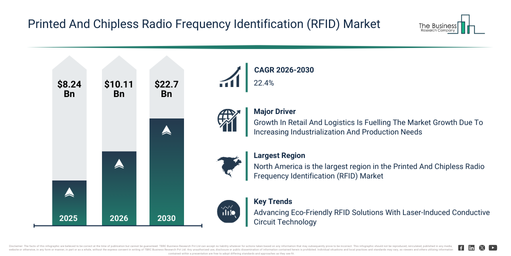
The market for printed and chipless radio frequency identification (RFID) has witnessed significant expansion over recent years. It is anticipated to grow from $8.24 billion in 2025 to $10.11 billion in 2026, achieving a compound annual growth rate (CAGR) of 22.7%. The historical growth of this market is attributable to various factors, including the escalating demand for retail automation, increasing requirements for logistics tracking, cost reductions in supply chain operations, the growing adoption of smart packaging solutions, and advancements in conductive ink technology.
The printed and chipless radio frequency identification (rfid) market size is anticipated to undergo significant expansion in the coming years. It is projected to achieve a value of $22.7 billion by 2030, advancing at a compound annual growth rate (CAGR) of 22.4%. This projected growth is driven by factors such as the expansion of healthcare asset tracking, the proliferation of contactless retail solutions, integration with iot-enabled systems, advancements in organic and carbon-based inks, and increasing adoption in aviation and transport sectors. Prominent trends expected during the forecast period include printed and chipless rfid adoption, the development of flexible and eco-friendly tags, high-volume low-cost tag manufacturing, integration with packaging and logistics, and advanced material-based RFID tags.
Get A Free Sample Report With In-Depth Market Insights:
Printed And Chipless Radio Frequency Identification (RFID) Market Growth Catalysts And Demand Drivers
Moving forward, an increase in retail and logistics activities is anticipated to fuel the expansion of the printed and chipless RFID market. Retail and logistics encompass the procedures for selling products to buyers and effectively overseeing their movement, warehousing, and distribution throughout the supply chain. The rising appeal of printed and chipless RFID stems from its minimal manufacturing expenses, which facilitates cost-effective and extensive deployment for high-volume and expendable goods. In retail and logistics, printed and chipless RFID offers economical, live product tracking, thereby enhancing inventory control and mitigating financial losses. Its adaptable tags help streamline operational processes and boost transparency within the supply chain. As an illustration, the House of Commons Library, a UK-based research and information service, reported in April 2025 that Great Britain’s retail sales hit $578.62 (£517 billion) in 2024, representing a 1.4% increase over 2023. Consequently, the expansion observed in retail and logistics is stimulating the growth of the printed and chipless RFID market.
Printed And Chipless Radio Frequency Identification (RFID) Market Segment Analysis And Revenue Potential
The printed and chipless radio frequency identification (rfid) market covered in this report is segmented –
1) By Type: Ink Stripes, Radar Array, Thin Film Transistor Circuit (TFTC), Surface Acoustic Wave (SAW), Other Types
2) By Technology: Time-Domain, Frequency-Domain, Magnetic-Based, Acoustic-Based, Other Technologies
3) By Application: Retail, Transport And Logistics, Aviation, Healthcare, Other Applications
Subsegments:
1) By Ink Stripes: Conductive Ink-Based Stripes, Magnetic Ink Stripes, Carbon-Based Ink Stripes
2) By Radar Array: Passive Radar Arrays, Active Radar Arrays, Ultra-Wideband (UWB) Radar Arrays
3) By Thin Film Transistor Circuit (TFTC): Organic Thin Film Transistor Circuit (TFTC), Amorphous Silicon Thin Film Transistor Circuit (TFTC), Oxide-Based Thin Film Transistor Circuit (TFTC)
4) By Surface Acoustic Wave (SAW): Reflective Delay Line Surface Acoustic Wave (SAW) Tags, Resonator-Based Surface Acoustic Wave (SAW) Tags, Passive Surface Acoustic Wave (SAW) Radio Frequency Identification (RFID) Sensors,
5) By Other Types: Photonic-Based Radio Frequency Identification (RFID), Capacitive Radio Frequency Identification (RFID) Tags, Inductive Loop Radio Frequency Identification (RFID) Tags
Printed And Chipless Radio Frequency Identification (RFID) Market Trends Shaping Long-Term Demand
Major companies active in the printed and chipless RFID market are prioritizing the development of advanced technologies, such as laser-induced carbon-based conductive circuit technology, to enhance tag performance, durability, and scalability while simultaneously reducing production costs for widespread adoption. Laser-induced carbon-based conductive circuit technology utilizes lasers to transform materials into precise, flexible carbon circuits. This method eliminates the necessity for metal inks, facilitating affordable and environmentally friendly manufacturing of electronic components like printed RFID tags. For instance, in June 2024, Pulpatronics Limited, a UK-based developer of sustainable and eco-friendly RFID tags, introduced chipless, metal-free, paper RFID tags. Their technology applies laser-induced conductive circuits on paper, removing the need for metal and silicon, which substantially decreases both production costs and environmental impact. This initiative aims to further expand sustainable RFID solutions using plant-based materials, advancing their mission to provide recyclable, eco-friendly alternatives for inventory tracking.
Printed And Chipless Radio Frequency Identification (RFID) Market Key Players Shaping Industry Direction
Major companies operating in the printed and chipless radio frequency identification (rfid) market are 3M Company, Molex LLC, Stora Enso Oyj, TOPPAN Holdings Inc., DAI Nippon Printing Co. Ltd., Avery Dennison Corporation, Zebra Technologies Corporation, Checkpoint Systems Inc., HID Global Corporation, Mühlbauer Holding AG & Co. KG, VTT Technical Research Centre of Finland Ltd., PragmatIC Semiconductor Ltd., Alien Technology Corporation, Tageos S.A., Thinfilm Electronics ASA, SATO Holdings Corporation, Vubiq Networks Inc., PolyIC GmbH & Co. KG, Smartrac Technology GmbH, Acreo Swedish ICT AB, KSW Microtec AG
View The Full Printed And Chipless Radio Frequency Identification (RFID) Market Report:
Printed And Chipless Radio Frequency Identification (RFID) Market Largest Region: Which Geography Holds The Biggest Share?
North America was the largest region in the printed and chipless RFID market in 2025. The regions covered in the printed and chipless radio frequency identification (rfid) market report are Asia-Pacific, South East Asia, Western Europe, Eastern Europe, North America, South America, Middle East, Africa.
Reach Out To Our Team:
The Business Research Company: https://www.thebusinessresearchcompany.com/
Americas: +1 310-496-7795
Asia: +44 7882 955267 & +91 8897263534
Europe: +44 7882 955267
Email us at: marketing@tbrc.info
Follow us on:
LinkedIn: https://in.linkedin.com/company/the-business-research-company
YouTube: https://www.youtube.com/channel/UC24_fI0rV8cR5DxlCpgmyFQ
Global Market Model: https://www.thebusinessresearchcompany.com/global-market-model

Wasay has over a decade of experience in market research, data modelling, and analytics, with prior experience at GlobalData and Decision Tree Consulting Services. At The Business Research Company , he leads research operations across syndicated studies, customized consulting engagements, and the Global Market Model platform. His professional experience includes supporting organizations such as Boston Consulting Group, KPMG, and Ernst & Young. Wasay holds a degree in Electronics and Communications Engineering, postgraduate management qualifications from International Management Institute Belgium and Indian School of Business and Entrepreneurship, and completed the Integrated Program in Business Analytics from Indian Institute of Management Indore.